Sandstone Paver Sizes and Thickness: Which Size for Which Job
Standard sandstone paver, tile and flagging sizes and thicknesses in one table, with weights per square metre and which thickness to use for paths, pools and driveways.
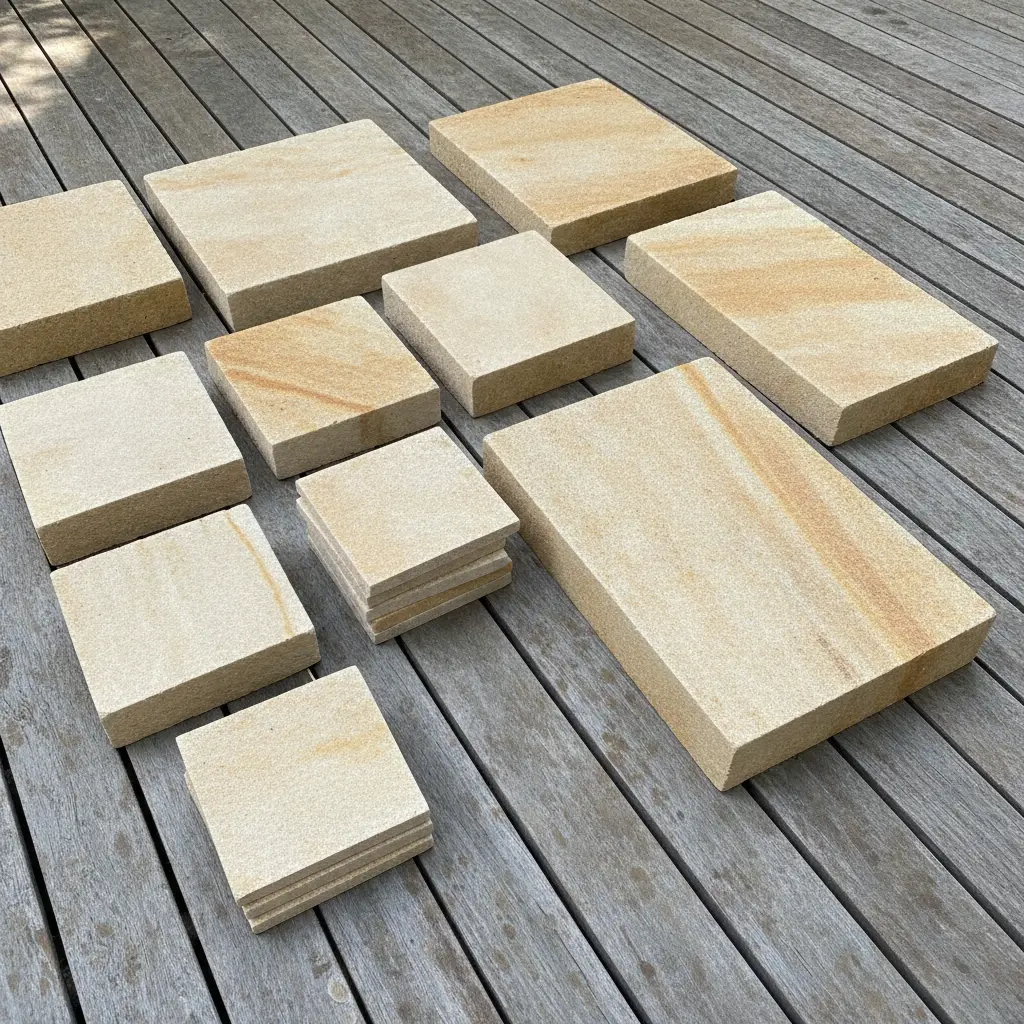
Sandstone pavers are usually 50mm thick for paths, patios and pool surrounds, and 75–100mm for driveways. Popular sawn sizes are 400x400mm, 600x400mm and 600x600mm, and outdoor tiles also come in 300x300mm and 600x300mm at 30mm thick. Any sawn size can be cut to order. Weight follows thickness: about 115kg per m² at 50mm and 230kg per m² at 100mm.
- Foot traffic: 50mm pavers or flagging.
- Driveways: 75mm minimum for cars, 100mm for heavier vehicles or steep drives.
- Over a slab: 30mm outdoor tiles; 20mm honed tiles indoors.
- Popular sizes: 400x400, 600x400 and 600x600mm; custom sizes cut to order.
- Weight: 2,300kg per m³, so thickness in metres x 2,300 gives kg per m².
What sizes do sandstone pavers come in?
| Product | Thickness | Sizes | Typical use | Guide price |
|---|---|---|---|---|
| Sawn all round pavers | 50mm | Cut to size; 400x400, 600x400, 600x600mm popular | Formal patios, entries, pool areas, interiors | From $120/m² |
| Sawn modular paving | 50, 75 or 100mm | Modular mixed sizes | Large patios, commercial areas, driveways | From $65/m² (50mm) |
| Outdoor tiles | 30mm | 300x300, 400x400, 600x300, 600x400, 600x600mm, custom | Patios, pool surrounds, balconies over a slab | From $110/m² |
| Indoor tiles | 20mm honed | 300x300 to 600x600mm | Living areas, kitchens, bathrooms | By quote |
| Hydrasplit paving | 50mm | Split to any width; 150mm strips common | Linear paving, edging, capping | From $95/m² |
| Sawn flagging | 50, 75 or 100mm | Irregular pieces | Crazy paving, paths, courtyards | From $85/m² (50mm) |
| Handsplit flagging | Thin 30–50, regular 50–75, track 75–100mm | Irregular, 10m² pallets | Heritage paving, cladding, driveways | By quote |
Guide prices are for stone only, ex-quarry at Glenorie. Thicker stone costs more per square metre because there is more stone in it: a 100mm paver contains twice the stone of a 50mm one.
How thick should sandstone pavers be?
50mm: paths, patios and pool surrounds
The standard thickness for anything walked on. 50mm pavers can be laid on a compacted crushed-rock base with a 20–30mm sand bed, or bedded in mortar on a slab. They suit patios, paths, courtyards, stepping stones and pool surrounds.
75–100mm: driveways and vehicle areas
Use 75mm minimum where cars drive and 100mm for heavier vehicles, steep driveways or where the base is less certain, always on a vehicle-rated base. Our sandstone driveway guide covers the build-up underneath.
20–30mm: tiles over a slab
Tiles are thinner because a concrete slab or screed carries the load. Outdoor tiles at 30mm suit balconies, alfresco areas and pool surrounds built on a slab; honed indoor tiles at 20mm suit floors. They are bedded in adhesive or mortar on the slab, not on sand. Our guide to sandstone tiles indoors and outdoors covers tile finishes and installation.
How much do sandstone pavers weigh?
Sandstone weighs about 2,300kg per cubic metre, so the weight per square metre is the thickness in metres times 2,300:
| Thickness | Weight per m² | One 600x600mm piece | One 400x400mm piece |
|---|---|---|---|
| 20mm | About 46kg | About 17kg | About 7kg |
| 30mm | About 69kg | About 25kg | About 11kg |
| 50mm | About 115kg | About 41kg | About 18kg |
| 75mm | About 173kg | About 62kg | About 28kg |
| 100mm | About 230kg | About 83kg | About 37kg |
Weights are calculated and rounded; real stone varies by a few per cent. A 30m² patio in 50mm pavers is about 3.5 tonnes of stone, so plan where the truck will unload. Our sandstone delivery guide lists pallet weights.
Which paver size suits my space?
- Small courtyards: large pavers in a simple stack bond, or a 45° diagonal, tend to make a small space feel larger because there are fewer joints.
- Narrow paths: rectangles such as 600x400mm laid with the long side across the path make it feel wider.
- Large patios: 600x600mm or modular mixed sizes in French pattern or random ashlar avoid a grid look over a big area.
- Curved or irregular areas: smaller formats or flagging reduce the number of awkward cuts.
- Stepping stones: 400x400mm up to 600x600mm at 50mm thick. See our stepping stones guide.
Our guide to sandstone paving patterns shows how each size and layout looks.
Are large-format pavers harder to lay?
Large pavers have advantages: fewer joints, fewer cuts in a simple layout and a calm, open look. They also need more care. A 600x600mm paver bridges more of the base, so the base must be flat and well compacted or the paver rocks. At 50mm thick it weighs about 41kg, so a two-person lift is sensible, and Safe Work Australia advises team lifts or mechanical aids for heavy loads. Our step-by-step guide to how to lay sandstone pavers covers base depths and bedding.
How many pavers do I need?
Work in square metres rather than pieces. Measure the area, then add an allowance for cuts: about 5% for stack bond, 5–7% for stretcher bond, 5–10% for French pattern and random ashlar, and 10–15% for herringbone, diagonal and crazy paving. If you want a piece count, divide the area by the area of one paver: a 600x600mm paver covers 0.36m², so 20m² is about 56 pavers before the allowance. The paver calculator does the sums and adds the base material.
How do I keep one look across paving, steps and coping?
Most outdoor areas use more than one thickness: 50mm paving on the patio, 30–40mm coping around the pool, 30–50mm treads on the steps and 75–100mm stone on the driveway. To keep them looking like one design:
- Order from one colour batch. Pavers, coping, treads and capping cut from the same quarry run match in colour.
- Use the same finish on walking surfaces. A sawn or sandblasted face on the patio, coping and steps reads as one surface; keep honed finishes for covered or indoor areas.
- Plan the levels. Where a 30mm tile meets a 50mm paver, the bedding must make up the 20mm difference so the surfaces finish flush.
- Repeat a module. Coping cut at 400mm wide sits neatly beside 400x400mm or 600x400mm pavers, so joints line up around the pool.
Our pool coping guide covers coping profiles and widths, and how to build sandstone steps covers tread sizes.
Can I get a custom size?
Yes. Sawn all round pavers and outdoor tiles are cut to size at the Glenorie quarry, so a size that suits your layout, a step landing or a long linear plank can be cut to order. Send the sizes and the quantity of each. Our guide to sandstone cut to size explains how to write a cutting list.
Get your quote from Stone Front
Stone Front saws its own pavers and tiles at Glenorie, in standard sizes or cut to your dimensions, and delivers across greater Sydney. Get an exact quote from Stone Front: tell us the product, quantity and your suburb at stonefront.com.au/get-a-quote and we usually reply the same business day. Tell us the size, thickness and finish you want, or describe the area and we will suggest them. See the paving range on our sandstone pavers Sydney page.
Frequently Asked Questions
What is the most common sandstone paver size?
Popular sawn all round paver sizes are 400x400mm, 600x400mm and 600x600mm at 50mm thick. Outdoor tiles also come in 300x300mm and 600x300mm, and any size can be cut to order.
How thick should sandstone pavers be?
Use 50mm for paths, patios and pool surrounds with foot traffic, 75mm minimum where cars drive and 100mm for heavier vehicles or steep driveways. Thinner 30mm outdoor tiles and 20mm indoor tiles are bedded on a slab rather than a sand bed.
How much does a square metre of sandstone paving weigh?
At about 2,300kg per cubic metre, 30mm sandstone weighs about 69kg per m², 50mm about 115kg, 75mm about 173kg and 100mm about 230kg. A 30m² patio in 50mm pavers is about 3.5 tonnes of stone.
Are large sandstone pavers harder to lay?
Large formats such as 600x600mm need a flat, well-compacted base because they bridge more of it, and at 50mm thick each paver weighs about 41kg, so a two-person lift is sensible. In return there are fewer joints and fewer cuts in a simple layout.
Can I order sandstone pavers in a custom size?
Yes. Sawn all round pavers and outdoor tiles are cut to size at the Glenorie quarry. Send Stone Front the sizes, thickness and quantity of each and your suburb for an exact quote.
Products Mentioned in This Article
Sawn All Round Pavers
Diamond-sawn on all sides for a formal, elegant finish.
Sandstone Tiles (Outdoor)
Precision-cut outdoor tiles for patios, pool areas and alfresco spaces.
Sawn Modular Paving
Economical modular pavers with a smart, contemporary finish.
Sawn Flagging (Crazy Paving)
Natural irregular shapes with sawn edges for a classic, informal look.