How to Lay Sandstone Pavers: Base, Falls and Step-by-Step Guide
How to lay pavers step by step: excavation and base depths for paths, patios and driveways, falls, bedding, cutting, joints and sealing.
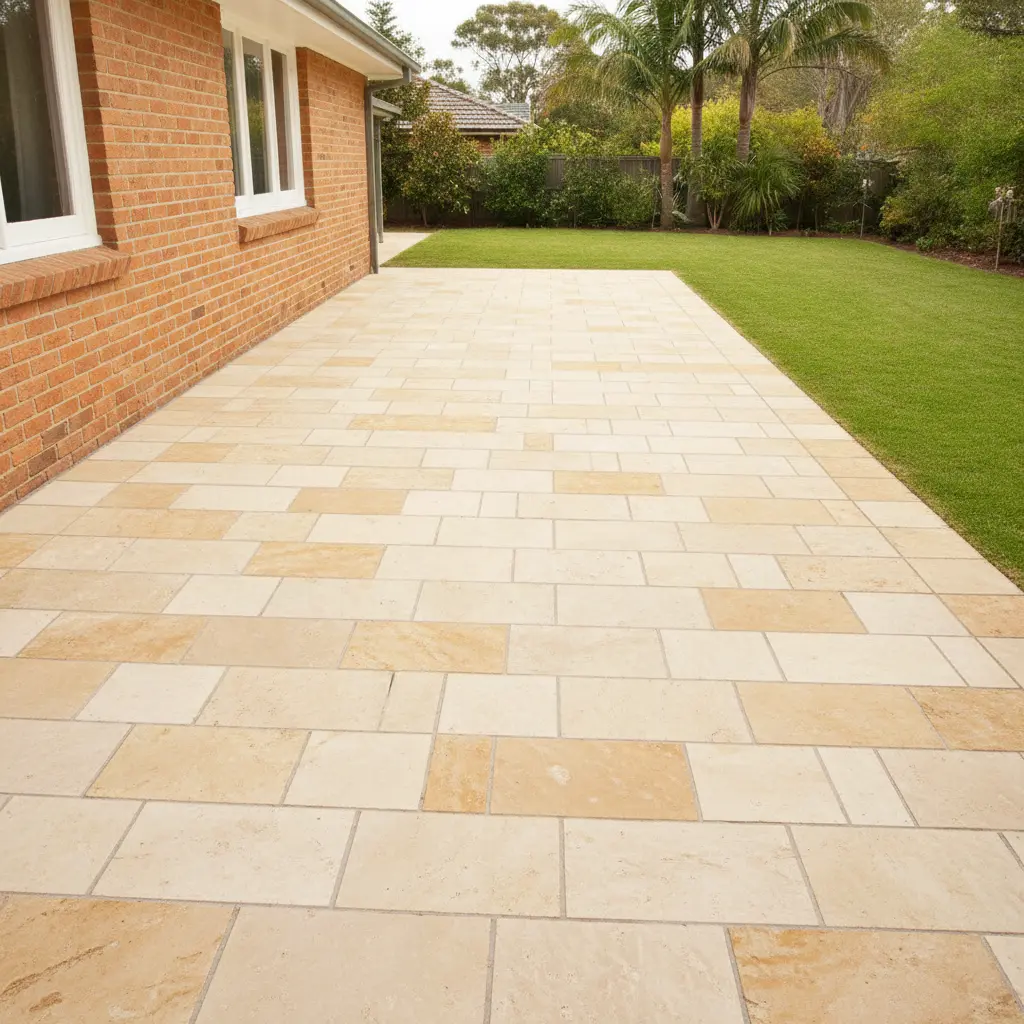
To lay sandstone pavers, excavate to the depth of the paver plus its base, compact 75–100mm of road base or crushed sandstone for foot traffic (150–200mm or a concrete slab for driveways), screed 20–30mm of bedding sand or spread a mortar bed, then lay the pavers with a fall of about 1:60–1:100 away from the house. Finish by filling the joints and sealing the stone.
- Typical dig for a patio: about 175–190mm (50mm paver + 25–40mm bedding + 100mm base).
- Falls: 1:60 to 1:100, which is 10–17mm per metre, away from the house.
- Pavers: sawn all round pavers are 50mm thick (75/100mm for vehicles) in 400x400, 600x400 and 600x600mm or cut to size.
- Base materials: crushed sandstone 75mm minus for the base, 20mm minus fill sand for bedding.
- Order extra: 5% for straight layouts, 10–15% for herringbone or diagonal patterns.
What is the right base for pavers?
The base for pavers is a layer of compacted crushed rock that spreads the load and stops the paving sinking. For foot traffic, 75–100mm of compacted road base or crushed sandstone is typical; for driveways, 150–200mm or a reinforced concrete slab. On top sits a thin bedding layer of sand (for dry-laid pavers) or mortar (for pavers on a slab). Depths depend on soil and use, so treat the table as a starting point.
| Use | Paver thickness | Compacted base | Bedding | Approx. total dig |
|---|---|---|---|---|
| Garden path | 50mm | 75mm crushed sandstone or road base | 20–30mm fill sand | About 150mm |
| Patio or entertaining area | 50mm | 100mm | 20–30mm sand or 25–40mm mortar | About 175–190mm |
| Pool surround | 50mm | Concrete slab (as specified) | 25–40mm mortar | Slab depth + about 90mm |
| Driveway | 75–100mm | 150–200mm or reinforced slab | Mortar on slab | About 250–330mm (engineer to confirm) |
| Reactive clay or wet ground | As above | Add 50mm and geotextile | As above | Get advice first |
We supply crushed sandstone in 75mm minus and 150mm minus for fill and road base, and 20mm minus fill sand for bedding; see crushed sandstone Sydney for details. For driveways, most NSW councils have rules on crossovers and drainage, so check yours.
Sand bed or mortar bed?
Sawn all round pavers are diamond-sawn on all six faces, so they can be laid with or without mortar joints.
- Dry-laid on sand: pavers sit on screeded fill sand over compacted base, with tight joints of 2–5mm filled with fine sand. It is quicker, cheaper and lets water soak away, and a paver can be lifted later. It suits paths and patios.
- Mortar bed on a slab: pavers are bedded in mortar on concrete with 5–10mm grouted joints. It is more rigid and suits pool surrounds, driveways and areas next to the house.
Mixed-size sawn modular paving (from $65/m²) is usually laid on mortar because its thicknesses can vary between pieces.
Tools and materials
- Pavers plus 5–15% extra, crushed sandstone or road base, fill sand or mortar
- String lines, pegs, line level or laser level, tape measure
- Plate compactor (hire), shovel, wheelbarrow, rake
- Two screed rails (25mm conduit or pipe works) and a straight timber screed board
- Rubber mallet, spirit level, wet-cutting diamond saw
- Gloves, eye and hearing protection and a P2 respirator; sandstone dust contains crystalline silica, so always cut wet
How to lay pavers, step by step
1. Measure and order
Measure the area in square metres and add 5% for straight layouts or 10–15% for herringbone and diagonal patterns. At about 2,300kg per cubic metre, 50mm sandstone pavers weigh roughly 115kg per m², so a 30m² patio is about 3.5 tonnes of stone; plan where the truck will unload.
The calculator below adds the extra for your pattern and works out the weight and the crushed sandstone for the base. It is also on its own page as the paver calculator.
Calculator
Paver calculator: m² to order
- Paved area
- 30.00 m²
- Order
- 31.5 m²
- Includes 5% extra; stack bond needs about 5%
- Pallets
- By quote
- Pallet sizes vary by product
- Stone weight
- 3.62 t
- About 115kg per m² at 50mm
2. Set out levels and falls
Peg out the area and run string lines at finished paving height. Build in a fall of 1:60–1:100 away from the house: over a 4m patio, that is 40–67mm. Set the string at the house end first, then drop it by the fall at the far end and mark both heights on the pegs. Keep the finished surface below the house damp course and weep holes.
3. Excavate
Dig out to the total depth (paver + bedding + base), plus about 100–150mm past the edges for the edge restraint. Remove roots and soft spots and compact the subgrade.
4. Lay and compact the base
Spread crushed sandstone or road base in layers of about 50–75mm, dampen it and compact each layer with a plate compactor. The finished base should follow the same fall as the paving.
5. Install the edge restraint
Dry-laid pavers need a fixed edge so they can’t creep outwards: a concrete haunch, a mortared soldier course or sandstone edging set in concrete.
6. Screed the bedding layer
Lay two screed rails on the base, spread fill sand, and drag a straight board along the rails to get an even 20–30mm layer. Remove the rails, fill the grooves and don’t walk on the screeded sand. For a mortar bed, spread only enough for a few pavers at a time.
7. Lay the pavers
Start at a fixed straight edge, usually along the house, and work outwards, kneeling on the laid pavers. Place each paver down rather than sliding it, tap it level with a rubber mallet and keep checking lines every few rows. Mix pavers from several pallets so the colours blend. For layout choices, see our guide to sandstone paving patterns.
8. Cut the edge pieces
Measure and mark each cut, then cut with a wet diamond saw. Avoid pieces narrower than about a third of a paver at the edges; shift the layout instead.
9. Fill the joints
For dry-laid pavers, sweep fine sand into the joints and repeat until full. For mortar-bedded pavers, grout the joints the next day and sponge the faces clean straight away.
10. Settle, clean and seal
Natural stone can chip under a bare plate compactor, so settle dry-laid pavers with a rubber mallet or a compactor fitted with a protective pad. Once the paving is clean and dry, apply a penetrating sealer and reseal every 2–3 years outdoors. Avoid acid cleaners.
Can you lay pavers on an existing concrete slab?
Yes, if the slab is sound. Check it for cracks, movement and drainage first: a slab that is cracked or sinking will pass those problems straight through to the stone. Clean off paint, oil and loose material, and make sure the slab already falls away from the house. Then bed the pavers in mortar (25–40mm) with grouted joints rather than laying them on sand. Allow for the extra height: 50mm pavers plus a 25–40mm bed raise the surface by 75–90mm, which can bring it too close to door sills and weep holes. If height is tight, ask about thinner outdoor sandstone tiles instead of pavers.
How do you stop water pooling on new paving?
Most pooling comes from a missing or reversed fall. Set the fall before you lay the base, not after, and check it with a long straight edge and level every few metres. Where paving runs to a door, a back wall or a pool fence with no fall-away, install a grated strip drain connected to the stormwater system. Most NSW councils require surface water to be directed to an approved drainage point rather than onto a neighbour’s land, so check yours. Dry-laid pavers drain partly through the joints and base, but they still need a fall.
Common paving mistakes
- Base too thin or not compacted in layers, leading to sinking and rocking pavers.
- No fall, or a fall towards the house.
- Using bedding sand to make up for an uneven base instead of fixing the base.
- Skipping the edge restraint on dry-laid paving.
- Cutting sandstone dry without a respirator.
Get sandstone pavers from Stone Front
We supply sawn all round pavers, sawn modular paving, crushed sandstone and fill sand from our Glenorie quarry, with pavers cut to your sizes and delivery across greater Sydney. Compare options on our sandstone pavers Sydney page, then send your area through our quote form; final pricing depends on quantity, finish and delivery.
Frequently Asked Questions
Can I lay pavers directly on dirt?
No. Pavers laid straight on soil sink, rock and let weeds grow through the joints. Remove topsoil down to firm subgrade, then lay and compact at least 75mm of crushed sandstone or road base for foot traffic, plus 20–30mm of bedding sand. Clay and wet soils need a deeper base and geotextile.
What sand do you use under pavers?
Use a clean bedding sand such as 20mm minus fill sand, screeded to an even 20–30mm over a compacted crushed-rock base. The crushed sandstone or road base does the structural work; the sand only beds and levels the pavers. Don’t use extra-thick sand to make up for an uneven base, as it settles unevenly.
How long does it take to lay a paved patio?
For a 20–30m² patio, allow roughly one to two days for excavation and base, then one to two days for laying, cutting and filling joints, depending on access, pattern and experience. Herringbone and diagonal patterns take longer because of the cuts, and mortar-bedded paving needs a few days to cure before heavy use.
Do sandstone pavers need sealing?
Sealing is recommended. Sandstone is porous, so a penetrating (impregnating) sealer reduces staining from food, leaves and pool water without changing the look much. Seal once the paving is clean and fully dry, then reseal every 2–3 years outdoors. Never use acid cleaners on sandstone.
How thick should sandstone pavers be for a driveway?
Use 75–100mm sawn all round pavers where cars drive, laid on a vehicle-rated base of 150–200mm compacted road base or a reinforced concrete slab. Standard 50mm pavers suit foot traffic only. Have an engineer confirm the base for steep or heavily used driveways, and check your council’s rules for crossovers.
How much do sandstone pavers cost?
Sawn all round pavers start from $120/m² and sawn modular paving from $65/m² (guide prices, ex-quarry). Add base material, bedding sand, delivery and labour if you are not laying them yourself. Final pricing depends on quantity, size, finish and delivery across greater Sydney.