How to Lay Crazy Paving: A Sandstone Step-by-Step Guide
Sawn vs handsplit crazy paving, the right base, mortar bed, jigsaw layout, joint widths, pointing, sealing and how much stone to order.
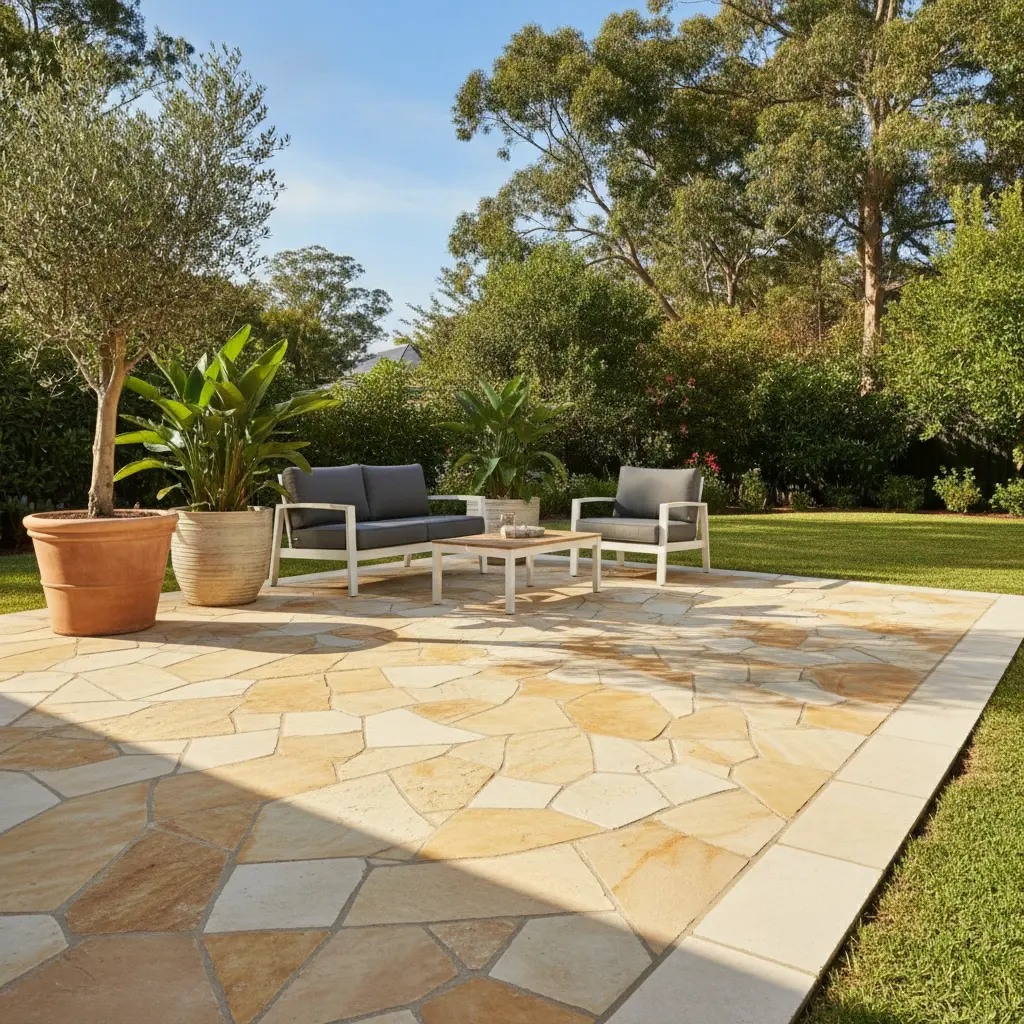
To lay crazy paving, bed irregular sandstone pieces on a mortar bed (typically 25–40mm thick) over a sound base, usually a concrete slab or well-compacted road base. Fit the pieces like a jigsaw with 10–20mm joints, point the joints with mortar the next day, and seal the stone once everything has cured. Sandstone crazy paving (sawn flagging) starts from $85/m² (guide price).
- Stone: sawn flagging (sawn edges, 50/75/100mm) or handsplit flagging (natural split, 30–100mm grades).
- Base: concrete slab for driveways and pool surrounds; compacted road base for garden paths and patios.
- Joints: about 10–15mm for sawn flagging, 15–25mm for handsplit.
- Wastage: order 10% extra for sawn flagging and 10–15% for handsplit.
- Falls: about 1:60 to 1:100 away from the house and pool.
What is crazy paving?
Crazy paving is paving made from irregular pieces of stone fitted together in a random, jigsaw-like pattern with mortar joints between them. In Sydney it is usually sandstone, either sawn flagging, where the pieces have straight diamond-sawn edges and a flat sawn surface, or handsplit flagging, where both the surface and edges are naturally split. It suits patios, paths, pool surrounds, driveways and even walls.
Sawn or handsplit crazy paving: which should you choose?
| Sawn flagging | Handsplit flagging | |
|---|---|---|
| Edges | Diamond-sawn, straight | Natural split, irregular |
| Surface | Flat sawn face | Natural riven texture |
| Thickness | 50, 75 or 100mm | Thin 30–50mm, regular 50–75mm, track 75–100mm |
| Look | Clean, geometric, contemporary | Rustic, traditional, cottage |
| Typical joint | 10–15mm | 15–25mm |
| Laying effort | Faster; edges fit more easily | Slower; more trimming and sorting |
| Supply | Mixed-colour pallets | 10m² pallets |
| Guide price | From $85/m² | By quote |
See photos, colours and pallet options on our sandstone crazy paving Sydney page and our handsplit sandstone flagging Sydney page, or order sawn flagging directly.
How much crazy paving do I need?
Measure the area in square metres (length x width, adding up separate rectangles for odd shapes) and add wastage: about 10% for sawn flagging and 10–15% for handsplit, because irregular pieces need trimming. For a 20m² patio in sawn flagging, order about 22m².
Plan delivery around weight. Sandstone weighs about 2,300kg per cubic metre, so 50mm flagging weighs roughly 115kg per m², 75mm about 173kg per m² and 100mm about 230kg per m². That 22m² of 50mm flagging is roughly 2.5 tonnes, so make sure the truck can get close or ask about crane-truck delivery.
What base does crazy paving need?
Crazy paving is only as good as what is under it. Because the pieces are irregular and mortar-jointed, the base must not move or the joints will crack.
- Concrete slab: the most durable base and the usual choice for pool surrounds and driveways. Your concreter or engineer will specify thickness and reinforcement; driveways need 75–100mm flagging or 75–100mm track-grade handsplit.
- Compacted road base or crushed sandstone: suitable for garden paths and patios, typically 75–100mm compacted in layers, with 50mm flagging bedded in mortar on top.
- Falls: build a fall of about 1:60 to 1:100 (10–17mm per metre) away from the house and away from the pool water so rain drains off.
How to lay crazy paving, step by step
Step 1: Set levels and falls
Run string lines at the finished paving height, including the fall. Check that the paving will finish below the house damp course and weep holes.
Step 2: Sort the stone
Spread out a pallet and sort the pieces: large pieces with a straight edge for the borders, medium pieces for the field, small pieces for filling gaps. Mix pieces from several pallets so colours blend.
Step 3: Dry lay a section
Lay out about 1–2m² on the ground next to the work area before mortaring. This lets you plan the jigsaw and spot problems early.
Step 4: Mix and spread the mortar bed
Use a sand and cement mortar (commonly around 4 parts sand to 1 part cement; follow your supplier’s mix) and spread a 25–40mm bed for one or two pieces at a time. Brush a cement slurry onto the back of each stone to help it bond.
Step 5: Lay the border first, then fill in
Set the straight-edged pieces around the perimeter, then work inwards. Tap each piece down with a rubber mallet and check it against the string line and a straight edge so the surface stays flat.
Step 6: Use the jigsaw rules
- Aim for three joints meeting in a Y; avoid four-way cross joints.
- Avoid long straight joints running across more than two or three pieces.
- Keep joint widths even; trim a piece with a saw rather than filling a wide gap with mortar.
- Avoid tiny slivers at the edges; they crack and come loose.
- Spread large and small pieces and colours evenly so no area looks patchy.
Step 7: Clean as you go
Wipe any mortar off the stone face straight away with a damp sponge. Dried mortar is hard to remove from porous sandstone, and acid cleaners will damage it.
Step 8: Point the joints
After about 24 hours, fill the joints with a fairly dry pointing mortar, pressing it in firmly and tooling it flush or slightly recessed. Keep the mix off the stone surface.
Step 9: Cure and seal
Keep foot traffic off for a few days and let the mortar cure fully before sealing; follow the sealer maker’s waiting time. Apply a penetrating (impregnating) sealer and reseal every 2–3 years outdoors. Some installers also pre-seal the stone before pointing to reduce staining. Our guide to sealing sandstone explains sealer choice and application, and the sandstone cleaning guide covers upkeep.
How wide should crazy paving joints be?
For sawn flagging, joints of about 10–15mm look neat because the sawn edges fit closely. Handsplit flagging needs 15–25mm because the natural edges are uneven. Whatever width you choose, keep it consistent across the whole area; even joints are what make crazy paving look deliberate rather than messy.
Laying crazy paving around a pool
Pool surrounds need a concrete base, falls away from the water and a neat edge at the pool. Most people finish the edge with sawn or bullnosed pool coping cut to size, then lay crazy paving behind it. Sawn flagging gives a flatter, easier-to-clean surface for bare feet; ask us about surface finish if slip resistance is a concern. Keep pool water and salt off fresh mortar until it has cured, and seal the stone. See our sandstone pool pavers Sydney page for coping and paving options.
Crazy paving ideas
- Framed crazy paving: a border of sawn edging or 150mm hydrasplit strips around crazy paving gives a crisp outline.
- Planted joints: on a compacted base, leave wider joints filled with soil and creeping thyme or native groundcover instead of mortar.
- Colour mixes: blend Light Yellow, Banded Yellow and Browns for a warm, traditional look, or stick to Marbled White for a paler contemporary finish.
- Driveways: track-grade handsplit (75–100mm) or 100mm sawn flagging on a reinforced slab.
- Mixing with other layouts: a crazy paving path leading to a sawn paver patio; compare the options in our guide to sandstone paving patterns.
Common crazy paving mistakes
- Laying onto uncompacted soil, which settles and cracks the joints.
- No fall, leaving puddles that stain the stone.
- Filling big gaps with mortar instead of cutting a piece to fit.
- Letting mortar dry on the stone face.
- Using acid to clean off mortar stains.
Get sandstone crazy paving from Stone Front
We supply sawn flagging in 50, 75 and 100mm and handsplit flagging in 10m² pallets, quarried at Glenorie, and you can visit to hand-select colours. Send your area and intended use through our quote form; final pricing depends on quantity, thickness and delivery.
Frequently Asked Questions
How much does sandstone crazy paving cost per square metre?
Sandstone crazy paving in sawn flagging starts from $85/m² (guide price, ex-quarry); handsplit flagging is priced by quote. Add 10–15% for wastage, plus base, mortar, sealer and delivery. Laying crazy paving is labour-intensive, so landscapers typically charge more per square metre than for regular pavers; get two quotes.
Can you lay crazy paving on sand?
Crazy paving can be dry-laid on compacted crushed rock and sand with planted or sand-filled joints for an informal garden path, but pieces move over time. For patios, pool surrounds and driveways, use a mortar bed on a compacted base or concrete slab with mortar-pointed joints so the irregular pieces stay locked in.
Can you lay crazy paving over existing concrete?
Yes, if the slab is sound, clean and already falls away from the house. Bed the flagging in a 25–40mm mortar bed with cement slurry on the back of each piece. The finished level rises by the stone plus the bed, about 75–90mm with 50mm flagging, so check door sills and weep holes first.
Is crazy paving old-fashioned?
Crazy paving has a traditional image, but sawn flagging with straight edges, tight even joints and a pale colour such as Marbled White gives a cleaner, contemporary look. Framing it with sawn edging or hydrasplit strips, or using it for paths beside large-format pavers, also gives it a more modern feel.
What colours does sandstone crazy paving come in?
Sawn flagging is supplied in mixed-colour pallets from the Glenorie quarry run, which includes Marbled White, White with Greys, Light Yellow, Banded Yellow, Light Yellow Multicoloured, Medium Yellow with Purples, White with Browns & Greys, Browns, Orange and Purples. You can visit to hand-select colours or match a batch from photos.