Sandstone Paving Patterns: 8 Layouts and Ideas Compared
Stack bond, stretcher, herringbone, French pattern, random ashlar and more: how each sandstone paving pattern looks, what it costs and how hard it is.
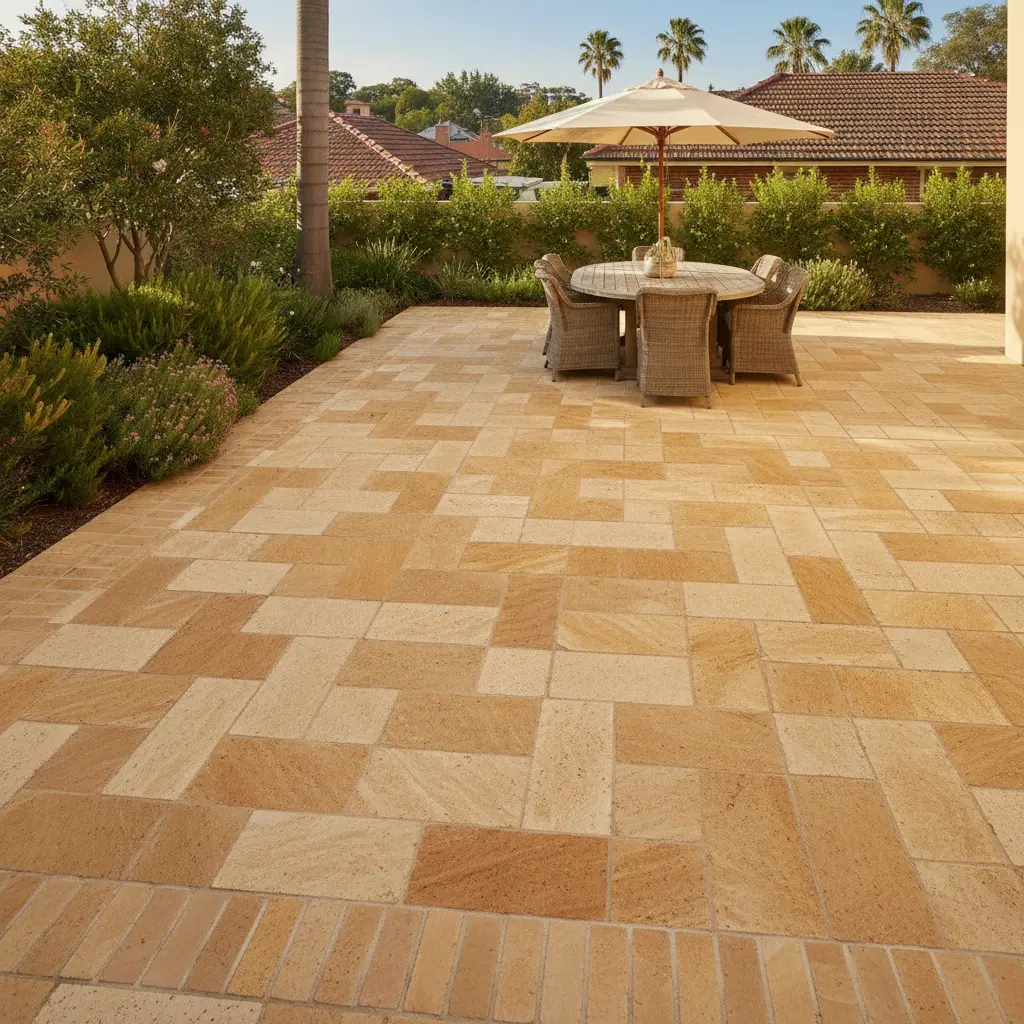
The most common sandstone paving patterns are stack bond, stretcher bond, herringbone, diagonal, French pattern, random ashlar, crazy paving and linear plank layouts. Stack and stretcher bond suit single-size sawn pavers and waste the least (around 5%). Herringbone and diagonal layouts look busier and need 10–15% extra for cuts. Multi-size layouts such as French pattern and random ashlar suit sawn modular paving, from $65/m².
Sandstone paving patterns compared
| Pattern | Look | Suits these sizes | Wastage (allow) | Difficulty |
|---|---|---|---|---|
| Stack bond | Clean grid, modern and formal | Squares: 400x400, 600x600mm | About 5% | Easy to lay; joints must be dead straight |
| Stretcher bond | Brick-like, lengthens a space | Rectangles: 600x400, 600x300mm | 5–7% | Easy |
| Herringbone (90°) | Woven zig-zag, lots of movement | 2:1 rectangles, e.g. 600x300mm | 10–15% | Moderate to hard |
| Diagonal (45°) | Dynamic, widens narrow areas | Squares or rectangles | 10–15% | Hard; many edge cuts |
| French pattern | Classic repeating multi-size | Set of four sizes from one module | 5–10% | Moderate |
| Random ashlar | Relaxed, irregular rectangles | Sawn modular paving, mixed sizes | 5–10% | Moderate; needs sorting |
| Crazy paving | Organic jigsaw | Sawn or handsplit flagging | 10–15% | Hard; labour-intensive |
| Linear plank | Long, narrow, contemporary | 150mm hydrasplit strips, long sawn pavers | 5–10% | Easy to moderate |
Sandstone paving patterns explained
1. Stack bond
Every paver lines up with its neighbours in both directions, creating a continuous grid. It is the simplest pattern to set out and suits square sawn all round pavers in 400x400 or 600x600mm for a modern courtyard or pool surround. Because every joint runs straight across the whole area, any error shows, so use string lines in both directions.
2. Stretcher bond (running bond)
Rectangular pavers are laid in rows with each row offset by half a paver, like brickwork. Laying the long side across the direction of view makes a narrow side path feel wider; laying it along a path makes it look longer. 600x400 and 600x300mm pavers work well. A third-offset version is common with longer pavers.
3. Herringbone
Rectangles are laid at right angles to each other in a zig-zag. The pavers interlock, which is why herringbone is traditional for driveways, and it adds lots of movement to a large plain area. Pavers need a 2:1 ratio (for example 600x300mm). Every edge needs angled cuts, so allow 10–15% extra stone and more labour.
4. Diagonal (45°)
A stack bond or herringbone turned 45° to the house. Diagonals draw the eye across a space and can make a small or narrow courtyard feel larger. Expect cuts along every edge and wastage of 10–15%.
5. French pattern
Also called Versailles or opus romano, French pattern uses a repeating set of four sizes from one module, for example 600x400, 400x400, 400x200 and 200x200mm. It looks random but repeats, so it is easier to lay than truly random paving. Because our pavers are cut to size at the quarry, you can order the four sizes in the right proportions.
6. Random ashlar
Random ashlar uses rectangles of many different sizes laid without a repeating module. It suits sawn modular paving, which comes in mixed sizes and colours at 50, 75 or 100mm thick. Because modular paving is a by-product of sawing other products, it is the lowest-cost sawn option at $65/m² (guide price). The trick is sorting pieces by size before you start and avoiding long continuous joints.
7. Crazy paving
Irregular pieces fitted together like a jigsaw with 10–25mm mortar joints. Sawn flagging gives a cleaner, more geometric version; handsplit flagging is more rustic. Our step-by-step guide on how to lay crazy paving covers bases, joints and the jigsaw rules.
8. Linear plank
Long, narrow pieces laid in a stretcher pattern create a timber-deck look in stone. Hydrasplit paving is 50mm thick and split to any width, with 150mm strips common, from $95/m². Use the same strips as edging or capping to frame the paving.
How do you choose a paving pattern?
- Size of the area: small courtyards suit simple stack or stretcher bond with larger pavers; busy patterns like herringbone can look cluttered in a tight space.
- Direction: long joints lead the eye. Run them towards a view, the pool or the back fence to make the space feel longer.
- Style of the house: stack bond and plank layouts suit contemporary homes; French pattern, random ashlar and crazy paving suit heritage and federation homes.
- Budget: material and labour both change with the pattern (see below).
- Use: driveways need interlocking or mortar-bedded patterns on a proper base.
Which sandstone paving pattern is cheapest?
On material alone, random ashlar in sawn modular paving is the lowest-cost sawn option (from $65/m²), followed by crazy paving in sawn flagging (from $85/m²), hydrasplit plank layouts (from $95/m²) and sawn all round pavers in stack, stretcher, herringbone or French pattern (from $120/m²). These are guide prices; final pricing depends on quantity, finish and delivery. Labour shifts the picture: stack and stretcher bond are the quickest to lay, while herringbone, diagonal and crazy paving take longer, so get two quotes for laying and compare them per square metre.
Sandstone paving ideas by area
Patios and entertaining areas
Large-format 600x600mm pavers in stack bond give a calm, open look for an alfresco area, and fewer joints make it easier to sweep. For a heritage home, French pattern or random ashlar in mixed yellows and browns feels more relaxed and hides wear.
Pool surrounds
Stack or stretcher bond in sawn all round pavers, finished with sawn or bullnose coping cut to size, keeps lines clean around the water. Run the joints parallel to the long side of the pool so the paving and pool line up. Choose a paler colour such as Marbled White or Light Yellow if you want a cooler, brighter look.
Paths and side passages
In a narrow side passage, stretcher bond with the long side running across the path makes the space feel wider. For garden paths, linear plank layouts in hydrasplit strips or a crazy paving path suit informal planting.
Driveways
Herringbone interlocks and handles turning wheels well, which is why it is traditional for driveways. Use 75–100mm pavers on a base designed for vehicles, or track-grade flagging laid as crazy paving on a reinforced slab.
Courtyards
Small courtyards suit one simple pattern and one colour. A 45° diagonal can make a tight square courtyard feel larger, but keep the pavers large so the cut edges don’t dominate.
Borders, banding and mixing patterns
- Soldier course border: a single row of pavers laid end-on around the edge. It frames any pattern and hides the cut edges of herringbone or diagonal layouts.
- Contrasting band: a strip in a different colour, such as Browns banding in a Light Yellow patio.
- Edging: finish where paving meets lawn or garden with matching sandstone edging or bullnose capping.
- Pattern zones: stack bond on the patio, stepping stones through the lawn, crazy paving on the path. Keep the stone colour consistent so the zones still read as one design.
How to set out a paving pattern
- Start from the main view. Set the first line parallel to the house or the main sightline, not the boundary fence, which is rarely square.
- Find the centre. For stack bond and French pattern, centre the layout on a door or window so cuts are equal on both sides.
- Dry lay a row in each direction. Adjust the starting point so you don’t end up with thin slivers at the edges.
- Keep checking. Use string lines every few rows; small errors grow across a large area.
The base, falls and laying steps are the same for every pattern; see our guide on how to lay sandstone pavers.
Get sandstone paving from Stone Front
We supply sawn all round pavers cut to the sizes your pattern needs, sawn modular paving, hydrasplit strips and flagging, all from our Glenorie quarry. Browse options on our sandstone pavers Sydney page and send your area and chosen pattern through our quote form.
Frequently Asked Questions
Which paving pattern is easiest for DIY?
Stack bond and stretcher bond are the easiest patterns for DIY because every paver is the same size and cuts are only needed at the edges, so wastage is around 5%. Stack bond needs very straight joints in both directions, which makes stretcher bond a little more forgiving of small errors.
Which paving pattern makes a small area look bigger?
Large pavers in a simple stack bond, or a 45° diagonal layout, tend to make small courtyards feel larger because there are fewer joints and the lines lead the eye across the space. In a narrow path, stretcher bond with the long side of each paver running across the path makes it feel wider.
What is the difference between random ashlar and crazy paving?
Random ashlar uses rectangles of different sizes with straight, square edges, so joints run in short straight lines. Crazy paving uses irregular pieces fitted like a jigsaw with wider mortar joints. Random ashlar looks more ordered and suits sawn modular paving; crazy paving looks more organic and suits sawn or handsplit flagging.
Does the paving pattern affect how strong the paving is?
On foot-traffic areas the base matters far more than the pattern. For driveways, interlocking patterns such as herringbone spread wheel loads and resist creeping better than stack bond, which has continuous joints in both directions. Whatever the pattern, use 75–100mm pavers and a vehicle-rated base for driveways.
How much extra paving should I order for herringbone?
Allow 10–15% extra for herringbone and other 45° layouts, compared with about 5% for stack or stretcher bond. Every edge piece in a herringbone layout needs an angled cut, and the offcuts are often too small to reuse. On small or irregular areas, lean towards the higher figure.
Products Mentioned in This Article
Sawn Modular Paving
Economical modular pavers with a smart, contemporary finish.
Sawn All Round Pavers
Diamond-sawn on all sides for a formal, elegant finish.
Hydrasplit Paving
Split-face finish paving strips for a contemporary, structured look.
Sawn Flagging (Crazy Paving)
Natural irregular shapes with sawn edges for a classic, informal look.