Sandstone Garden Edging Ideas: Types, Costs and How to Lay It
Seven sandstone edging types compared, garden edging ideas, how much you need per metre and how to lay edging in a concrete haunch.
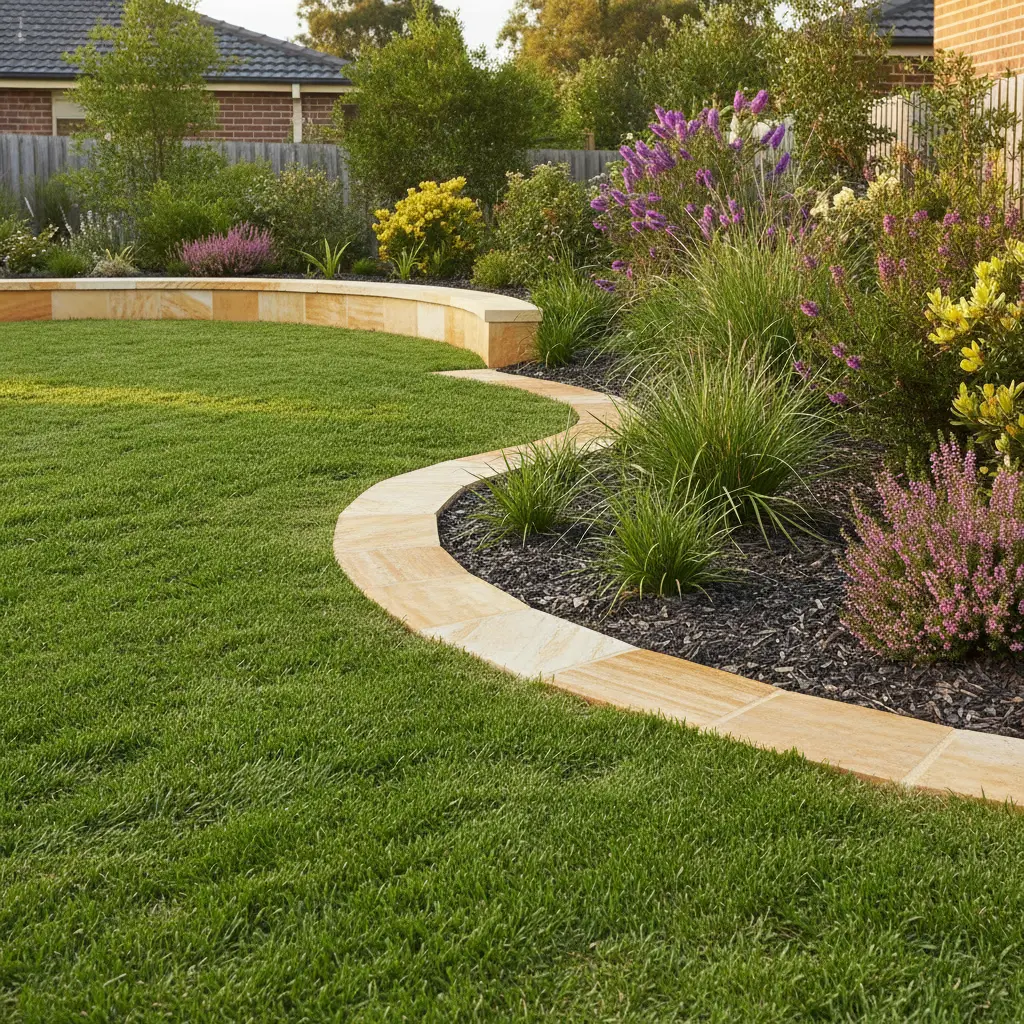
Sandstone garden edging is a row of natural stone (sawn strips, split strips, logs or blocks) set along the edge of a garden bed, lawn or path to hold soil and mulch in place and give the garden a clean line. Most Sydney gardens use sawn or hydrasplit strips bedded in a concrete haunch, and quarry-direct sandstone edging starts from $35 per lineal metre (guide price).
- Price: sawn sandstone edging from $35 per lineal metre (guide price, ex-quarry).
- Profiles: sawn, split, bullnose and rockfaced, plus 50mm-thick hydrasplit strips (150mm wide is common).
- Chunkier options: split logs (about 300x300mm cross-section) and rough squared blocks for raised or sloping beds.
- How much: measure the run in lineal metres and add 5–10% for cuts, corners and curves.
- Laying: set on a stiff concrete bed with a concrete haunch behind so the stone can’t be pushed out by soil or a mower.
What types of sandstone edging are there?
Sandstone edging comes in two broad groups: thin strips that sit flush with or just above the ground, and heavier logs, blocks and boulders that also hold back a little soil. The right one depends on whether you want a crisp mowing line, a raised bed or a rustic border. Every piece is quarried, sawn and split at our Glenorie quarry and can be cut to the length and width you need.
| Edging type | Profile and look | Typical size | Suits | Guide price |
|---|---|---|---|---|
| Sawn edging | Square, smooth diamond-sawn faces; crisp and modern | Cut to the width and length you need | Lawn edges, mowing strips, contemporary beds | From $35/lm |
| Bullnose edging and capping | Rounded front edge; softer, finished look | Cut to size | Raised beds, low wall tops, steps, pool surrounds | From $35/lm; profile affects price |
| Rockfaced edging | Chiselled, pitched face; traditional | Cut to size | Cottage and heritage gardens | By quote |
| Hydrasplit strips | Machine-split textured face, sawn top and bottom | 50mm thick; 150mm strips common, any width | Edging and capping that matches hydrasplit paving | Hydrasplit paving from $95/m² |
| Split logs | Sawn top and bottom, rough natural split face | About 300x300mm cross-section, various lengths | Raised beds, sloping lawns, low retaining edges | By quote |
| Rough squared blocks | Roughly shaped, rustic | Roughly one-man sized | Bush gardens, dry-stacked low edges | From $120/m² of wall face |
| Boulders | Natural, irregular | 1–2 man boulders | Native and coastal gardens | By quote |
You can compare all of these side by side on our sandstone garden edging Sydney page, or go straight to the sandstone edging product page for the sawn, split, bullnose and rockfaced profiles.
Garden edging ideas using sandstone
1. A flush mowing strip
Set sawn edging level with the lawn, or 5–10mm below it, so one mower wheel can run along the stone. It ends hand-trimming along the bed and stops runners like buffalo and couch creeping into the garden. Wider strips (150mm or more) make the mowing line easier to follow.
2. Hydrasplit strips to match your paving
If the patio or path is hydrasplit paving, use 150mm hydrasplit strips from the same colour batch as the edging. The split face and 50mm thickness tie the beds to the paving so the whole yard reads as one design.
3. Bullnose capping on raised beds
A raised bed built from blocks looks finished with a bullnosed cap on top. The rounded edge is comfortable to sit on and sheds water. Capping is cut to size, so it can overhang the wall face by 20–30mm for a shadow line.
4. Split log borders on a slope
Split sandstone logs are about 300mm square, so one log laid on its side makes a bold edge that also holds back 150–250mm of soil when partly buried. They suit sloping front lawns and terraced vegetable beds. A single-skin log wall typically goes to about 1m before engineering is needed; for an edge you will be well under that.
5. Short pieces for curved beds
Straight stone can follow a curve if it is cut into short lengths of about 300–400mm. The tighter the curve, the shorter the pieces. Ask for edging cut to length when you order so you are not cutting on site.
6. Rough squared blocks or boulders for a natural look
For bush or native gardens, a loose line of rough squared blocks or 1–2 man boulders gives a softer, irregular edge. You can hand-select pieces from the bins at the quarry so the shapes and colours suit your garden.
7. Edging a gravel path
Gravel and crushed sandstone paths need a firm edge on both sides or the gravel spreads into the lawn. Sawn edging set 20–30mm proud of the gravel holds the path in place and gives a clean line.
How much sandstone edging do I need?
Edging is sold by the lineal metre, so measure the length of every edge you want to define and add them together. Use a tape or a string line laid along curves, then straighten it to measure. Add 5–10% for cuts, corners and breakages; allow the higher figure for curved beds.
- Example 1: a 4m x 2m bed against a fence, edged on three sides, needs 4 + 2 + 2 = 8 lineal metres, so order about 8.5–9m.
- Example 2: a circular bed 3m across has a perimeter of about 9.4m (3 x 3.14), so order around 10–10.5m in short lengths.
- Weight: sandstone weighs about 2,300kg per cubic metre, so a 1m length of 150x50mm strip weighs roughly 17kg, while a 1m split log of 300x300mm weighs roughly 200kg and needs small machinery to place.
How to lay sandstone edging (with a concrete haunch)
Sandstone edging lasts for decades when it sits on a firm concrete bed with a haunch (a wedge of concrete) behind it. Without the haunch, soil pressure, roots and mower wheels slowly push the pieces out of line.
- Set out the line. Run a string line between pegs at the finished height of the edging. For curves, lay a hose on the ground and mark it with spray paint.
- Dig a trench. Dig about 100mm wider than the edging and deep enough for 75–100mm of concrete under the stone plus the part of the stone that will be below ground.
- Compact the base. Tamp the bottom of the trench firm. On soft ground, add a thin layer of compacted crushed rock or road base.
- Lay a stiff concrete bed. Use a dry, stiff mix so the stone doesn’t sink. Work in 1–2m sections so the concrete doesn’t go off before you set the stone.
- Set the edging. Press each piece into the bed and tap it down to the string line with a rubber mallet. Check level along the length and across the top.
- Butt the joints. Sawn edging can butt tight; split or rockfaced pieces usually need a 5–10mm joint, filled with mortar.
- Haunch the back. Pack concrete against the back of the stone at a 45° angle, finishing about two-thirds of the way up the piece. Under lawn, keep the haunch low enough for 50mm of soil and turf to cover it.
- Clean and cure. Wipe any concrete off the stone face straight away with a damp sponge, then leave it to cure for a few days before backfilling and mowing over it.
The same method is used for the edge restraint around sand-laid pavers, which we cover in our guide on how to lay sandstone pavers.
What colour sandstone edging should I choose?
Sandstone from the Glenorie quarry runs through a range of colours: Marbled White, White with Greys, Light Yellow, Banded Yellow, Light Yellow Multicoloured, Medium Yellow with Purples, White with Browns & Greys, Browns, Orange and Purples. For edging next to paving, match the paving batch so the two read as one. For edging against lawn or mulch, a warmer yellow or banded stone contrasts well with green. Colour batches can be matched from photos if you are adding to existing stonework.
Does sandstone edging need sealing?
Sandstone is porous, so edging next to mulch, soil and sprinklers can stain and grow moss over time. A penetrating (impregnating) sealer reduces water and dirt uptake without changing the look much; outdoors you typically reseal every 2–3 years. Never clean sandstone with acid-based cleaners, which damage the surface. Our guides to sealing sandstone and cleaning sandstone cover the routine.
Get sandstone edging from Stone Front
We supply sawn, split, bullnose, rockfaced and hydrasplit edging, plus split logs and blocks, quarry-direct from Glenorie with custom cutting and delivery across greater Sydney. Final pricing depends on quantity, profile and delivery, so send us your lineal metres through our free quote form or visit the quarry to hand-select your stone.
Frequently Asked Questions
How much does sandstone garden edging cost in Sydney?
Sawn sandstone edging starts from $35 per lineal metre (guide price, ex-quarry) at Stone Front’s Glenorie quarry. Hydrasplit strips, split logs and rockfaced profiles are priced by quote. Final pricing depends on quantity, profile and delivery, so budget separately for concrete and labour if you are not laying it yourself.
Can I lay sandstone edging without concrete?
Heavy pieces such as split logs or large blocks can sit on compacted crushed rock without concrete because their weight holds them in place. Thin sawn or hydrasplit strips should be bedded in concrete with a haunch behind them; otherwise soil pressure, roots and mower wheels gradually push them out of line.
Is sandstone edging a better choice than timber or steel edging?
It depends on the look and budget. Sandstone doesn’t rot like timber, can double as a mowing strip or a seat on a raised bed, and matches sandstone paving. It costs more up front and is heavier to install. Timber is cheaper but needs replacing sooner; steel gives a thin modern line but no mowing strip.
Can sandstone edging be cut to size?
Yes. Stone Front cuts edging, capping and pool coping to size at the Glenorie quarry, so you can order exact lengths, short pieces for curved beds or wider strips for a mowing edge. Sending a list of lengths with your quote request reduces cutting on site and wastage.
Where can I see sandstone edging before buying in Sydney?
You can visit the quarry at Glenorie NSW 2157 (Monday to Friday 7:00am–3:30pm, Saturday 8:00am–midday, closed Sundays and public holiday weekends) to inspect stock and hand-select pieces from the bins. Colour batches can also be matched from photos if you are adding to existing stonework.
Products Mentioned in This Article
Sandstone Edging
Define garden beds, pathways and driveways with natural sandstone edging.
Hydrasplit Paving
Split-face finish paving strips for a contemporary, structured look.
Split Logs (Sandstone Logs)
Approximately 300x300mm logs for retaining walls and stepped landscapes.
Rough Squared Blocks
Economical blocks for retaining walls and garden projects.