Sandstone Benches, Letterboxes and Fence Pillars: A Buyer’s Guide
Seat heights and bench sizes, letterbox build options, fence pillars and caps, sandstone capping and how to order custom stonemasonry pieces.
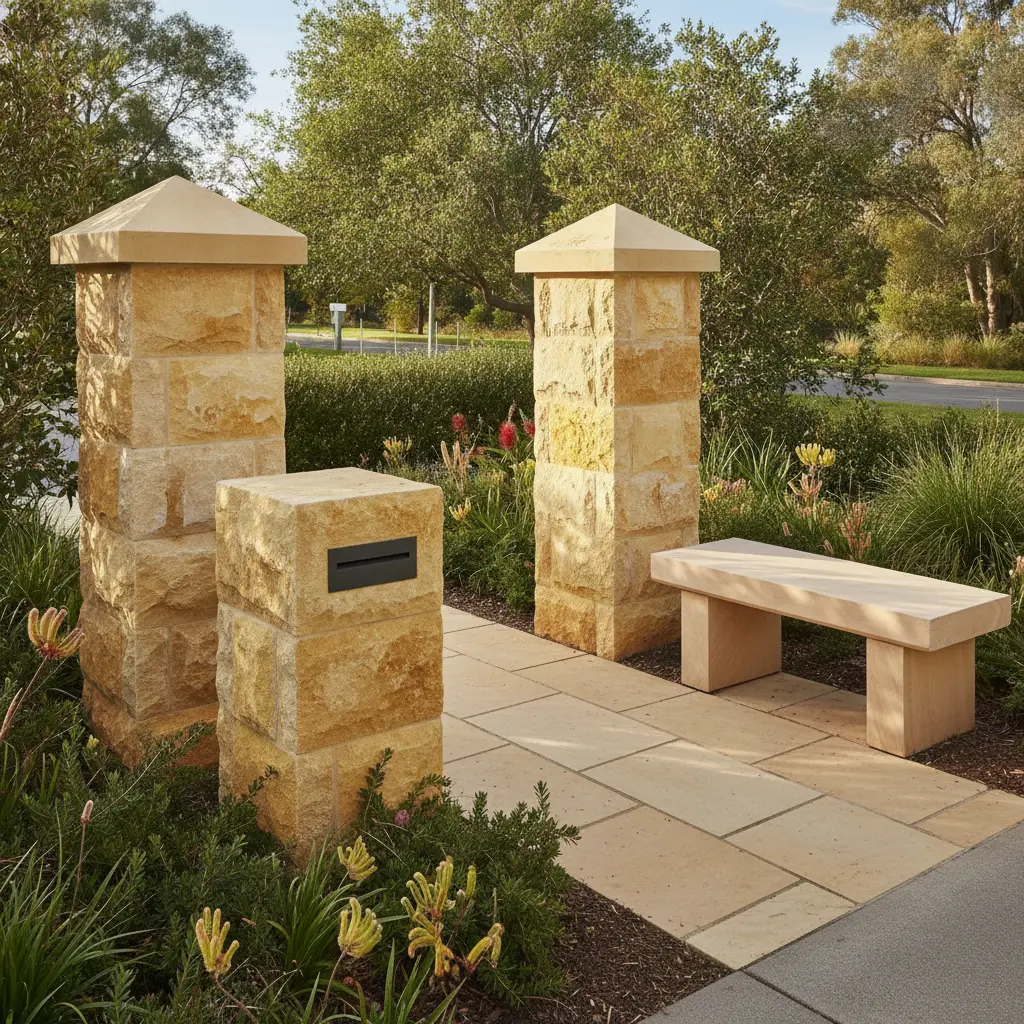
Sandstone benches, letterboxes and fence pillars are custom stonemasonry pieces cut from solid sandstone. A comfortable sandstone bench seat sits about 450mm high and 400–450mm deep. Letterboxes are usually a solid block or a rockfaced pier with a cap, and fence pillars are built from blocks around a core and finished with a pyramid or flat pier cap. All are made to order and priced by quote.
- Seat height: about 450mm; seat depth 400–450mm; allow about 600mm of length per person.
- Weight: sandstone weighs about 2,300 kg/m³, so a solid 1,200 x 450 x 450mm bench weighs roughly 560kg.
- Piers: built from 110mm-bed rockfaced blocks (100–250mm high) and finished with a pier or pyramid cap.
- Ordering: custom pieces are cut at the Glenorie quarry from a drawing with dimensions, finish and edge profile.
What sandstone pieces can be made to order?
Our custom stonemasonry covers the pieces that finish a garden or entry: bench seats and bench tops, letterboxes, plinths, bird baths, pier caps, pyramid caps, wall capping, bullnosed stair treads, and edge work such as bullnosing and rockfacing. Each piece is cut from quarry-run stone, so you can choose the colour, from Marbled White to Banded Yellow, Browns or Purples, and match it to paving or walls already on site.
How high should a sandstone bench seat be?
About 450mm from the ground or paving to the top of the seat is a comfortable height for most adults; 400–450mm is the usual range. The other dimensions follow from how many people you want to seat.
| Dimension | Typical size | Notes |
|---|---|---|
| Seat height | About 450mm | Measured to the finished seat top |
| Seat depth | 400–450mm | Deeper reads as a platform, shallower as a ledge |
| Length per person | About 600mm | Two people need about 1,200mm, three about 1,800mm |
| Bench top thickness (slab on supports) | Depends on span | Ask the stonemason; longer spans need thicker stone or a middle support |
Types of sandstone bench seat
Solid block bench
A single sawn block is the simplest and most permanent sandstone bench. It has no joints to fail and nothing to fix. It is also heavy: a 1,200 x 450 x 450mm block is 0.243m³, which at 2,300 kg/m³ is about 560kg. Plan for machine placement or a crane truck, and a firm, level, compacted base.
Slab on plinths
A sandstone slab resting on two sandstone plinths or piers looks lighter and uses less stone. A 1,500 x 450 x 100mm top weighs about 155kg, so it is still a machine or team lift. The stonemason will advise the slab thickness for the span and where the supports should sit.
Seat wall with capping
A low retaining or garden wall built to seat height and finished with wide capping turns a level change into seating. A single 110mm skin of blocks is too narrow to sit on comfortably, so seat walls are usually built thicker or topped with capping wide enough to sit on.
Boulder seats
A flat-topped boulder bedded so its top sits at roughly seat height makes a natural bench in a bushland garden. Our guide to landscaping with sandstone boulders covers how deep to bury them so they look as if they belong. Choose sandstone boulders with a naturally flat bed.
What is sandstone capping?
Capping is the flat stone that finishes the top of a wall, pier or seat. It sheds rain, protects the mortar joints below and gives the wall a finished edge. Capping is cut to size, usually with a small overhang past each face of the wall so water drips clear, and the exposed edges can be square sawn, pencil round, bullnosed or rockfaced. Hydrasplit paving, split to width, can also double as capping on garden walls. For seat walls, choose a capping width that is comfortable to sit on and an edge profile that is kind to the backs of legs: pencil round or bullnose.
How to build a sandstone letterbox
| Build option | How it is made | Good for |
|---|---|---|
| Solid block letterbox | One large block cut to take a letterbox insert or a mail slot | A monolithic, sculptural look; needs a machine to place |
| Built pier with insert and cap | Rockfaced or sawn blocks laid around a letterbox insert, finished with a pier or pyramid cap | Matching a sandstone fence, wall or house; hand-built from one-man blocks |
| Letterbox in a front wall | An insert built into a low sandstone wall, with capping over | Long front walls and gateways |
To show the weights involved, a solid block 400 x 400 x 1,100mm high is 0.176m³, or roughly 405kg, so it needs a concrete footing and machine placement. A built pier uses blocks that one or two people can handle, laid on a footing like a small wall.
Australia Post publishes guidance on letterbox position, height, slot size and street-number visibility. Check its current advice before you finalise the size and height of a sandstone letterbox, and make sure the mail slot and rear door suit the insert you plan to use.
How to build sandstone fence pillars
Most sandstone fence pillars (piers) are built from blocks laid around a hollow core, sitting on a concrete footing. Where the pier carries a gate or heavy fence panels, the core is usually filled with reinforced concrete so the stone is a facing and the core takes the load. Rockfaced blocks are the traditional choice: they have a 110mm bedwidth (the width of a standard brick) and come in 100, 150, 200 and 250mm heights, so courses line up with brick and blockwork.
- Set out and pour footings sized for the pier and the gate or fence it supports.
- Lay the blocks course by course around the core, keeping each course level and the corners plumb. A 1.8m pier in 200mm blocks is roughly nine courses before mortar joints and the cap.
- Fix gate hinges and fence brackets into the core as you go, not afterwards.
- Finish with a cap: a flat pier cap with a small overhang, or a pyramid cap for a traditional entry.
Gate piers for heavy or automated gates should be designed by an engineer. Most NSW councils set height and location limits for front fences and pillars built without approval, so check with yours before building. For block dimensions and weights, see our sandstone block sizes and weights guide.
How to order custom sandstone pieces
- Sketch it with dimensions: length, width and height of each piece, plus how many.
- Choose the finish and edge: sawn, rockfaced or split faces; square, pencil round or bullnose edges.
- Choose the colour: send photos to match existing stone, or visit the Glenorie quarry (Mon–Fri 7:00am–3:30pm, Sat 8:00am–midday) and hand-select.
- Describe access: driveway width, steps, slope and overhead wires. Heavy pieces can go in by crane truck.
- Request a quote. Pricing reflects stone volume, finish, profile work, colour and delivery.
How much do sandstone benches and letterboxes cost?
Custom pieces are priced by quote because no two are the same. The main cost drivers are the volume of stone, sawn versus rockfaced finishes, edge work such as bullnosing, colour selection and delivery. Building piers and walls from standard sandstone blocks is often more economical than a single large cut piece. Rockfaced blocks are from $180/m² of wall face (guide price). Installation is a separate cost: landscapers and stonemasons quote differently, so get two quotes.
Order custom sandstone from Stone Front
Benches, letterboxes, pier caps and capping are cut to your drawing at our Glenorie quarry and delivered across greater Sydney. Send your sketch and photos for a custom stonemasonry quote.
Frequently Asked Questions
Can a sandstone bench go on a deck or lawn?
On lawn or garden beds, a sandstone bench needs a firm, compacted base or a concrete pad so it doesn’t sink or tilt. On a deck or suspended slab, have the structure checked first: a solid 1,200 x 450 x 450mm bench weighs about 560kg, concentrated on a small area. A slab-on-plinths bench is lighter.
How long does a custom sandstone piece take to make?
It depends on the piece, the finish and the edge work involved, and on the current cutting schedule at the quarry. Simple capping and pier caps are quicker than a bullnosed bench or a cut letterbox block. Ask for a lead time when you request your quote, and allow extra time if you want to hand-select the stone.
Do sandstone benches need sealing?
Bench tops benefit from a penetrating sealer, especially under trees that drop leaves and berries, or near barbecues and outdoor dining where food and oil spill. A penetrating sealer keeps the natural look and texture. Reseal outdoor sandstone about every 2–3 years, or when a few drops of water soak straight in.
Can new sandstone pillars match an existing sandstone fence?
Usually, yes. Colour batches can be matched from photos, or you can hand-select blocks at our Glenorie quarry. Rockfaced blocks come in 100, 150, 200 and 250mm heights on a 110mm bed, so courses can be matched to most existing sandstone and brick walls.
Should a sandstone letterbox be rockfaced or sawn?
Rockfaced blocks have a traditional chiselled, pitched face that suits heritage homes and rockfaced fences, from $180/m² of wall face (guide price). Sawn all round blocks are diamond-sawn on six sides for a crisp, modern look, from $250/m². A cap with a bullnose or pyramid profile finishes either style.
Products Mentioned in This Article
Custom Stonemasonry
Bespoke sandstone pieces: bullnosing, caps, benches, letterboxes and more.
Rockfaced Blocks
Traditional rockfaced finish blocks for walls, edging and complete homes.
Sawn All Round Blocks
Premium diamond-sawn blocks with a beautiful finish on all 6 sides.
Sandstone Boulders
Natural boulders from gabion-size to large feature rocks.