Landscaping with Sandstone Boulders: Sizes, Placement and Ideas
Boulder size classes from gabion spalls to feature rocks, how to place boulders so they look natural, boulder walls, steps and seats, and access.
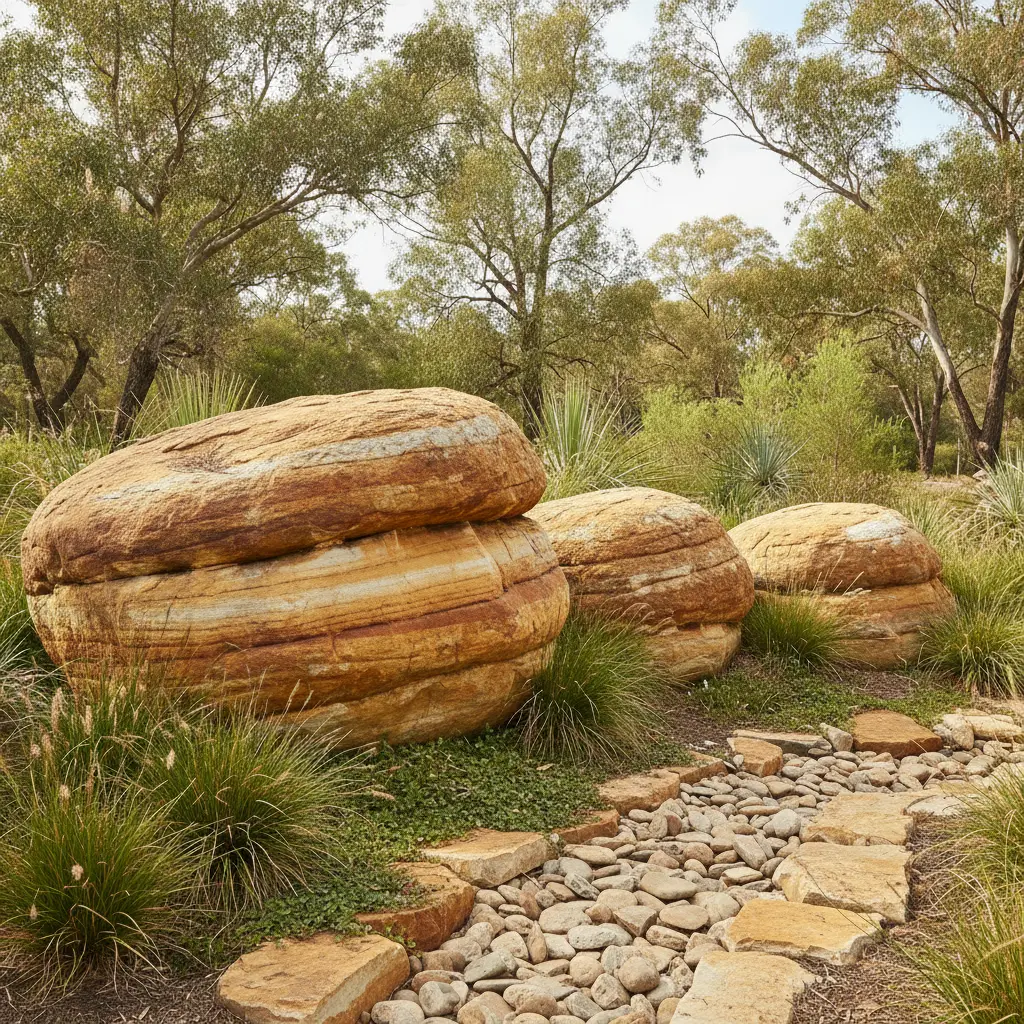
Sandstone boulders are natural, unshaped rocks used as feature stones, seats, steps and retaining walls. Choose the size class to suit your access and machinery: 75–150mm gabion spalls and 1–2 man boulders are placed by hand, while bobcat rock and large feature boulders are placed by machine. Bury each boulder about a third deep and group them in odd numbers so they look as if they have always been there.
- Size classes: gabion spalls (75–150mm), 1–2 man boulders, bobcat rock, select boulders and large feature boulders.
- Weight: sandstone is about 2,300 kg/m³, so a boulder that fills a 1m cube would weigh about 2.3 tonnes.
- Walls: select boulders are more shaped, so they stack into a more structured wall and cost less than sawn blocks.
- Placement: bury about one-third, group in threes or fives, and line up the bedding layers.
- Price: by quote, with delivery across greater Sydney, including crane truck for difficult access.
What size sandstone boulders can you buy?
| Size class | Rough size | How it is placed | Typical uses |
|---|---|---|---|
| Gabion spalls | 75–150mm | By hand, shovel or bucket | Gabion baskets, dry creek beds, drainage zones |
| 1–2 man boulders | Small enough for one or two people to move | By hand, trolley or small machine | Garden edges, rockeries, small features, creek-bed banks |
| Bobcat rock | Too heavy to lift by hand | Bobcat or mini excavator | Retaining, larger features, steps |
| Select boulders | Machine size, more shaped faces and beds | Excavator | Structured boulder walls |
| Large feature boulders | Excavator or crane size | Excavator or crane truck | Entry statements, pool landscapes, focal points |
Boulders are irregular, so weights vary, but a cube gives you an upper limit. A 300mm cube of sandstone weighs about 62kg, a 500mm cube about 290kg, an 800mm cube about 1.2 tonnes and a 1m cube about 2.3 tonnes. A rounded boulder weighs less than the cube that would just contain it. Our sandstone block sizes and weights guide shows how to calculate the weight of any piece.
How to place boulders so they look natural
- Bury about a third. A boulder sitting on top of the soil looks dropped there. Set roughly one-third of its height below ground so it looks like part of an outcrop that the garden grew around.
- Group in odd numbers. Threes and fives read more naturally than pairs. Use one dominant boulder, a medium one and a smaller one, set close enough to read as a group.
- Vary the sizes. Boulders all the same size look manufactured. Mix size classes and fill between them with smaller rocks or spalls.
- Line up the bedding layers. Sandstone has visible layers from how it was deposited. Turn each boulder so its layers run the same way, usually close to horizontal, as if they were all part of one rock shelf.
- Pick one colour batch. Boulders from the same part of the quarry share tones, from Light Yellow to Banded Yellow, Browns and Purples. You can choose them in person at the Glenorie quarry.
- Turn the good face out. Decide the main viewpoint, such as the house, deck or front gate, and turn each boulder’s most interesting face towards it.
- Plant around the base. Grasses, groundcovers and strappy natives softening the base finish the illusion.
Before delivery day, mark where each boulder will go with spray paint or a garden hose, and stand cardboard boxes or wheelie bins in those spots to judge the scale from the house. Boulders tend to look smaller on a truck than they do in a garden bed, and a mock-up also shows whether a group reads as one outcrop or as scattered rocks. Photograph the layout and send it with your quote request, so the boulders picked at the quarry match the spaces you have planned.
Building a boulder retaining wall
A boulder wall is a gravity wall: its weight holds the soil back. Set big, heavy boulders in the bottom course on a firm, excavated base, then step each course back into the slope so every boulder bears on two below it. Place free-draining material and a drainage pipe behind the wall so water can’t build up. Select sandstone boulders are the grade to ask for here: their flatter beds and faces stack into a tighter, more structured wall than random boulders, and they cost less than sawn blocks.
Most NSW councils require approval and engineering for retaining walls above a set height or close to a boundary, so check with yours before you build. If you’d rather build with wire baskets, our guide to sandstone gabion walls covers basket sizes and fill.
Boulder steps and seats
Boulder steps
Flat-topped boulders make steps that suit bushland gardens better than formal treads. Choose boulders with a broad, level top, set each one on compacted ground and let it bear on the boulder below. As a common guide, keep the rise between steps around 150–180mm and the tread at least 300mm deep, and keep the rise consistent all the way up so nobody trips. For bigger, machine-placed steps and large features, sandstone billets provide large-format pieces with more regular shapes.
Boulder seats
A boulder bedded so its flat top sits at about 450mm makes a comfortable seat. Pair two or three seat boulders around a fire pit or under a tree. For cut stone benches, sawn seats and letterboxes, see our guide to sandstone benches, letterboxes and pillars.
Machinery and access: what size boulder can you get in?
Access decides the size class more often than design does. Before you order, measure and note:
- Side access width and any gates, steps or tight corners a machine has to pass.
- Ground conditions: lawn, paving, driveways or soft ground that needs protecting with boards or mats.
- Slope and where a machine can safely work.
- Overhead power lines and trees, which matter for excavators and crane trucks.
- Where the truck can park, and whether a crane-truck delivery could lift boulders over the house or fence line.
1–2 man boulders still need care. Safe Work Australia advises team lifts or mechanical aids such as trolleys and small machines for heavy loads, and anything larger should be placed with a machine fitted with a rock grab or chains, run by an experienced operator.
Feature boulder ideas for Sydney gardens
- Entry statement: one large feature boulder beside the driveway or front gate, planted around with grasses.
- Dry creek bed: a winding channel of gabion spalls edged with 1–2 man boulders, which also carries stormwater through the garden.
- Pool landscape: a group of three feature boulders beside the pool, kept clear of the pool fence so they can’t be climbed.
- Rockery on a slope: bobcat rock bedded into the bank, with soil pockets for planting between.
- Uplit boulder: a spotlight grazing a textured boulder face at night.
- Driveway edge: boulders spaced along a verge to stop cars cutting the corner.
How much do sandstone boulders cost?
Boulders are priced by quote, sold by the tonne or per rock depending on size and grade. Price depends on the size class, how much character or shaping the boulders have (select boulders cost more than regular boulders but less than sawn blocks), the total tonnage and delivery, including crane-truck delivery where needed. Installation is separate. Landscapers usually price machine time by the hour or the day, so get two quotes.
Get sandstone boulders from Stone Front
We supply boulders in every size class straight from our Glenorie quarry, and you can hand-select feature rocks on site (Mon–Fri 7:00am–3:30pm, Sat 8:00am–midday). See our sandstone boulders Sydney page for the range, then tell us your machinery and access for a boulder supply and delivery quote.
Frequently Asked Questions
Do sandstone boulders change colour over time?
Yes, gradually. Freshly quarried sandstone mellows as it weathers, and boulders in shade or damp spots often pick up lichen and moss, which many people like in bushland gardens. Boulders are usually left unsealed so they age naturally. If you want to keep a fresh colour, a penetrating sealer slows weathering.
Are boulders or sawn blocks better for a retaining wall?
It depends on the look and budget. Boulder walls look natural and suit bushland gardens; select boulders stack tighter than random boulders and cost less than sawn blocks. Sawn all round blocks (from $250/m²) give crisp, formal walls. Most NSW councils require engineering above a set wall height, whichever you choose.
Can boulders be delivered to a backyard with no side access?
Often, yes. We deliver across greater Sydney, including by crane truck, which can lift boulders over a house or fence where a machine can’t drive in. Tell us the truck parking spot, lift distance, overhead wires and trees when you ask for a quote so the right truck and boulder sizes are planned.
Can I choose my own feature boulders?
Yes. You can visit the Glenorie quarry and hand-select feature rocks Monday to Friday 7:00am–3:30pm and Saturday 8:00am–midday (closed Sundays and public holiday weekends). Choosing in person lets you pick the shape, face and colour of each boulder for a focal point.