Sandstone Block Sizes and Weights: Dimensions, Kilograms and Coverage
Standard sandstone block dimensions with calculated weights, blocks and kilograms per square metre of wall, pallet coverage, lifting and billets.
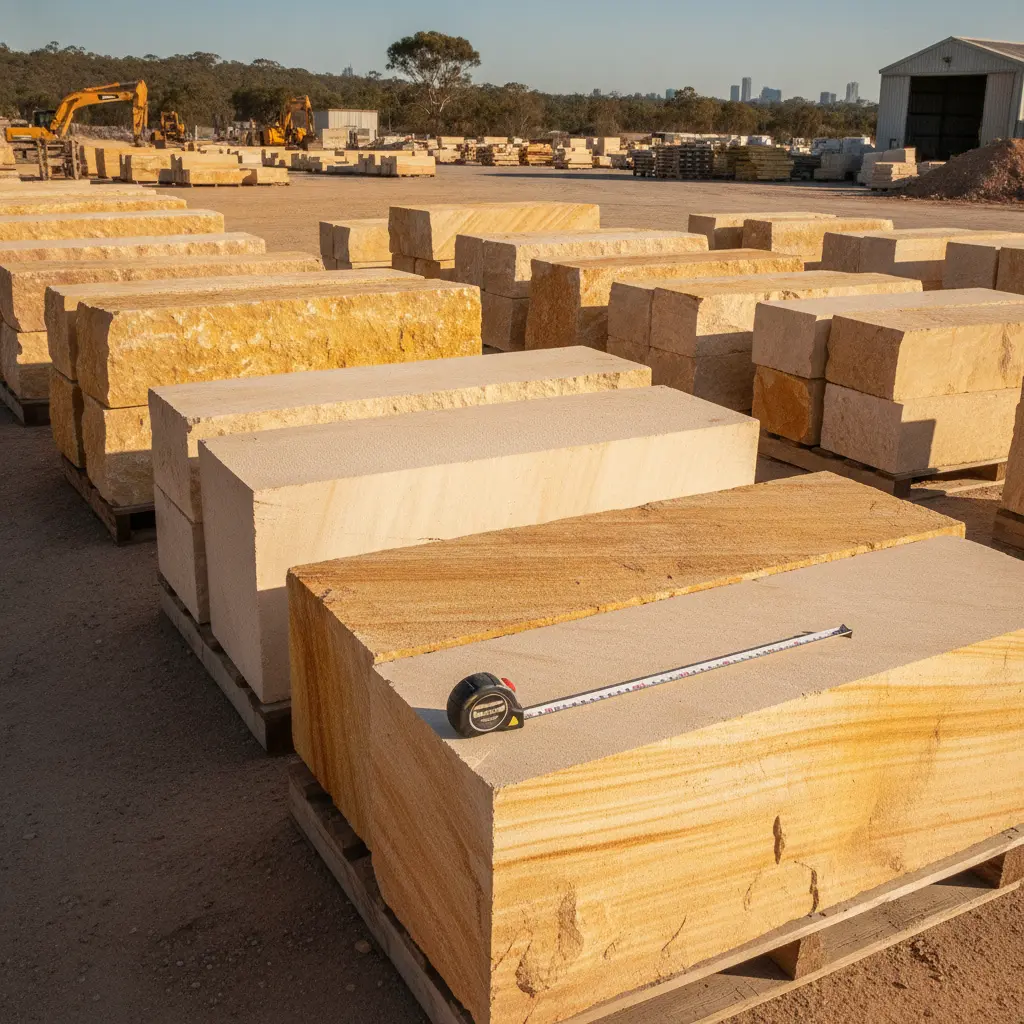
Standard sandstone blocks are 110mm wide (the bedwidth) and 100, 150, 200 or 250mm high, plus a 300mm-high block at 130mm bedwidth. Lengths vary because blocks are random length. Sandstone weighs about 2,300 kg/m³, so a 110 x 200 x 400mm block weighs roughly 20kg, and every square metre of 110mm-thick wall face weighs about 253kg.
- Weight formula: length x width x height (in metres) x 2,300 = kilograms.
- Typical block: 110 x 200 x 400mm is about 20kg.
- Wall weight: about 253kg per m² of 110mm wall, or roughly 4m² of wall face per tonne.
- Pallets: rough squared blocks come 4 layers to a pallet, covering 4m² of wall face.
- Logs: a 300 x 300mm split log weighs about 207kg per metre.
What are the standard sandstone block sizes?
The standard bedwidth of a sandstone block is 110mm, the same as the width of a standard brick, so sandstone walls line up with brick and blockwork. Heights are 100, 150, 200 and 250mm, plus a 300mm-high block with a 130mm bedwidth. Lengths are random, so blocks are sold by the square metre of wall face rather than by the piece.
| Block type | Face | Size | Guide price (from) |
|---|---|---|---|
| Rockfaced blocks | Traditional chiselled, pitched face | 110mm bed; 100–250mm high; 300mm high at 130mm bed | $180/m² of wall face |
| Hydrasplit blocks | Machine-split face | Same dimensions as rockfaced | $190/m² |
| Sawn all round blocks | Diamond-sawn on all six sides | Same standard sizes; can be cut to size | $250/m² |
| Rough squared blocks | Roughly squared, natural faces | Roughly one-man size, varied | $120/m² of wall face |
| Large rough squared blocks | Rough, usually one sawn side | 2–3 man size | By quote |
| Sandstone billets | Large format | Machine-placed pieces | By quote |
Final pricing depends on quantity, finish and delivery.
How heavy is a sandstone block?
Sandstone weighs about 2.2–2.4 tonnes per cubic metre, and 2,300 kg/m³ is a fair working figure. Multiply the block’s dimensions in metres and then by 2,300. For a 110 x 200 x 400mm block: 0.11 x 0.2 x 0.4 = 0.0088m³, and 0.0088 x 2,300 = 20.24kg, or about 20kg.
| Bedwidth x height | 400mm long | 600mm long | Per lineal metre |
|---|---|---|---|
| 110 x 100mm | 10kg | 15kg | 25kg |
| 110 x 150mm | 15kg | 23kg | 38kg |
| 110 x 200mm | 20kg | 30kg | 51kg |
| 110 x 250mm | 25kg | 38kg | 63kg |
| 130 x 300mm | 36kg | 54kg | 90kg |
Weights are rounded and calculated at 2,300 kg/m³. Because the density of sandstone ranges from about 2,200 to 2,400 kg/m³, a real block can be roughly 4% lighter or heavier, and a wet block weighs a little more because the stone is porous. Blocks are random length, so use the per-metre column to scale: a 110 x 200mm block 500mm long is about half of 51kg, roughly 25kg.
How many sandstone blocks per square metre of wall?
Because lengths vary, it is easier to count courses and lineal metres than individual blocks. Each course covers the block height, so one square metre of wall face needs 1 ÷ block height (in metres) lineal metres of block.
| Block height | Courses per 1m of height | Lineal metres of block per m² | Blocks per m² (if 400mm long) | Weight per m² of wall face |
|---|---|---|---|---|
| 100mm | 10 | 10 | 25 | 253kg |
| 150mm | 6.7 | 6.7 | 16.7 | 253kg |
| 200mm | 5 | 5 | 12.5 | 253kg |
| 250mm | 4 | 4 | 10 | 253kg |
| 300mm (130mm bed) | 3.3 | 3.3 | 8.3 | 299kg |
These figures ignore mortar joints, which reduce the block count slightly; dry-laid walls use the full figure. The weight of a single-skin wall depends on its thickness, not its block height: 0.11m x 1m² x 2,300 = 253kg for every square metre of 110mm wall, so one tonne of blocks builds roughly 4m² of wall face. At 130mm bed, a square metre weighs about 299kg, or roughly 3.3m² per tonne.
Worked example: a garden wall 8m long and 800mm high has 6.4m² of face. In 200mm-high blocks that is 4 courses, or 32 lineal metres of block (8m x 4 courses). At 253kg per square metre, the blocks weigh about 6.4 x 253 = 1,619kg, roughly 1.6 tonnes. At the rockfaced guide price of $180/m², the stone starts from about $1,152 before capping, delivery and mortar.
Use the calculator below for your own wall, or open the sandstone block calculator on its own page. It works out courses, lineal metres, an approximate block count and the weight of stone, and pallets for rough squared blocks.
Calculator
Sandstone block wall calculator
- Courses
- 4
- 200mm per course
- Lineal metres of block
- 32.0 m
- Blocks (approx.)
- 80
- If they average 400mm long
- Wall face
- 6.40 m²
- About 253kg per m² at 110mm bed
- Approx. weight
- 1,619 kg
- About 1.62t, or 51kg per lineal metre
How much does a pallet of rough squared blocks cover?
Rough squared blocks are palletised in 4 layers, giving 4m² of wall face per pallet. You can also buy them loose by the tonne and hand-select from the bins at our Glenorie quarry. For a wall 10m long and 600mm high (6m² of face), you need 1.5 pallets, so order 2.
Rough squared blocks vary in depth, so pallet weight varies too. Every 100mm of block depth adds about 230kg per square metre of wall face. For example, if the blocks averaged 200mm deep, 4m² would weigh about 4 x 0.2 x 2,300 = 1,840kg, close to two tonnes. Check the actual pallet weight with us before collecting with a trailer, and always stay within your vehicle and trailer ratings.
How heavy are large sandstone blocks, billets and logs?
Weight climbs quickly as blocks get bigger, because it grows with all three dimensions. Large sandstone blocks are 2–3 man size: a 600 x 400 x 300mm block is 0.072m³, or about 166kg. That is why large blocks, billets and logs are placed with a machine.
- Billets are large-format sandstone for big retaining walls, commercial landscaping and features, and are always machine placed. A piece 1,200 x 600 x 600mm would weigh about 994kg, roughly a tonne. Ask us for the sizes currently in stock.
- Split logs are about 300 x 300mm in cross-section, so they weigh about 207kg per lineal metre; a 1.5m log is about 310kg. They can be installed with small machinery, and a single-skin log wall typically goes to about 1m before engineering is needed.
- Boulders are irregular, but a boulder that fills a 1m cube would weigh about 2.3 tonnes. See our guide to landscaping with sandstone boulders for size classes and placement.
Can one person lift a sandstone block?
Standard 110mm-bed blocks are made to be laid by hand, but they are heavier than they look. A 100 or 150mm-high block 400–600mm long weighs about 10–23kg. A 250mm-high block weighs about 25kg at 400mm long and 38kg at 600mm, and the 300mm-high block at 130mm bed about 36kg and 54kg. Safe Work Australia advises team lifts or mechanical aids for heavy loads. In practice that means:
- Having pallets delivered as close to the wall as possible; crane-truck delivery helps where access is difficult.
- Using block trolleys, lifting clamps or a small machine for large blocks and long lengths.
- Sharing heavy lifts between two people and not carrying blocks over uneven ground or up steps.
- Wearing gloves and safety boots, because sandstone edges are abrasive.
How to calculate the weight of any sandstone piece
- Measure length, width and height in millimetres.
- Convert to metres by dividing each by 1,000.
- Multiply them together to get cubic metres.
- Multiply by 2,300 to get kilograms (or by 2.3 for tonnes).
For example, a 1,500 x 400 x 150mm step tread is 1.5 x 0.4 x 0.15 = 0.09m³, or about 207kg. A 500 x 500 x 100mm pier cap is 0.025m³, or about 58kg.
Get sandstone blocks from Stone Front
Every block size above is quarried, split and sawn at Glenorie and delivered across greater Sydney, including by crane truck. Compare types and colours on our sandstone blocks Sydney page, then send your wall length and height for a block quote with delivery.
Frequently Asked Questions
How many sandstone blocks are in a tonne?
About 49 blocks of 110 x 200 x 400mm, since each weighs roughly 20kg at 2,300 kg/m³. Because block lengths vary, it is more useful to think in wall area: one tonne of 110mm-bed blocks builds roughly 4m² of single-skin wall face, whatever the block height.
Can sandstone blocks be cut to size?
Yes. Custom cutting to size is done at the Glenorie quarry. Sawn all round blocks are diamond-sawn on all six faces, so they can be cut to exact lengths and heights for steps, seats, piers and modern walls. Rockfaced and hydrasplit blocks come in the standard 110mm bed heights.
What size sandstone blocks are used for retaining walls?
Low garden walls are often built from standard 110mm-bed blocks or rough squared blocks. Taller retaining walls need heavier, deeper stone such as large rough squared blocks, billets or split logs, and engineering. Most NSW councils require approval above a set height, so check with yours before you start.
What is the difference between a sandstone block and a billet?
Standard blocks are made to be laid by hand, with a 110mm or 130mm bedwidth and heights from 100 to 300mm. Billets are large-format pieces for big retaining walls, commercial landscaping and features, and are always placed by machine. A billet 1,200 x 600 x 600mm would weigh about a tonne.
Do sandstone blocks need mortar?
Most rockfaced, hydrasplit and sawn block walls are laid in mortar so the courses stay true. Rough squared blocks are often dry-stacked for low garden walls, where the weight of the stone holds them in place. Retaining walls that need engineering should be built to the engineer’s specification.
Products Mentioned in This Article
Rockfaced Blocks
Traditional rockfaced finish blocks for walls, edging and complete homes.
Hydrasplit Blocks
Modern split-face blocks for contemporary walling projects.
Rough Squared Blocks
Economical blocks for retaining walls and garden projects.
Sawn All Round Blocks
Premium diamond-sawn blocks with a beautiful finish on all 6 sides.
Sandstone Billets
Large sandstone billets for retaining, landscaping and structural applications.