Sandstone Stepping Stones: Sizes, Spacing and How to Lay Them
How big, how thick and how far apart sandstone stepping stones should be, which stone to use, and how to set steppers in lawn or gravel.
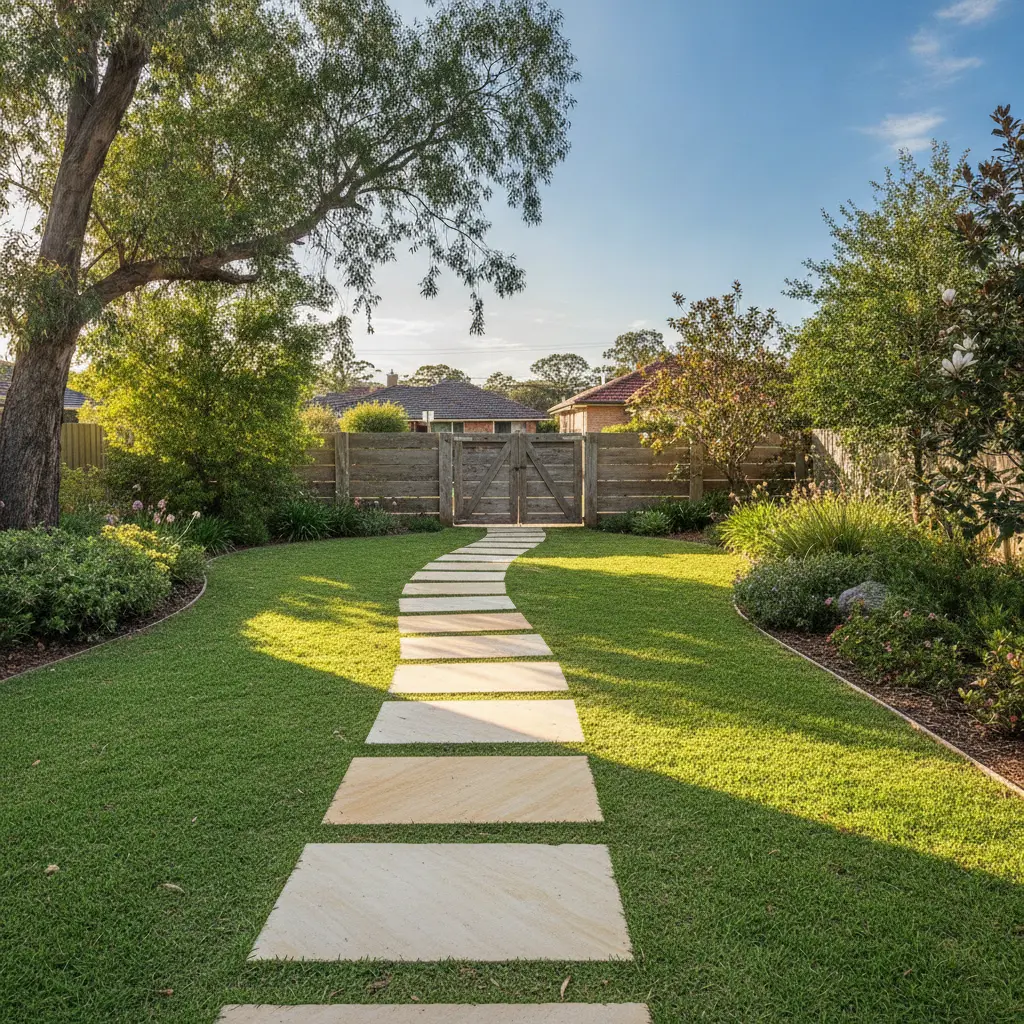
Sandstone stepping stones (also called sandstone steppers) are individual slabs laid through a lawn, gravel area or garden bed to make a walkable path without full paving. For a natural stride, space them about 600–650mm centre to centre, use pieces at least 400mm across and about 50mm thick, and set the tops level with or just below the surrounding lawn so a mower passes over.
- Spacing: 600–650mm centre to centre for adults; about 1.6 stones per metre of path.
- Size: 400x400, 600x400 and 600x600mm are common, and pavers can be cut to any size.
- Thickness: 50mm for foot traffic; 75–100mm where a vehicle may cross.
- Price: sawn all round pavers from $120/m², sawn flagging from $85/m² (guide prices).
What size should sandstone stepping stones be?
A stepping stone needs to be big enough to take a whole foot comfortably and heavy enough not to rock. Pieces of 400mm or more across work for most paths, and larger slabs make a bolder, more contemporary statement. Thickness matters more in loose materials like gravel, where a thin stone can tilt.
| Where | Typical size | Thickness | Suitable stone |
|---|---|---|---|
| Path across a lawn | 400x400 to 600x400mm | 50mm | Sawn all round pavers |
| Statement steppers | 600x600mm or larger, cut to size | 50mm | Sawn all round pavers |
| Gravel or pebble path | 400x400 to 600x600mm | 50–75mm | Sawn all round pavers or sawn flagging pieces |
| Bush or cottage garden | Irregular pieces, 400mm+ across | 50–75mm | Handsplit flagging or large sawn flagging pieces |
| Across a driveway strip | 600x400mm or larger | 75–100mm on a concrete base | Sawn all round pavers (vehicle thickness) |
You can see the full range of slab sizes on our sandstone paving slabs Sydney page.
How far apart should stepping stones be?
Space stepping stones about 600–650mm centre to centre, measured from the middle of one stone to the middle of the next. That matches a relaxed adult stride, so you land on each stone without stretching or shuffling. With 400mm stones, that leaves a gap of 200–250mm between them; with 600x400mm stones laid across the path (400mm along the line of travel), the gap is the same 200–250mm.
- Check your own stride: walk the route on damp grass or sand at a normal pace and measure between footprints.
- For children or older visitors: close the spacing to around 500–550mm.
- How many stones: at 625mm centres you need about 1.6 stones per metre, so a 10m path takes 16 stones.
- Meandering paths: keep the centre-to-centre spacing the same through the bends, and stagger stones slightly left and right for a natural walking line.
Which sandstone should you use for stepping stones?
That depends on the style of garden. There are three main options, all quarried at Glenorie.
Sawn all round pavers
Sawn all round pavers are diamond-sawn on all six faces, so every stepper is the same size and thickness and sits flat. They are 50mm thick as standard (75 or 100mm for vehicle areas) and can be cut to any size. As a rough guide at $120/m², a 400x400mm stepper is 0.16m² of stone, or about $19 each before cutting and delivery. They suit modern and formal gardens.
Sawn flagging pieces
Sawn flagging is irregular pieces with diamond-sawn edges, 50, 75 or 100mm thick, from $85/m². Picking out the larger pieces gives a stepping-stone path with a looser, organic outline that matches crazy paving elsewhere in the garden.
Handsplit flagging
Handsplit flagging has a natural split surface and edges, sold in 10m² pallets. The regular grade (50–75mm) suits stepping stones in cottage, bush and native gardens where you want the stone to look like it has always been there.
How to lay stepping stones in a lawn
- Lay out the stones on the grass. Walk the route a few times and adjust spacing until it feels natural.
- Mark around each stone. Cut around the outline with a spade or half-moon edger, then lift the stone aside.
- Dig out the turf and soil. Dig to the stone’s thickness plus 30–50mm for bedding, so a 50mm stone needs a hole about 80–100mm deep.
- Firm the base. Tamp the bottom of the hole flat. On soft or sandy soil, add 25mm of compacted crushed rock first.
- Add bedding sand. Spread 20–30mm of 20mm minus fill sand, or a sand and cement mix if you want the stones fixed.
- Set the stone. Bed it down with a rubber mallet so the top sits 10–20mm below the turf. A mower can then pass straight over.
- Check level and rock. Stand on each corner. If it rocks, lift it and adjust the bedding.
- Backfill the edges. Fill any gaps with soil, firm it and water in. The grass will close up to the stone within a few weeks.
How to lay stepping stones in gravel or garden beds
In gravel, the stepping stones need a firmer base because the surrounding surface moves. Excavate the whole path, compact 50–75mm of crushed sandstone (75mm minus) as a base, lay weed mat, and set each stone on a mortar or sand-cement pad so it can’t tilt. Then spread the gravel so it finishes 10–15mm below the stone surface. Crushed sandstone in 75mm minus and 150mm minus, and 20mm minus fill sand for bedding, is available from our crushed sandstone Sydney page.
In mulched garden beds, sit the stones on compacted soil with a sand bed and keep the mulch below the stone surface so it doesn’t wash over and stain the stone.
Stepping stone path ideas
- Ladder path: 600x400mm stones laid across the path at regular spacing, like the rungs of a ladder. Clean and contemporary.
- Offset pairs: two smaller stones side by side, staggered, for a wider path through a lawn.
- Steppers in pebbles: large sawn slabs floating in river pebbles or crushed sandstone, finished with sandstone garden edging to keep the gravel in place.
- Mixed sizes: alternating 600x600mm and 400x400mm stones for a more playful rhythm.
- Steppers that lead to steps: run the stones up to a set of block or boulder steps; see our guide on how to build sandstone steps.
Common stepping stone mistakes
- Stones too small or too thin. Pieces under about 300mm across feel awkward underfoot, and thin stones crack or tilt in soft ground.
- Setting stones proud of the lawn. A stone sitting above the turf catches mower blades and becomes a trip hazard.
- Laying straight onto grass. Without removing the turf and adding a sand bed, stones sink unevenly within a season.
- Uneven spacing. Stones that are too far apart or vary in spacing make people step on the lawn instead, wearing a track beside the path.
- Ignoring drainage. In low, wet spots, raise the whole path slightly or improve drainage first, or the stones will sit in water.
How much do sandstone stepping stones cost?
Stone cost depends on size and type. Sawn all round pavers start from $120/m² and sawn flagging from $85/m² (guide prices); handsplit flagging is priced by quote. A 10m path of 16 stones at 400x400mm uses about 2.6m² of stone, so the stone itself is a modest part of the job. Final pricing depends on quantity, cutting and delivery. Laying stepping stones is one of the easier DIY stone jobs; if you hire a landscaper, ask for a price per stone or per metre of path.
How do you look after sandstone stepping stones?
Sandstone is porous, so stones in shady, damp lawns can grow moss and algae. A penetrating (impregnating) sealer reduces this, typically resealed every 2–3 years outdoors. Scrub with water and a stiff brush or a stone-safe cleaner, and never use acid cleaners, which etch the surface. Keep the turf trimmed back from the edges so grass doesn’t creep over the stone.
Order sandstone stepping stones from Stone Front
We cut sandstone pavers and slabs to size at our Glenorie quarry, and you are welcome to visit and hand-select flagging pieces from the bins. Tell us the size, thickness and number of stones you need through our quote form; final pricing depends on quantity, finish and delivery across greater Sydney.
Frequently Asked Questions
What is the difference between stepping stones and steppers?
There is no difference: steppers is a common Australian trade name for stepping stones. Both describe individual pavers or slabs set apart in a lawn, gravel area or garden bed. Sandstone steppers are usually 400x400 to 600x600mm and about 50mm thick for foot traffic.
Can I put stepping stones on top of grass without digging?
Only as a temporary path. Stones laid on top of grass sink unevenly, rock underfoot and catch mower blades. For a permanent path, remove the turf, dig to the stone thickness plus 30–50mm, add a sand bed and set each stone 10–20mm below the lawn.
Are sandstone stepping stones slippery?
Sawn sandstone has a fine, even texture that is comfortable underfoot, and handsplit stone has more natural texture. Any stone can become slippery when moss or algae grows on it in shady, damp lawns, so keep stones clean, trim grass back from the edges and seal them to reduce water uptake.
How long does it take to lay a stepping stone path?
A 10m lawn path of about 16 stones is typically a one-day DIY job: lay out and walk the route, cut and dig each hole, bed the stones in sand and backfill. Gravel paths take longer because the whole path needs excavating, a compacted base and weed mat before the stones and gravel go down.
Can I get sandstone stepping stones cut to a custom size in Sydney?
Yes. Stone Front cuts sawn all round pavers to size at its Glenorie quarry, from standard 400x400mm steppers to large statement slabs. You can also visit to hand-select flagging pieces from the bins, Monday to Friday 7:00am–3:30pm and Saturday 8:00am–midday.