How to Build Sandstone Steps: Sizes, Materials and Step-by-Step Guide
Riser and tread sizes, the 2R + G rule, blocks vs solid treads vs boulders, and a step-by-step guide to building sandstone steps that last.
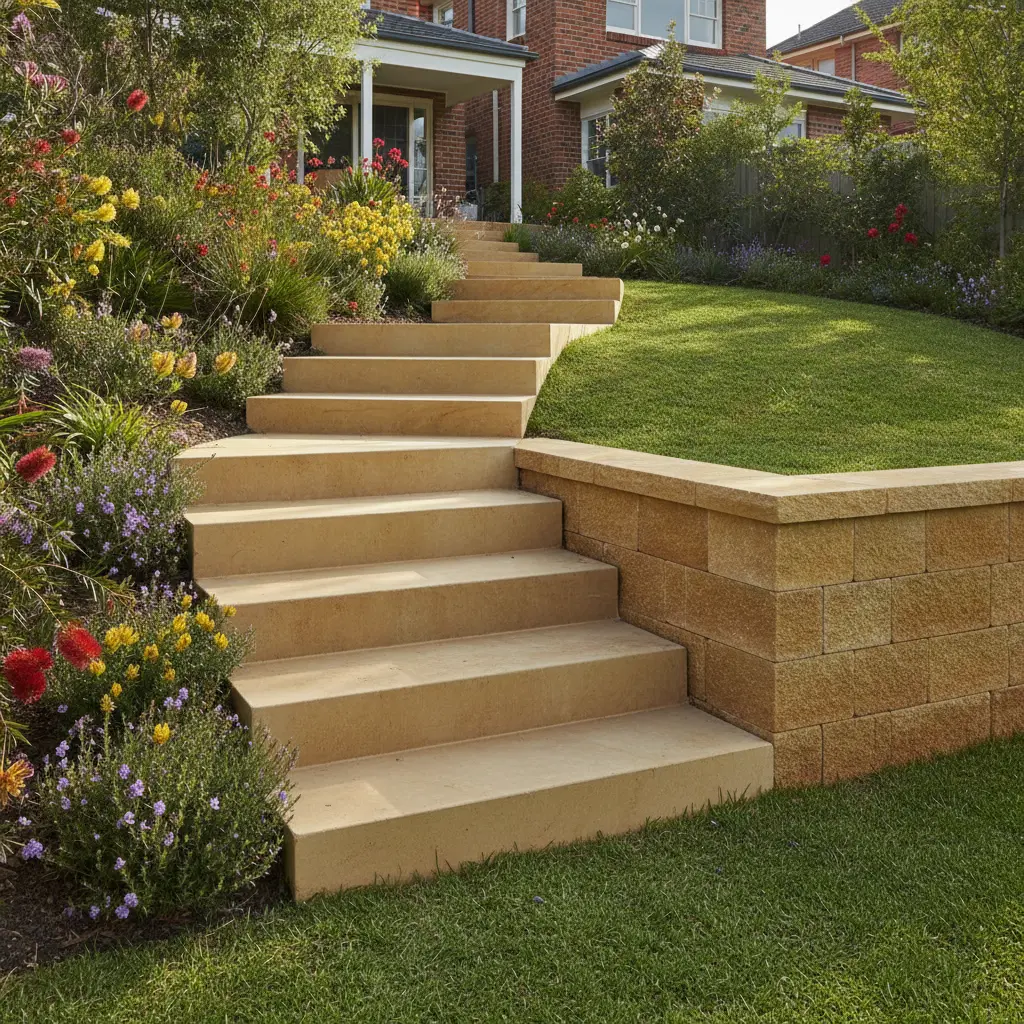
To build sandstone steps, first work out a comfortable rise and going: most outdoor steps sit at 150–180mm high and 300–400mm deep, checked with the rule that twice the riser plus the going (2R + G) should land between 600 and 650mm. Then build each step from the bottom up on a compacted or concrete base, using sandstone blocks, solid treads or boulders.
- Comfortable riser: 150–180mm. Keep every riser in a flight the same height.
- Comfortable going (tread depth): 300–400mm or more for garden steps.
- Check rule: 2R + G ≈ 600–650mm (for example 2 x 150 + 330 = 630mm).
- Block sizes: sandstone blocks are 110mm bedwidth in heights of 100, 150, 200 and 250mm, so a 150mm block makes one riser.
- Guide prices: rockfaced blocks from $180/m² of face, sawn all round blocks from $250/m²; bullnosed treads and boulders by quote.
How high and deep should outdoor sandstone steps be?
Outdoor steps feel comfortable when they match a normal walking stride. The 2R + G rule captures this: two risers plus one going should add up to roughly 600–650mm. Lower risers need deeper treads, which is why garden steps are often shallower and longer than indoor stairs.
| Riser (R) | Going (G) | 2R + G | How it feels |
|---|---|---|---|
| 100mm | 450mm | 650mm | Very gentle; good for long, low garden slopes |
| 125mm | 400mm | 650mm | Relaxed garden steps |
| 150mm | 300–350mm | 600–650mm | Comfortable everyday steps; matches a 150mm block |
| 165mm | 300mm | 630mm | Compact flight where space is tight |
| 180mm | 300mm | 660mm | Upper limit; fine for short flights |
How many steps do I need?
Measure the total rise from the bottom ground level to the top ground level. Divide it by your target riser height, round to a whole number of steps, then divide the total rise by that number to get the exact riser. For example, a 750mm rise ÷ 165mm = 4.5, so use 5 risers of 150mm each. Five risers give four treads plus the top landing; at a 330mm going that is a horizontal run of about 1,320mm. If the run doesn’t fit, use fewer, taller risers or add a turn or landing.
Which sandstone should you use for steps: blocks, solid treads or boulders?
There are three common ways to build sandstone steps. Blocks give a crisp, built look and are the usual DIY choice; a solid bullnosed tread over block risers is the most finished option; boulders suit natural gardens and steep banks.
| Option | How it is built | Look | DIY difficulty | Guide price |
|---|---|---|---|---|
| Sawn all round blocks | 150mm-high blocks form each riser; three or four 110mm-wide blocks laid back to back, or a paver on top, form the tread | Crisp, formal, square edges | Moderate | From $250/m² of face |
| Rockfaced blocks | Same dimensions as sawn blocks with a chiselled, pitched riser face | Traditional, textured | Moderate | From $180/m² of face |
| Solid bullnosed treads | A single slab tread with a rounded front edge, set over block or concrete risers | Finished, architectural | Moderate to hard (heavy pieces) | By quote (stonemasonry) |
| Boulder steps | Large flat-topped boulders bedded into the slope, each one overlapping the one below | Natural, bush garden | Hard; usually machine placed | By quote |
| Split logs | 300x300mm logs set partly into the slope as risers, with gravel or pavers behind as the tread | Chunky, rustic | Moderate; small machinery helps | By quote |
Sawn all round blocks are diamond-sawn on all six faces, so treads are flat and joints are tight. Rockfaced blocks have the same dimensions but a hand-pitched face for a heritage look. Bullnosed stair treads are made to order through our custom stonemasonry service. Sizes, options and photos for all of these are on our sandstone steps Sydney page.
What you need to build sandstone steps
- Sandstone blocks, treads or boulders (allow 5–10% extra for cuts)
- Crushed sandstone or road base for the sub-base, and concrete for footings
- Mortar (sand and cement) or a stone-rated construction adhesive
- String lines, pegs, a spirit level or laser level, tape and a straight edge
- Plate compactor or hand tamper, shovel, rubber mallet
- Wet-cutting diamond saw, gloves, eye protection and a P2 respirator (sandstone dust contains crystalline silica, so cut wet)
How to build sandstone block steps, step by step
Step 1: Measure and set out
Measure the total rise and the space available for the run, then work out your riser and going as above. Drive a peg at the bottom and top, run a string line at finished height and mark where the front edge (nosing) of each step will sit.
Step 2: Excavate the slope
Cut the slope into a rough staircase shape, slightly deeper and wider than the finished steps. Each step needs firm, undisturbed ground or well-compacted fill under it.
Step 3: Build the bottom footing
The bottom riser carries the most load, so sit it on a concrete footing or at least 100mm of compacted crushed sandstone or road base. Check it is level side to side.
Step 4: Lay the first riser
Bed the first row of blocks on mortar, tap them down to the string line and check level along the length. Build in a slight fall to the front, around 1:100, so water runs off each tread instead of pooling.
Step 5: Backfill and compact behind the riser
Fill behind the blocks with crushed sandstone or road base in thin layers, compacting each layer. This compacted fill supports the tread and the next riser.
Step 6: Lay the tread
Either lay three or four blocks (110mm bedwidth each) back to back to make up a 330–440mm going, or bed a solid tread or 50mm paver over the riser and fill. Let a solid tread overhang the riser by 20–30mm to create a shadow line and a clear nosing.
Step 7: Set the next riser on the back of the tread
The next riser sits on the back 50–100mm of the tread below, which locks the flight together. Repeat steps 4–7 up the slope, checking every riser height with a gauge stick.
Step 8: Finish, clean and seal
Point any open joints, sponge off mortar from the faces as you go, and once the steps are dry apply a penetrating sealer. Reseal outdoors every 2–3 years and avoid acid cleaners.
How to build boulder steps
Boulder steps use large, flat-topped boulders placed one above another, each one overlapping the boulder below by 100–150mm. Start at the bottom with the largest stone bedded well into the ground, then backfill and compact behind it before placing the next. Because boulders vary, ask to hand-select pieces with flat tops at the quarry. Large stones are usually placed with an excavator; we deliver across greater Sydney, including crane-truck delivery for difficult access.
How do you make sandstone steps safe?
- Keep risers equal. A variation of more than a few millimetres between steps is a trip hazard.
- Choose a grippy surface. Use a sawn, natural split or sandblasted finish on treads rather than a honed one, and keep treads clear of moss.
- Add a handrail on longer flights. If steps are part of the main access to a house, building rules on handrails and balustrades may apply, so check with your council or certifier.
- Light them. Low-glare step lights make edges visible at night; see how many step lights you need.
How much do sandstone steps cost?
Material cost depends on the stone, the width of the steps and the number of risers. Blocks are priced per square metre of face: rockfaced from $180/m² and sawn all round from $250/m² (guide prices). Solid bullnosed treads and boulders are priced by quote. Labour often costs more than the stone on a flight of steps; landscapers and stonemasons typically quote per step or per day, so get two quotes and ask whether footings, fill and sealing are included. Finish the area around the steps with matching sandstone garden edging for a tidy look.
Get sandstone for your steps from Stone Front
We quarry, saw and split blocks, treads and boulders at Glenorie and can cut pieces to your riser and tread sizes. Send us your total rise and step width through our quote form and we will work out quantities and delivery; final pricing depends on quantity, finish and delivery.
Frequently Asked Questions
Can I build sandstone steps myself?
Yes, a short flight of block steps in a garden is a realistic DIY job if you can handle heavy blocks and use a level and plate compactor. Large solid treads, boulder steps and long flights usually need machinery and a landscaper. Steps forming the main access to a house may need to meet building rules, so check with your council.
What is the difference between sandstone steps and sandstone stairs?
In everyday use they mean the same thing. Steps usually describes a few outdoor steps on a garden slope, while stairs more often means a longer flight. Construction is the same: equal risers of 150–180mm, a going of 300–400mm and a firm, compacted or concrete base under every step.
How wide should outdoor steps be?
Around 900mm is a practical minimum for one person, while 1,200–1,500mm lets two people pass and feels more generous in a garden. Wider steps need more stone, so estimate material per riser: each step’s face area is its width multiplied by the riser height, for example 1.5m x 0.15m = 0.225m².
Do sandstone steps need a concrete footing?
The bottom step should sit on a concrete footing or at least 100mm of compacted crushed sandstone or road base, because it carries the most load. Upper steps can sit on compacted fill and the back of the tread below. Large flights, steps built on fill and steps on reactive clay should be checked by an engineer.
Can sandstone for steps be delivered to a steep or tight site?
Yes. Stone Front delivers across greater Sydney, including crane-truck delivery for difficult access such as steep blocks, narrow side passages and sites where stone has to be lifted over a house or fence. Mention the access when you request a quote so the right truck is booked.
Products Mentioned in This Article
Sawn All Round Blocks
Premium diamond-sawn blocks with a beautiful finish on all 6 sides.
Rockfaced Blocks
Traditional rockfaced finish blocks for walls, edging and complete homes.
Custom Stonemasonry
Bespoke sandstone pieces: bullnosing, caps, benches, letterboxes and more.
Sandstone Boulders
Natural boulders from gabion-size to large feature rocks.