Sandstone Driveways: Which Stone, How Thick, What Base and Cost
Planning a sandstone driveway: 75mm vs 100mm pavers, sawn modular vs flagging vs track handsplit, the base underneath, crushed sandstone driveways, edging and cost.
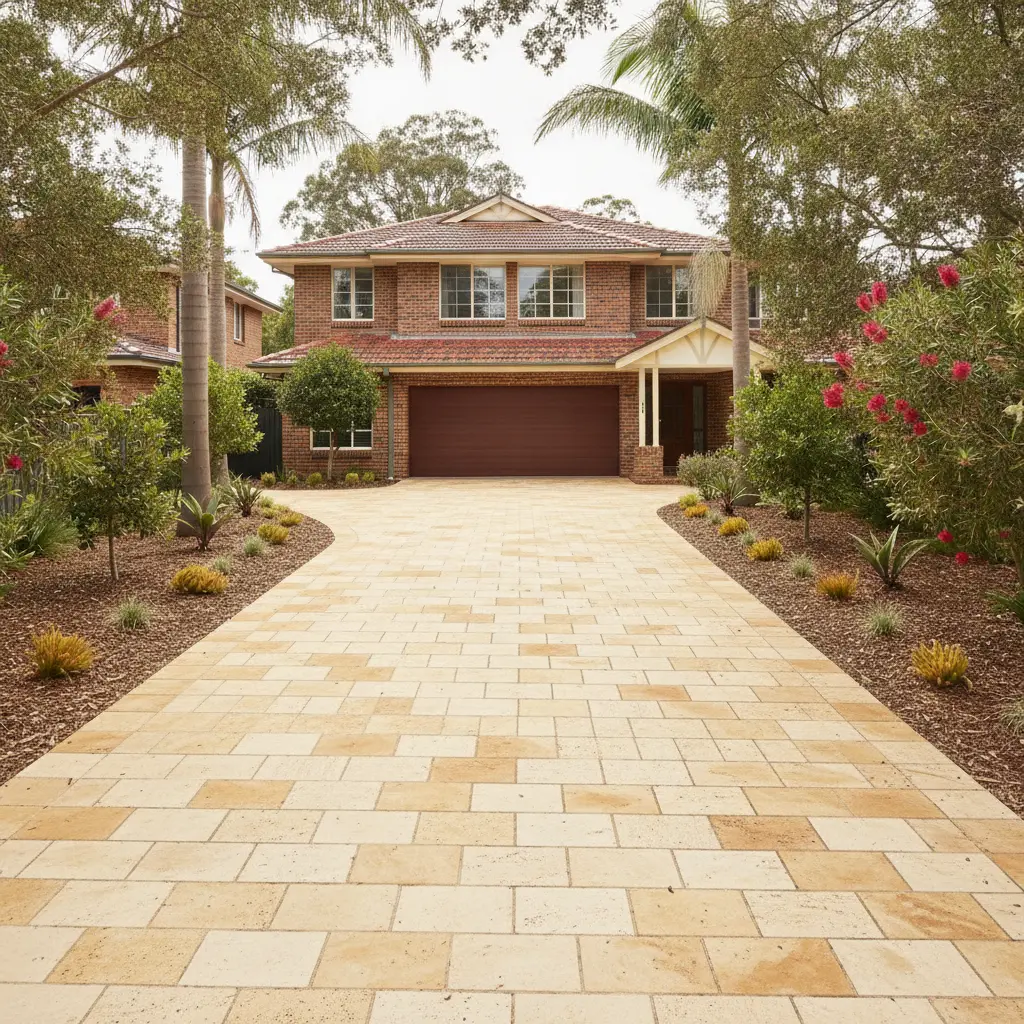
A sandstone driveway needs 75mm-thick stone at minimum, or 100mm for heavier vehicles and steep drives, laid on a 150–200mm compacted road base or a reinforced concrete slab. Choose sawn modular paving for a structured look, sawn flagging for crazy paving, or track handsplit flagging for a heritage finish, all available in driveway thicknesses. For rural and bush driveways, compacted 75mm minus crushed sandstone can be the finished surface.
- Thickness: 75mm for cars, 100mm for heavier vehicles or steep driveways. Never 50mm.
- Base: 150–200mm compacted road base, or a reinforced slab on clay soils and steep sites.
- Stone: sawn modular paving, sawn flagging or track handsplit flagging (75–100mm).
- Pattern: interlocking layouts such as herringbone spread wheel loads best.
- Weight: about 173kg per m² at 75mm and 230kg per m² at 100mm.
Which sandstone suits a driveway?
Three Stone Front products are stocked in driveway thicknesses. They differ mainly in look and how they are laid.
| Option | Thickness | Look | Laying | Guide price |
|---|---|---|---|---|
| Sawn modular paving | 75mm or 100mm | Structured rectangles, contemporary | Mortar or screed bed; herringbone or stretcher | By quote (50mm from $65/m²) |
| Sawn flagging | 75mm or 100mm | Crazy paving with sawn edges | Mortar bed, pointed joints | By quote (50mm from $85/m²) |
| Track handsplit flagging | 75–100mm | Traditional riven face, heritage | Mortar bed, pointed joints | By quote |
| Crushed sandstone | Compacted 75mm minus | Natural, rural, bush | Spread in layers and compacted | By quote per tonne |
Sawn modular paving is a by-product of sawing other products, which is why it is the most economical sawn paver. Track handsplit flagging is the heavy grade of handsplit and suits period homes where a split finish matches the house. If you prefer brick, our recycled brick driveway guide covers bricks laid on edge in herringbone.
How thick should a sandstone driveway be?
Thickness is the single most important decision. Use 75mm minimum for cars on a well-compacted base and 100mm for heavier vehicles, steep driveways or where the base is less certain. Standard 50mm pavers are for foot traffic: they suit the front path beside the driveway, not the wheel tracks.
Thicker stone is heavier, which matters for delivery. Sandstone weighs about 2,300kg per cubic metre:
- 75mm stone weighs about 173kg per m², so a 40m² driveway is about 6.9 tonnes of stone.
- 100mm stone weighs about 230kg per m², so the same driveway is about 9.2 tonnes.
That is more than one pallet and often more than one truck, so plan where the stone will be set down. Our sandstone delivery guide covers pallets, cranes and access.
What goes under a sandstone driveway?
A driveway is only as good as its base. A typical residential build-up, from the bottom:
- Firm subgrade: remove topsoil and soft material down to firm ground.
- Base: 150–200mm of compacted road base, placed and compacted in layers, or a reinforced concrete slab on clay soils and steep sites.
- Bedding: a mortar or flowable screed bed.
- Stone: 75–100mm pavers or flagging, with joints filled or pointed.
Crushed sandstone from the same quarry makes a free-draining base: 150mm minus to build up a level, then 75mm minus on top. Compacted crushed sandstone weighs about 1.8–2.0 tonnes per cubic metre, so a 40m² driveway with a 150mm base needs 6m³, or roughly 11–12 tonnes. The crushed sandstone calculator works this out layer by layer, and our crushed sandstone guide explains the grades.
Give the driveway a fall so water runs off, and direct it away from the house and garage. Have an engineer confirm the base for steep or heavily used driveways, and check your council’s rules before changing the crossover at the kerb.
Which pattern is strongest for a driveway?
Interlocking patterns such as herringbone spread wheel loads and resist creeping better than stack bond, which has continuous joints in both directions. A 45° herringbone also hides small movements well. Herringbone uses more cuts, so allow 10–15% extra stone, compared with about 5% for stack or stretcher bond. Crazy paving in sawn or track handsplit flagging is locked together by its mortar bed and pointed joints. Our guide to sandstone paving patterns compares all eight common layouts.
Can I have a crushed sandstone driveway?
Yes, and it is the simplest sandstone driveway. 75mm minus crushed sandstone compacts into a firm, free-draining surface used on rural and bush driveways. Spread it in layers of about 50–75mm, dampen each layer and compact it with a plate compactor or roller. Where the ground needs building up, place 150mm minus first. A crushed surface suits flat and gently sloping driveways; on steep sections, running water scours it, so consider paving the steepest part. Top up low spots after heavy rain.
How should a sandstone driveway be edged?
Edges stop the paving creeping outward and give the driveway a finished line:
- Sawn or hydrasplit edging set in a concrete haunch along each side. Sandstone edging starts from $35 per lineal metre.
- Track handsplit flagging set on edge, whose extra bedwidth makes a deep, solid border.
- A soldier course of the same pavers, laid across the line of the driveway.
- Sandstone boulders spaced along a verge to stop cars cutting the corner.
Our garden edging guide shows how to lay edging in a haunch.
How much does a sandstone driveway cost?
Driveway-grade stone in 75mm and 100mm is priced by quote, because thickness, colour selection and quantity all move the price. For reference, 50mm sawn modular paving starts from $65/m² and 50mm sawn flagging from $85/m² (guide prices, ex-quarry); thicker stone costs more per square metre because there is more stone in it.
To budget the whole job, add:
- Stone, plus 5–15% depending on the pattern.
- Base material: crushed sandstone or road base, or a concrete slab.
- Bedding and pointing: mortar or screed.
- Edging by the lineal metre.
- Delivery: priced by suburb and access; ordering the stone and base on one delivery saves a second trip.
- Installation: excavation, base, laying and sealing by your landscaper or paver.
How do I look after a sandstone driveway?
Seal the surface with a penetrating sealer once it is clean and fully dry; sealing reduces staining and makes cleaning easier. Reseal every 2–3 years outdoors. Clean up oil drips promptly and never use acid cleaners on sandstone. Our guides to sealing sandstone and cleaning sandstone cover products and methods.
Get your quote from Stone Front
Stone Front supplies driveway-grade sandstone and the crushed sandstone base from one quarry at Glenorie, on one delivery where possible. Get an exact quote from Stone Front: tell us the product, quantity and your suburb at stonefront.com.au/get-a-quote and we usually reply the same business day. Include the driveway area, the thickness you want and a photo of the access. See the full range on our sandstone driveway pavers page.
Frequently Asked Questions
How thick should sandstone be for a driveway?
Use 75mm minimum for cars on a well-compacted base, and 100mm for heavier vehicles, steep driveways or where the base is less certain. 50mm sandstone is for foot traffic only and should not be used where vehicles drive.
What base goes under a sandstone driveway?
A typical residential build-up is 150–200mm of compacted road base, or a reinforced concrete slab on clay soils and steep sites, then a mortar or screed bed and the 75–100mm stone. Have an engineer confirm the base for steep or heavily used driveways.
Can crushed sandstone be used as a driveway surface?
75mm minus crushed sandstone compacts into a firm, free-draining surface and is used as the finished surface on rural and bush driveways, as well as the base under paving. Where the ground needs building up, 150mm minus goes in first with 75mm minus on top.
Which paving pattern is strongest for a driveway?
Interlocking patterns such as herringbone spread wheel loads and resist creeping better than stack bond, which has continuous joints in both directions. Whatever the pattern, thickness and base matter most.
How much does a sandstone driveway cost?
Driveway-grade 75mm and 100mm sawn modular paving, sawn flagging and track handsplit flagging are priced by quote; for reference, 50mm modular starts from $65/m² and 50mm sawn flagging from $85/m². Add base material, delivery and installation, and get an exact supply quote from Stone Front with your area and suburb.
Products Mentioned in This Article
Sawn Modular Paving
Economical modular pavers with a smart, contemporary finish.
Sawn Flagging (Crazy Paving)
Natural irregular shapes with sawn edges for a classic, informal look.
Sandstone Edging
Define garden beds, pathways and driveways with natural sandstone edging.
Recycled Brick Pavers
Recycled bricks selected and prepared for paving applications.