Crushed Sandstone Guide: Grades, Paths, Quantities and Prices
What 75mm minus, 150mm minus and 20mm fill sand are for, how to calculate tonnes, how to build a crushed sandstone path and what affects price.
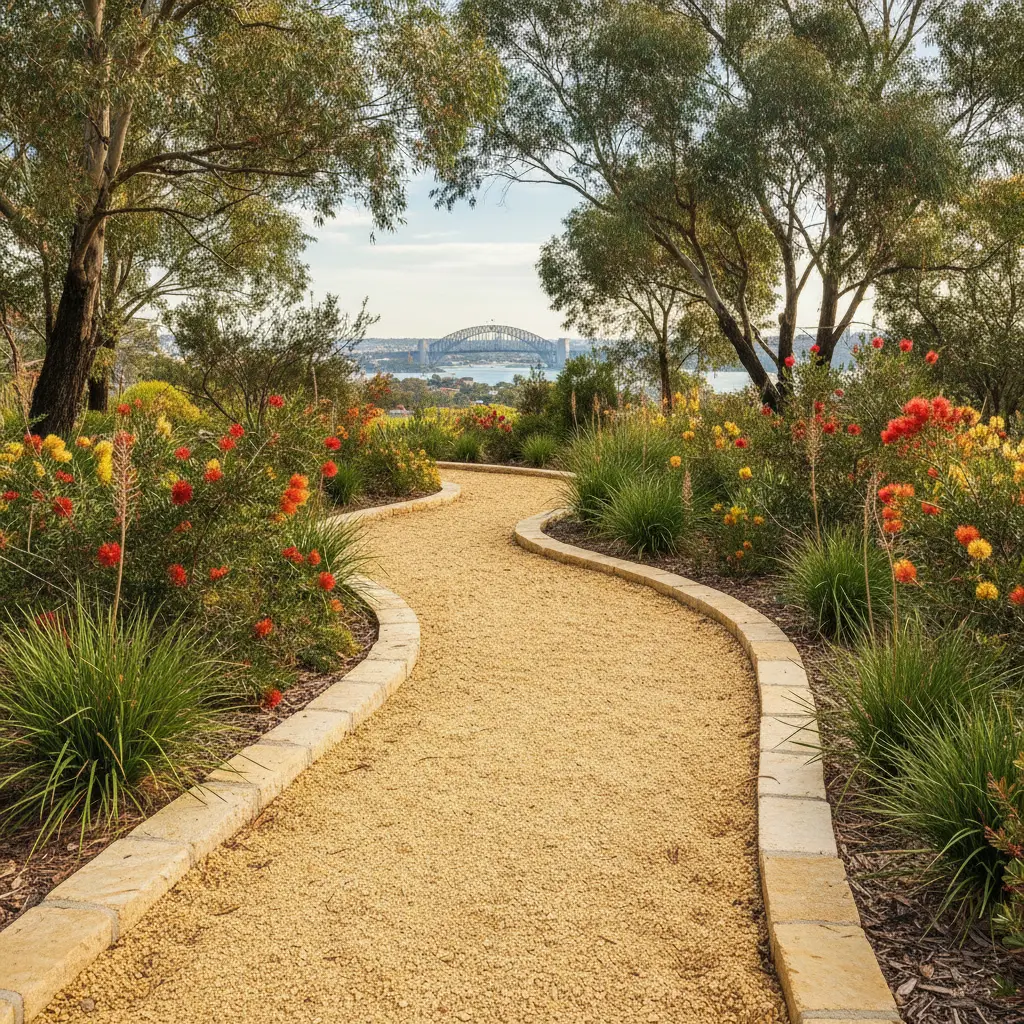
Crushed sandstone is quarried sandstone broken down into a graded mix of stone and fines that compacts into a firm, free-draining base. It comes as 75mm minus and 150mm minus for fill, road base, driveways, arenas, under slabs and native-garden paths, plus 20mm minus fill sand for bedding and trenches. To estimate how much you need, multiply area by depth by about 1.8–2.0 tonnes per cubic metre.
- Grades: 150mm minus (bulk fill), 75mm minus (base and paths), 20mm minus fill sand (bedding and trenches).
- Quantity rule of thumb: area (m²) x compacted depth (m) x 1.8–2.0 = tonnes.
- Example: a 10m x 1m path at 75mm deep needs about 1.35–1.5 tonnes.
- Price: by quote, based on tonnage, grade, delivery distance and access.
What is crushed sandstone?
Crushed sandstone is natural sandstone that has been put through a crusher at the quarry. “Minus” describes the grading: 75mm minus means every piece is 75mm or smaller, all the way down to sand and fines. That spread of sizes is what makes it useful. The fines fill the gaps between the larger pieces, so when the material is dampened and compacted it locks into a firm layer instead of staying loose like single-size gravel.
Ours is crushed at the Glenorie quarry from the same stone as our paving and blocks, so it is clean natural sandstone in warm cream and yellow tones, not recycled rubble.
Crushed sandstone grades and uses
| Grade | Size range | Typical uses | Notes |
|---|---|---|---|
| 150mm minus | 150mm down to fines | Bulk fill under slabs and building platforms, farm tracks, deep fill | Compact in layers; too coarse for a finished walking surface |
| 75mm minus | 75mm down to fines | Road base, driveway and paving sub-base, horse arenas, native-garden paths, retaining wall backfill | The all-rounder for bases and paths |
| 20mm minus fill sand | 20mm down to fines | Pipe bedding and trenching, sand blinding under slabs, paver bedding | Used by concreters, plumbers and electricians |
| Gabion spalls | 75–150mm screened stone | Gabion baskets, dry creek beds, drainage zones | No fines, so it drains freely and stays loose |
How much crushed sandstone do I need?
Work out the volume, then convert it to tonnes. Crushed sandstone is sold by the tonne, and compacted crushed material weighs roughly 1.8–2.0 tonnes per cubic metre. Treat this as an approximate rule of thumb: the real figure depends on grading, moisture and how hard the layer is compacted.
Tonnes = length (m) x width (m) x compacted depth (m) x 1.8–2.0
| Job | Dimensions | Volume | Approx. tonnes |
|---|---|---|---|
| Garden path | 10m x 1m x 75mm | 0.75m³ | 1.35–1.5t |
| Wider path | 20m x 1.2m x 100mm | 2.4m³ | 4.3–4.8t |
| Fill under a slab | 8m x 5m x 150mm | 6m³ | 10.8–12t |
| Driveway base | 30m x 3m x 150mm | 13.5m³ | 24.3–27t |
| Arena base layer | 20m x 40m x 100mm | 80m³ | 144–160t |
Remember to convert millimetres to metres (75mm = 0.075m). Allow a little extra for uneven ground and levelling, and use the depth your engineer, concreter or landscaper specifies for slabs and driveways. If one project needs more than one grade, for example 150mm minus to build up a level and 75mm minus on top, work out each layer separately and add them together so everything can be planned as one delivery. Send us the dimensions and we will confirm the tonnage in your quote.
The calculator below does the sum for you, layer by layer. It is also on its own page as the crushed sandstone calculator.
Calculator
Crushed sandstone tonnage calculator
- Area
- 10.00 m²
- Compacted volume
- 0.75 m³
- Crushed sandstone
- 1.35–1.50 t
- One tonne covers about 6.7–7.4m² at 75mm
How to build a crushed sandstone path
A compacted crushed sandstone path is one of the simplest and most natural-looking paths you can build in a Sydney garden, especially in native and bushland settings where the colour matches the local stone.
- Mark out the path. About 1m wide suits one person; 1.2–1.5m lets two people walk side by side.
- Excavate. Dig out roughly 100–150mm, removing roots and topsoil, and shape the base with a slight crossfall or crown so water runs off rather than along the path.
- Install edging. An edge stops the path spreading into garden beds. Sandstone edging (from $35 per lineal metre, guide price) suits the look; set it before you spread the base.
- Lay geotextile if needed. On clay or soft ground, a geotextile fabric under the path helps stop the base mixing into the soil.
- Spread 75mm minus in layers. Place it in layers of about 50–75mm, dampen each layer and compact it with a plate compactor before adding the next.
- Finish the surface. Rake larger stones off the top or top-dress with a thin layer of finer material such as 20mm minus fill sand, then water and compact again for a smoother walking surface.
- Maintain. Top up low spots after heavy rain and re-compact every so often.
Crushed paths suit flat and gently sloping ground. On steeper slopes, running water scours the surface, so break the path with steps or use stepping stones or paving on the steepest sections.
Crushed sandstone for driveways and under slabs
For driveways, 75mm minus compacts into a strong, free-draining base under paving or as the finished surface on rural and bush driveways. Where deeper fill is needed to build up a level, 150mm minus goes in first, topped with 75mm minus. Under slabs, follow the engineer’s or concreter’s specification for the fill and any sand blinding. The 20mm minus fill sand is commonly used for that blinding layer and for bedding pipes and conduits in trenches. Laying sandstone paving over a crushed sandstone base has a practical bonus: base and surface are the same material and behave the same way.
Crushed sandstone vs sandstone gravel
“Sandstone gravel” is used loosely. Sometimes it means crushed sandstone with fines, and sometimes screened sandstone pieces with the fines removed. The difference matters:
- Crushed sandstone (with fines) compacts into a firm surface that you can walk, cycle or drive on. It drains well but holds its shape.
- Screened stone without fines, such as 75–150mm gabion spalls, drains freely and stays loose. It suits drainage zones, gabion baskets and dry creek beds, not walking surfaces.
Crushed sandstone also works in native planting. It drains the way Sydney’s sandstone bushland soils drain, so plants that struggle in heavy clay often do well in or beside it.
How much does crushed sandstone cost?
Crushed sandstone is priced by quote rather than from a fixed list, because delivery often makes up a large share of the cost. What affects the price:
- Tonnage: larger loads usually work out cheaper per tonne once delivery is shared across more material.
- Grade: 150mm minus, 75mm minus and 20mm minus fill sand are priced separately.
- Delivery distance and truck size across greater Sydney.
- Access: whether a tipper can reverse in and tip where you want it, slope, overhead wires and trees.
- Combined loads: adding crushed sandstone to a delivery of paving, edging or blocks can save a second trip.
When you ask for a quote, include the delivery suburb, the area and depth, what the material is for, and a note about access.
Gabion spalls and boulders for the same project
Many crushed sandstone jobs also need larger stone. Gabion spalls are 75–150mm and fill wire baskets; a 2m x 1m x 0.5m basket takes roughly 1.5 tonnes. Our guide to boulders and gabion walls covers basket walls in detail, and landscaping with sandstone boulders covers feature rocks, dry creek beds and boulder edges that pair well with a crushed sandstone path.
Order crushed sandstone from Stone Front
Crushed sandstone and fill sand come straight from our Glenorie quarry and are delivered by the tonne across greater Sydney. See grades and uses on our crushed sandstone Sydney page, then send your dimensions for a tonnage and delivery quote.
Frequently Asked Questions
Is crushed sandstone the same as road base?
It does a similar job. 75mm minus crushed sandstone compacts into a firm, free-draining base for driveways and paving, much like road base. The difference is that it is clean crushed quarry sandstone rather than recycled mixed material, which matters in native gardens, arenas and anywhere the colour shows.
How much area does a tonne of crushed sandstone cover?
At roughly 1.8–2.0 tonnes per cubic metre compacted, one tonne covers about 6.7–7.4m² at 75mm deep, or about 5–5.6m² at 100mm deep. Treat these as approximate, and allow a little extra for uneven ground and levelling.
Do weeds grow through crushed sandstone paths?
Weeds rarely push up through a well-compacted base, especially with geotextile underneath, but seeds blown onto the surface can sprout in the fines. Hand-pull or spot-treat them while small, and keep the path compacted and topped up so there are fewer loose pockets for seeds to settle in.
Does crushed sandstone get muddy when wet?
A properly compacted crushed sandstone path drains quickly and stays firm in normal rain. Problems come from poor compaction, no crossfall or water running along the path. Build it in compacted layers, shape it so water runs off the side and add drainage where stormwater crosses the path.
How long does a crushed sandstone path last?
With edging to contain it, good compaction and occasional top-ups, a crushed sandstone path can last many years. Expect to rake and re-compact low spots after heavy storms, and to add a thin top-up layer every few years in high-traffic areas or on gentle slopes where rain washes fines away.