Recycled Brick Driveways: Bricks, Patterns, Base and Cost
How to plan a recycled brick driveway: which bricks to use, laying on edge in herringbone, base depth, edge restraints, quantities and costs.
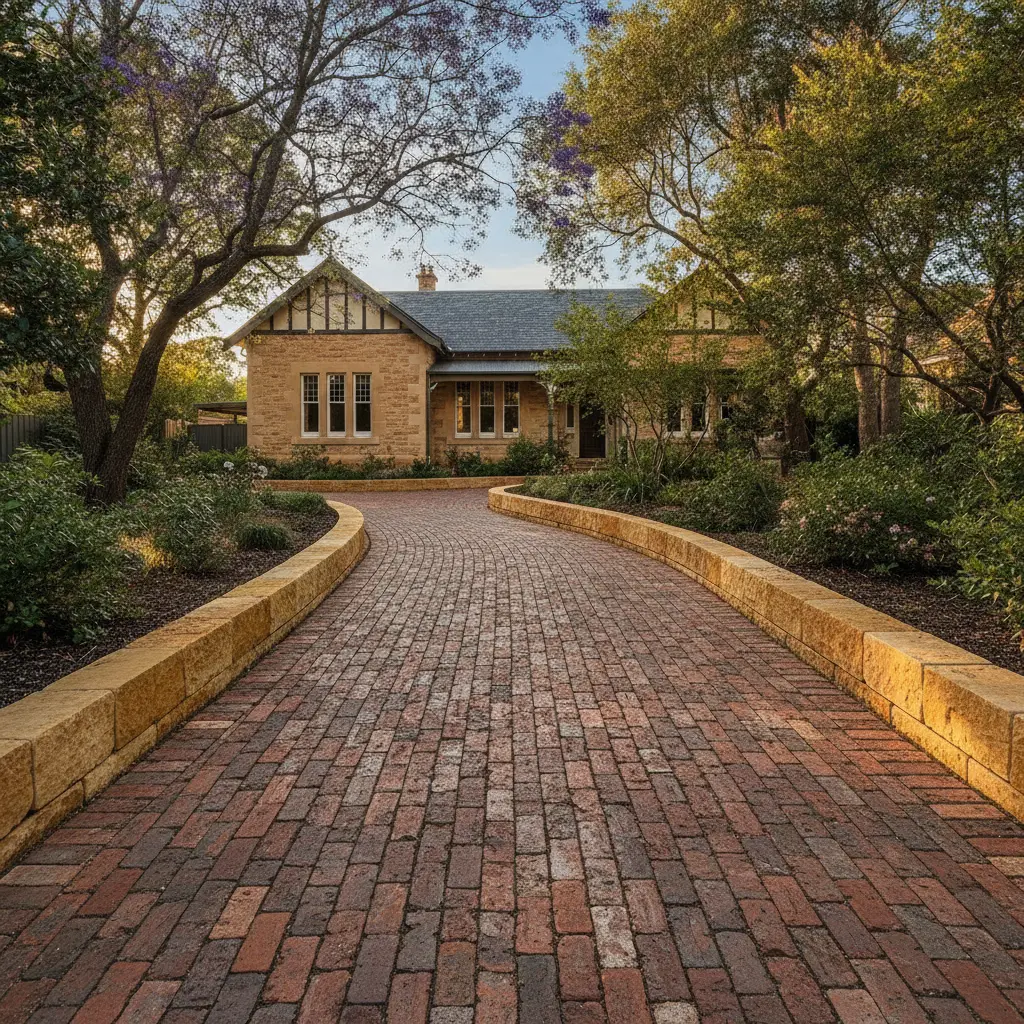
Yes, recycled bricks make a hard-wearing driveway if you choose hard-fired pavers or bricks, lay them on edge in a herringbone pattern, and build a properly compacted base with a firm edge restraint. Plan on about 54 bricks per square metre laid on edge (about 38 laid flat) with the narrow sand joints used in driveway paving. At $1.50 per recycled brick paver (guide price), that is roughly $81 per m² in bricks before base, sand and labour.
- Bricks per m²: about 54 on edge, about 38 laid flat (2–5mm sand joints)
- Recycled brick pavers: from $1.50 per brick (guide price)
- Pattern for vehicles: herringbone, for maximum interlock
- Standard brick size: approx 230 x 110 x 76mm
- Base: compacted road base or crushed sandstone, with a screeded sand bedding layer
Can you use recycled bricks for a driveway?
You can, and a recycled brick driveway is a warm, characterful way to finish a Sydney frontage, particularly on period homes. The key is choosing the right brick. Driveway bricks need to be hard and dense enough to carry tyre loads without cracking or wearing away, so use hard-fired pavers or hard-fired bricks, not soft, underfired commons.
Our recycled brick pavers are lime-mortar bricks. Because lime mortar is soft, the bricks can be cleaned without damaging their faces and edges, so you get bricks with intact arrises and plenty of character. Each batch is different, so inspect stock at the yard and ask us which bricks on hand suit vehicle traffic. If you are paving a path or courtyard rather than a driveway, our recycled brick paving guide covers lighter-duty paving in detail.
Should driveway bricks be laid flat or on edge?
For driveways, most installers lay bricks on edge. A standard brick is approx 230 x 110 x 76mm. Laid flat, it is 76mm deep and shows its broad face; laid on edge, it is 110mm deep and shows its narrow face. The deeper section resists rocking and cracking under turning tyres, and the narrow faces create more joints, which helps the paving lock together.
| Laying method | Brick depth | Bricks per m² | Brick cost per m² at $1.50 | Suited to |
|---|---|---|---|---|
| On edge | about 110mm | about 54 | about $81 | Driveways, parking pads, heavier use |
| Flat | about 76mm | about 38 | about $57 | Paths, patios, courtyards, light vehicle use on a rigid base |
These counts assume a standard 230 x 110 x 76mm brick and the narrow 2–5mm sand joints used in flexible paving. Wider mortar joints reduce the count (about 48 per m² on edge with 10mm joints), and recycled batches vary in size, so measure a sample brick and confirm quantities with us before ordering.
Which brick pattern suits a driveway?
Herringbone
Herringbone, laid at 45 or 90 degrees to the direction of travel, is the standard choice for vehicle paving. Each brick is locked by its neighbours on several sides, so bricks resist creeping and rotating when tyres turn, brake and accelerate. It needs more cuts along the edges, so allow extra bricks.
Basketweave
Basketweave lays pairs of bricks at right angles to each other. It has a classic period look but less interlock than herringbone, so it is better kept to paths, courtyards and low-speed areas, or laid over a concrete slab if used on a driveway.
Stretcher bond
Stretcher (running bond) lays bricks in straight staggered rows, like a wall. It is simple and wastes little, and if you use it on a driveway, lay the rows across the direction of travel rather than along it. Many people use a stretcher or soldier course as a border around a herringbone field.
How deep should the base be for a brick driveway?
A brick driveway is only as good as the base underneath it. A typical flexible build-up, from the bottom up, is:
- Firm subgrade: excavate below topsoil to firm ground and compact it. Soft spots should be dug out and replaced.
- Road base: compacted road base or crushed sandstone, placed and compacted in layers. For cars on firm ground, 150–200mm is commonly specified; clay, soft ground and heavier vehicles need more. Ask your installer or engineer to confirm for your site.
- Bedding sand: a screeded layer of bedding sand, commonly 20–30mm, levelled but not compacted before laying.
- Bricks: laid on edge, then compacted into the bedding with a plate compactor fitted with a protective pad.
- Joint sand: fine, dry sand swept into the joints and compacted again until the joints are full.
Our crushed sandstone is supplied as 75mm minus and 150mm minus for fill, road base and driveways, and as 20mm minus fill sand for bedding. Build in a consistent fall so water runs off to a drain or garden, never towards the garage or house. For steep driveways, or where an engineer specifies it, bricks can instead be mortar-set on a concrete slab.
Do you need an edge restraint?
Yes. Without a firm edge, tyres gradually push the outer bricks outward, joints open and the whole surface starts to move. Common edge restraints are a soldier course of bricks set in a concrete haunch, a concrete kerb or strip, or sandstone edging bedded in concrete. Install the edges before laying the field so you have a fixed line to work to, and bed them deeply enough that they cannot roll.
How many recycled bricks do I need for a driveway?
Multiply the area by 54 for bricks on edge, then add around 10% for cuts, especially with herringbone. Prices below use recycled brick pavers at $1.50 per brick (guide price).
| Driveway size | Area | Bricks on edge (54/m²) | With 10% extra | Approx. brick cost |
|---|---|---|---|---|
| Single, 3m x 6m | 18m² | 972 | about 1,070 | about $1,600 |
| Single, 3m x 10m | 30m² | 1,620 | about 1,780 | about $2,670 |
| Double, 6m x 6m | 36m² | 1,944 | about 2,140 | about $3,210 |
| Long, 5m x 10m | 50m² | 2,700 | about 2,970 | about $4,460 |
What does a recycled brick driveway cost?
The bricks themselves are the easiest part to price: about $81 per m² on edge using recycled brick pavers at $1.50 each. For walls, garden edges and borders, recycled red bricks start from $1.20 per brick and reclaimed bricks from $0.90 per brick; ask us whether a particular batch is hard enough for vehicle traffic before using it on a driveway.
The rest of the cost is in the work: excavation and spoil removal, road base, bedding and joint sand, edge restraints, compaction, cutting, and any council approval for the crossing between your boundary and the road. Labour is often a large share of the total, so get two or three itemised quotes from paving contractors and compare them line by line. Final material pricing depends on quantity and delivery.
Should you seal a recycled brick driveway?
Sealing is optional. A penetrating (impregnating) sealer can make oil drips and tyre marks easier to clean and can help keep joint sand in place. Sealers can darken or change the colour of old brick, so test one on a spare brick first, and follow the manufacturer's guidance on reapplication. Many owners leave recycled brick unsealed and let it weather naturally.
Recycled brick or sandstone for your driveway?
If you want a lighter, more formal finish, sandstone is the alternative: our sawn sandstone pavers are cut at 75mm or 100mm thick for vehicle areas. See sandstone driveway pavers Sydney for options. Recycled brick suits period homes and anyone who wants a warm red-brown driveway with a reused, characterful finish.
Get recycled brick pavers from Stone Front
Visit our yard to inspect and hand-select recycled brick pavers (Monday to Friday 7:00am–3:30pm, Saturday 8:00am–midday), or send your driveway measurements through our quote form. We can price the bricks, crushed sandstone base and delivery together.
Frequently Asked Questions
Are recycled bricks strong enough for a driveway?
Hard-fired recycled pavers and hard-fired bricks suit car driveways when laid on edge, in herringbone, over a compacted road base with a firm edge restraint. Soft or underfired bricks can crack or wear under tyres, so inspect the batch and ask which bricks in stock suit vehicle traffic before you order.
Do I need council approval for a brick driveway?
Most NSW councils control the driveway crossing — the section between your boundary and the road — and set their own specifications for it. Whether paving inside your property needs approval depends on the site and the work involved, so check with your council before you start, especially if you are changing the driveway’s width or levels.
Can I lay a recycled brick driveway myself?
An experienced DIYer can, but the base is the hard part. You’ll need to excavate, place and compact road base in layers with a plate compactor, screed bedding sand, set edge restraints and cut bricks with a masonry saw. Many people pay a contractor for excavation and base, then lay the bricks themselves.
Do recycled bricks come cleaned?
Yes. Our recycled bricks are lime-mortar bricks, and because lime mortar is soft they can be cleaned without damaging their faces and edges. Expect the character of reused brick — colour variation, small marks and traces of earlier use — which is a large part of the appeal for driveways and paving.
Will all the recycled bricks match?
Recycled bricks vary in colour and tone, even within one batch. For an even overall look, order all the bricks for the driveway at once and draw from several pallets as you lay, so the colours blend across the surface rather than forming patches of lighter or darker brick.