Sandstone Cut to Size: What Can Be Cut and How to Order It
Which sandstone products are cut to size at the quarry, the sizes, edges and finishes available, and how to write a cutting list so your pieces fit first time.
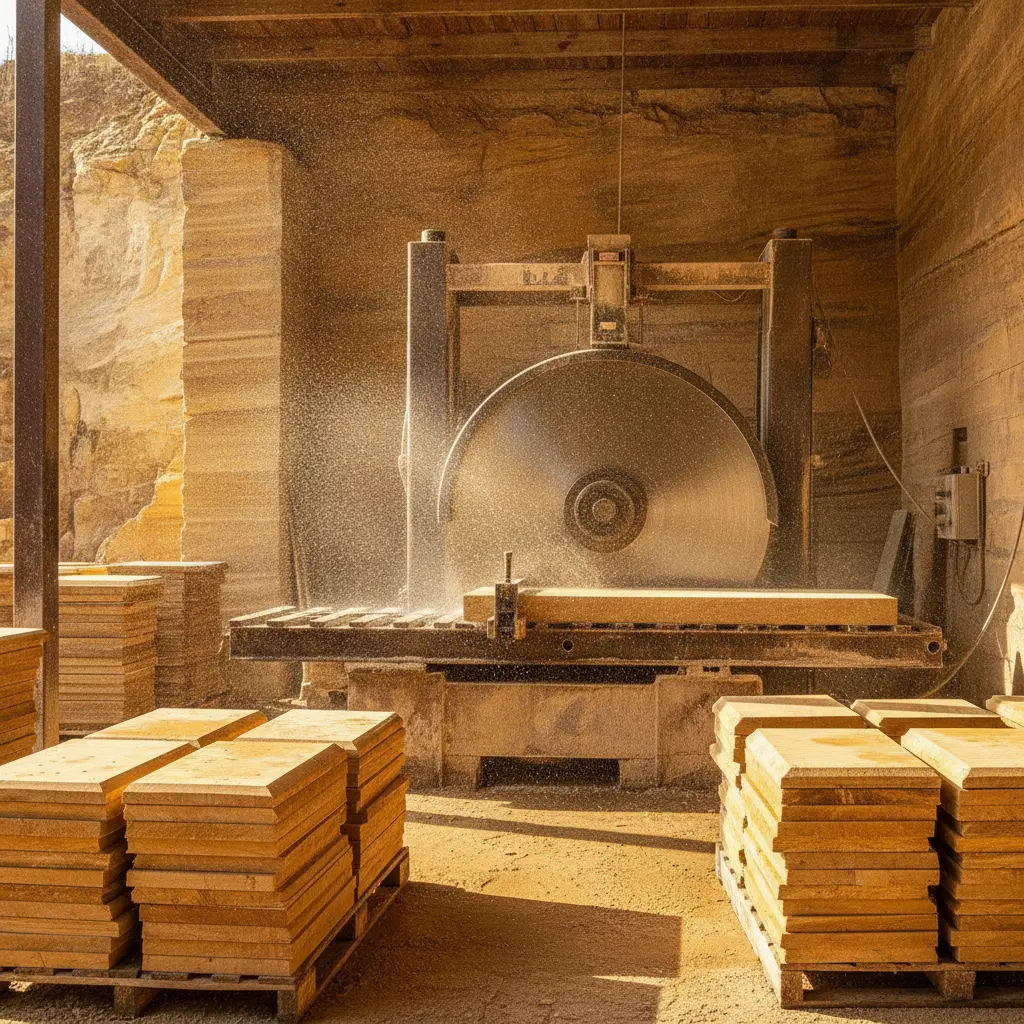
Most sawn sandstone can be cut to size at the quarry: pavers, outdoor tiles, step treads, wall capping, pool coping, edging and sawn blocks, with square, bullnose, pencil-round or chamfered edges and sawn, honed or sandblasted faces. To order, send a cutting list with the length, width, thickness, edge and finish of each size and how many you need. Stone Front cuts at Glenorie and quotes the cut pieces and delivery together.
- Pavers: sawn all round pavers at 50mm, cut to your dimensions; 400x400mm, 600x400mm and 600x600mm are popular.
- Strips: hydrasplit paving at 50mm, split to any width; 150mm strips are common.
- Capping and coping: capping cut to the wall width; pool coping at 400mm or 500mm wide.
- Steps: treads cut to stair width, solid steps up to about 2m long in one piece.
- Turnaround: simple stonemasonry items about 1–2 weeks; elaborate pieces about 4–6 weeks.
Which sandstone products can be cut to size?
| Product | Thickness | What can be specified | Guide price |
|---|---|---|---|
| Sawn all round pavers | 50mm | Length and width to order; sawn on all six sides | From $120/m² |
| Outdoor sandstone tiles | 30mm | 300x300 to 600x600mm or custom; sawn, honed, natural split or sandblasted | From $110/m² |
| Hydrasplit paving and strips | 50mm | Split to any width, e.g. 150mm | From $95/m² |
| Sandstone edging | Various | Lengths, widths and heights; short pieces for curves | From $35 per lineal metre |
| Wall capping | 30–50mm | Cut to wall width, mitred corners, radius pieces | By quote |
| Pier caps | 50–75mm | Cut to pier size; bullnose, chamfer or pyramid | By quote |
| Pool coping | 30–40mm | 400mm or 500mm wide; bullnose, pencil-round or drop-face; radius pieces to a template | By quote |
| Stair treads and risers | Treads 30–50mm, risers 20–30mm | Cut to stair width, tread depth and riser height | By quote per piece |
| Sawn all round blocks | To order | Custom dimensions, heights and lengths | From $250/m² |
| Custom stonemasonry | To order | Benches, letterboxes, bullnosed treads, caps | By quote |
Guide prices are for stone only, ex-quarry. Cutting extra profiles, such as a bullnose on every piece, adds to the price, and the quote shows it.
Some products are not cut to exact sizes because their character comes from being split or natural. Handsplit flagging, rough squared blocks, split logs and boulders are supplied as they come from the quarry face, although you can hand-select pieces from the bins at Glenorie.
What edge profiles and finishes can I choose?
Edge profiles
- Square: a plain sawn edge. Clean and contemporary; the default for pavers and tiles.
- Bullnose: a full half-round. Comfortable to sit on and kind to bare feet, so it suits pool coping, step nosings and seat walls.
- Pencil-round: a small radius that takes the sharpness off a square edge without the softer look of a bullnose.
- Chamfer: a 45° bevel; crisp, and common on capping and pier caps.
- Drop-face: a thickened front edge on coping, so a 30–40mm piece looks deeper from the side.
Face finishes
- Sawn: flat, with fine saw marks and reliable grip. The usual choice for outdoor paving and step tops.
- Honed: ground smooth and matte, for indoor floors, benchtops, feature walls and covered areas.
- Sandblasted: a sawn face blasted to an even, fine texture; the most slip-resistant finish, used for pool surrounds and ramps.
- Split and rockfaced: natural or pitched faces on blocks, cladding and the fronts of steps.
Finishes can be combined on one piece, such as a sawn top with a rockfaced front on a step, or a sandblasted coping with a bullnose edge. Our sandstone finishes page compares every finish, and our guide to hydrasplit sandstone explains the split face.
How do I write a cutting list?
A cutting list is a simple table of every size you need. It is the single most useful thing you can send for cut stone, because it removes guesswork on both sides. For each line, give:
- What it is: paver, tread, capping, coping, cap or block.
- Length x width x thickness in millimetres.
- Quantity of that size.
- Edge profile and which edges get it: one long edge, both long edges, or all round.
- Face finish: sawn, honed or sandblasted.
- Colour: quarry-run, or matched to existing stone.
Example for a front entry:
| Item | Size (mm) | Qty | Edge | Finish |
|---|---|---|---|---|
| Step tread | 1,500 x 350 x 50 | 4 | Bullnose, front edge | Sandblasted |
| Riser | 1,500 x 160 x 30 | 4 | Square | Sawn |
| Landing paver | 600 x 600 x 50 | 8 | Square | Sandblasted |
| Pier cap | 450 x 450 x 60 | 2 | Chamfer all round | Sawn |
Add a sketch or a marked-up plan if the layout is not obvious, and note anything that has to line up, such as joints that must meet a doorway or drain.
How do I measure for cut-to-size stone?
- Measure the finished size, not the opening. For capping and coping, add the overhang you want; capping usually overhangs a wall by about 20–30mm on each side.
- Allow for joints. Decide the joint width first, then take it off the piece sizes. Diamond-sawn pavers can be laid with or without mortar joints.
- Check square. Measure both diagonals of a landing or step. If they differ, the space is out of square and some pieces will need trimming on site.
- Template curves. For curved pools and walls, make a template from hardboard or cardboard, or give the radius, so radius pieces can be cut to it.
- Measure twice. Cut stone is cut to your sizes, so confirm the list before ordering, ideally with your installer.
Should I cut sandstone on site or at the quarry?
Both have a place. Quarry cutting suits repeated sizes, large formats, step treads, coping, capping and anything with a profiled edge, because the stone is cut once from full slabs on a large saw and you receive finished pieces. That keeps waste down and the edges consistent. Site cutting suits the last edge pieces against walls, drains and curved garden beds, which an installer marks in place and cuts with a diamond blade.
A common approach is to order the field pavers, treads and coping cut to size, plus a small allowance for site cuts. For standard layouts, add about 5% for stack bond and 10–15% for herringbone or diagonal patterns. Our guide to sandstone paver sizes and thickness helps you pick the size before you write the list.
How long does custom cutting take?
Turnaround depends on the piece and the quantity. Simple stonemasonry items such as pyramid caps take about 1–2 weeks, and elaborate custom pieces about 4–6 weeks. Ask for a timeline with your quote, and tell us if a landscaper, tiler or stonemason is booked, so delivery can be planned around them.
Where is cut-to-size sandstone used?
- Pool surrounds: coping cut to the pool perimeter, with matching pavers. See our pool coping guide.
- Walls and fences: capping cut to the wall width with mitred corners and pier caps. See our wall capping guide.
- Steps and entries: treads, risers and landings from one colour batch. See how to build sandstone steps.
- Indoor floors: honed tiles and sawn all round pavers in a set size.
- Garden features: benches, letterboxes and plinths. See sandstone benches, letterboxes and pillars.
Get your quote from Stone Front
Stone Front cuts its own sandstone at the Glenorie quarry, so the people quoting your cutting list are the people cutting it. Get an exact quote from Stone Front: tell us the product, quantity and your suburb at stonefront.com.au/get-a-quote and we usually reply the same business day. Email cutting lists, sketches and templates to info@stonefront.com.au.
Frequently Asked Questions
Can sandstone pavers be cut to any size?
Sawn all round pavers are cut to your specified dimensions at 50mm thick. Popular sizes are 400x400mm, 600x400mm and 600x600mm, but non-standard sizes are cut to order. Send the sizes and the quantity of each with your quote request.
What edge profiles can sandstone be cut with?
Common edge profiles are square (sawn), bullnose (a full half-round), pencil-round (a small radius), chamfer (a 45° bevel) and drop-face on coping. Bullnose suits pool coping and step nosings; pencil-round and square suit contemporary designs.
How long does custom-cut sandstone take?
It depends on the piece. Simple stonemasonry items such as pyramid caps take about 1–2 weeks and elaborate custom pieces about 4–6 weeks. Ask for a timeline with your quote, especially if a tradesperson is booked to lay the stone.
Is it cheaper to cut sandstone on site or at the quarry?
For repeated sizes, treads, coping, capping and anything with a profiled edge, cutting at the quarry is usually simpler and reduces waste, because the stone is cut once from full slabs. Edge cuts against walls and drains are normally made on site by the installer.
Can curved pieces be cut for pools and walls?
Yes. Radius pieces for curved pools and walls are cut to a template. Send a template or accurate measurements of the curve with your quote request so the coping or capping follows the line.
Products Mentioned in This Article
Sawn All Round Pavers
Diamond-sawn on all sides for a formal, elegant finish.
Custom Stonemasonry
Bespoke sandstone pieces: bullnosing, caps, benches, letterboxes and more.
Sawn All Round Blocks
Premium diamond-sawn blocks with a beautiful finish on all 6 sides.
Sandstone Tiles (Outdoor)
Precision-cut outdoor tiles for patios, pool areas and alfresco spaces.