How to Get an Accurate Sandstone Quote: What to Measure and Send
The details Stone Front needs to quote your sandstone exactly: product, finish, thickness, quantity in m², lineal metres or pieces, suburb, access, timing and photos.
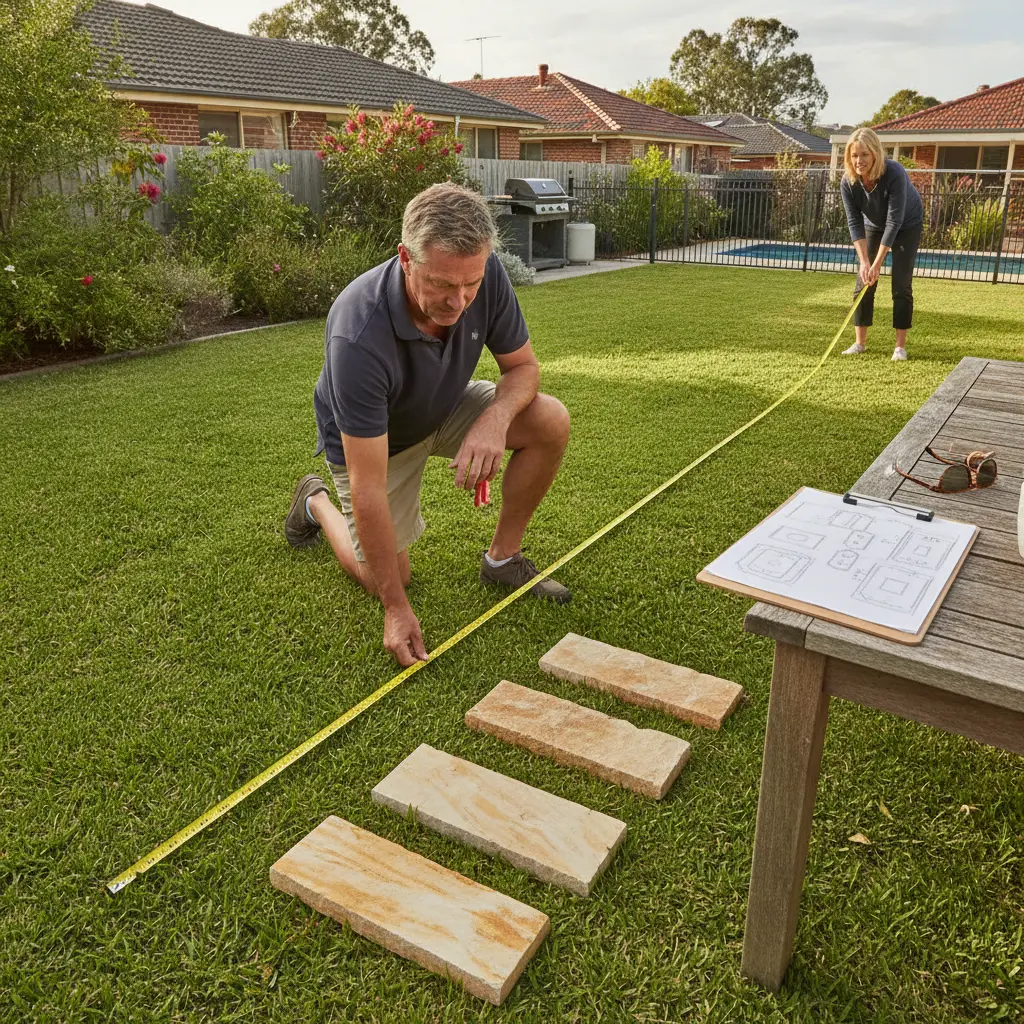
To get an accurate sandstone quote, send five things: the product and finish, the thickness or size, the quantity in the right unit (square metres, lineal metres or pieces), your suburb or postcode, and a short note on delivery access and timing. Add photos or plans if you have them. With those details Stone Front can quote stone, cutting and delivery exactly, and we usually reply the same business day.
- Product and finish: for example sawn all round pavers, sawn flagging, rockfaced blocks or hydrasplit edging, and sawn, honed, sandblasted or split.
- Thickness or size: 50mm for foot traffic, 75–100mm for driveways, or the block height and bedwidth for walls.
- Quantity: m² for paving, tiles and cladding; m² of wall face for blocks; lineal metres for edging, capping, coping and logs; a piece count for steps, treads and caps; tonnes for crushed sandstone, boulders and spalls.
- Suburb and access: where the truck can park, how far the stone has to travel, and whether a crane truck is needed.
- Timing, photos and plans: when you need the stone, plus anything that shows the site.
What details does a sandstone quote need?
A quote is only as exact as the information behind it. Every missing detail either gets assumed or has to be checked back with you, and both slow things down. The table below lists what Stone Front needs for each type of job.
| Job | Product details | Quantity to send | Also useful |
|---|---|---|---|
| Paving, patio, path | Product, finish, thickness, paver size | Net area in m² and the laying pattern | Sketch with dimensions, photo of the area |
| Pool surround | Paver or tile, finish, coping profile | Paving m² plus pool perimeter in lineal metres | Pool shape, number of corners, any curves |
| Retaining or garden wall | Block type, block height, bedwidth | Wall length and height (m² of wall face) | Capping, corners, steps in the wall |
| Log wall | Split logs | Wall length and number of 300mm courses | Machine access, slope |
| Edging, capping, coping | Profile, width, thickness, edge | Lineal metres, plus piers or corners | Wall width for capping |
| Steps and treads | Solid block steps or sawn treads, nosing | Number of steps, width, going and rise | Photo of the existing stair |
| Cladding | Finish and thickness | Wall area in m², less openings | Height of the wall, corners |
| Crushed sandstone, boulders, spalls | Grade or size class | Tonnes, or area and depth | Where the truck can tip |
How do I measure for sandstone paving?
Measure the area to be paved in metres and work out the square metres. A rectangle is length x width; a 6m x 4.5m patio is 27m². For an L-shape or an irregular area, split it into rectangles and triangles, work out each one and add them together. A triangle is half the base x the height. Measure to the edge of the paving, not to the edge of the garden bed beyond it.
Then add an allowance for cuts and breakage, which depends on the pattern:
- About 5% for stack bond and 5–7% for stretcher bond.
- 5–10% for French pattern, random ashlar and linear plank layouts.
- 10–15% for herringbone, 45° diagonal layouts and crazy paving.
If you are not sure which figure applies, send the net area and the pattern and we will add the allowance. The paver calculator does the same sum and also gives the weight of stone and the crushed sandstone needed for the base. Our guide to sandstone paving patterns shows how each layout looks.
How do I measure for a sandstone wall?
Blocks are sold by the square metre of wall face, so you need the wall length and its height. A wall 10m long and 800mm high is 8m² of face. Include the course that sits below ground level, because it still needs stone. If the wall steps down a slope, measure each section separately.
For coursed walls, count courses: wall height divided by block height, rounded up. In 200mm blocks, an 800mm wall is 4 courses. Rough squared blocks come in pallets of 4 layers covering 4m² of wall face, so an 8m² wall is 2 pallets. The sandstone block calculator works out courses, lineal metres, block count and weight from your length and height. For a cost walk-through, see sandstone retaining wall cost.
Tell us about capping, corners, piers and any steps built into the wall. They change what has to be cut, and capping is quoted by the lineal metre.
How do I measure edging, capping, coping and steps?
- Edging: measure the run in lineal metres. A tape or a garden hose laid along a curve and then measured works well. Say whether the edging stands on edge or lies flat, and the width you want.
- Capping: measure the run length and the width of the wall. Capping overhangs the wall by about 20–30mm on each side, so a 230mm brick wall takes capping about 280mm wide. Count corners and piers.
- Pool coping: measure the pool perimeter in lineal metres, count the corners and note any curved sections. Coping is cut at 400mm or 500mm wide, and radius pieces are cut to a template.
- Steps: count the steps and give the stair width, the going (tread depth) and the rise of each step. Comfortable outdoor steps have a going of 300–350mm and a rise of 150–175mm.
Cut-to-size pieces are cut to the sizes you give us, so measure twice before you order. Our guide to sandstone cut to size explains how to write a cutting list.
Which product, finish and thickness should I ask for?
If you have not chosen yet, describe the job and we will suggest options. As a starting point:
- Paths, patios and pool surrounds: 50mm pavers or flagging. Sawn finishes give reliable grip outdoors; sandblasted is the most slip-resistant finish for pool areas.
- Driveways: 75mm minimum for cars, 100mm for heavier vehicles or steep sites. See our sandstone driveway guide.
- Garden and retaining walls: 110mm-bed blocks in 100–250mm heights, a 300mm block at 130mm bed, rough squared blocks, or 300 x 300mm split logs.
- Feature walls: cladding or veneer, usually 20–30mm thick, in split-face, rockfaced or sawn finishes.
Colour matters too. Quarry-run pallets blend the natural range, from Marbled White and Light Yellow to Banded Yellow, Browns and Purples, and are the most economical. Single-colour or matched selections cost more because the stone has to be sorted. Our sandstone colour guide describes all ten quarry colours.
What affects the price of a sandstone quote?
Five things move the price:
- Product and cutting. Split products need less machine time than sawn ones, so crazy paving in sawn flagging sits below sawn all round pavers.
- Thickness. A 100mm paver contains twice the stone of a 50mm one.
- Colour selection. Quarry-run is the most economical; hand-sorted colours cost more.
- Quantity. Full pallets work out better than part pallets, and tonnage lots better again.
- Delivery. Priced by suburb and access, with crane-truck drops costing more than kerbside. Collection from the quarry is free.
For budgeting before you ask, these are Stone Front guide prices for stone only, ex-quarry at Glenorie:
| Product | Guide price (from) |
|---|---|
| Sawn modular paving | $65/m² |
| Sawn flagging (crazy paving) | $85/m² |
| Hydrasplit paving | $95/m² |
| Outdoor sandstone tiles | $110/m² |
| Sawn all round pavers | $120/m² |
| Rough squared blocks | $120/m² of wall face |
| Wall cladding | $140/m² |
| Rockfaced blocks | $180/m² of wall face |
| Hydrasplit blocks | $190/m² of wall face |
| Sandstone edging | $35 per lineal metre |
Guide prices are a starting point, not a quote. Logs, boulders, billets, steps, capping, handsplit flagging and crushed sandstone are priced by quote. The full list is on our sandstone prices Sydney page.
What should I tell you about delivery and timing?
Delivery is quoted by suburb and access, so the more we know, the more exact the quote. Tell us:
- Where a truck can park, and how far it is from there to the work area.
- Whether the stone has to go up or down steps, along a side passage or over a fence.
- Overhead power lines, trees, steep driveways and soft ground.
- Whether you want everything on one delivery, including base material.
- When you need the stone, and whether a landscaper or stonemason is booked.
Our sandstone delivery guide explains crane versus kerbside delivery, pallet weights and how to prepare the site.
What photos and plans help most?
A few photos often answer questions that would otherwise take several emails:
- A wide photo of the area from the house or street.
- A photo of the access route the stone will take.
- Any existing stone you want to match, photographed in daylight.
- Landscape or architectural plans with dimensions, or a hand sketch with measurements.
Email them to info@stonefront.com.au with your name, suburb and the product you are interested in, or attach them to your quote request.
Get your quote from Stone Front
Stone Front quarries, cuts and delivers its own sandstone from Glenorie in Sydney’s Hills District, so your quote comes straight from the people supplying the stone. Get an exact quote from Stone Front: tell us the product, quantity and your suburb at stonefront.com.au/get-a-quote and we usually reply the same business day. If you would rather see the stone first, ask for a quarry visit when you request your quote. Quick answers on prices, sizes and delivery are on our sandstone FAQ page.
Frequently Asked Questions
What information do I need to get a sandstone quote?
Send the product, finish and thickness or size, the quantity (square metres for paving, cladding and tiles, square metres of wall face for blocks, lineal metres for edging, capping and coping, or a piece count for steps and caps), your suburb or postcode, delivery access and when you need it. Photos or plans help Stone Front quote accurately the first time.
How quickly does Stone Front reply to a quote request?
Stone Front usually replies to quote requests the same business day. Requests that include the product, quantity, suburb and access are the fastest to price, because nothing has to be checked back with you before the quote goes out.
Should I add extra for wastage when I ask for a quote?
Yes. Add about 5% for stack and stretcher bond paving, 5–10% for French pattern and random ashlar, and 10–15% for herringbone, diagonal layouts and crazy paving. Tell us the net area and the pattern and we can add the allowance for you.
Are Stone Front prices supply only or installed?
Guide prices are for stone only, ex-quarry at Glenorie NSW. Delivery is priced separately by suburb and access, and collection from the quarry is free. Installation is arranged by you or your landscaper or stonemason.
Can I get a quote without exact measurements?
Yes. Send rough dimensions, a sketch or a photo with a few key measurements and Stone Front can give a guide quantity and price. Confirm the measurements before ordering, especially for cut-to-size pieces, because sawn items are cut to the sizes you give us.
Products Mentioned in This Article
Sawn All Round Pavers
Diamond-sawn on all sides for a formal, elegant finish.
Sawn Flagging (Crazy Paving)
Natural irregular shapes with sawn edges for a classic, informal look.
Rockfaced Blocks
Traditional rockfaced finish blocks for walls, edging and complete homes.
Sandstone Edging
Define garden beds, pathways and driveways with natural sandstone edging.