What Is Hydrasplit Sandstone? Finish, Uses and Prices
Hydrasplit sandstone is natural stone split by a hydraulic machine. How it compares with sawn and rockfaced finishes, where to use it, and what it costs.
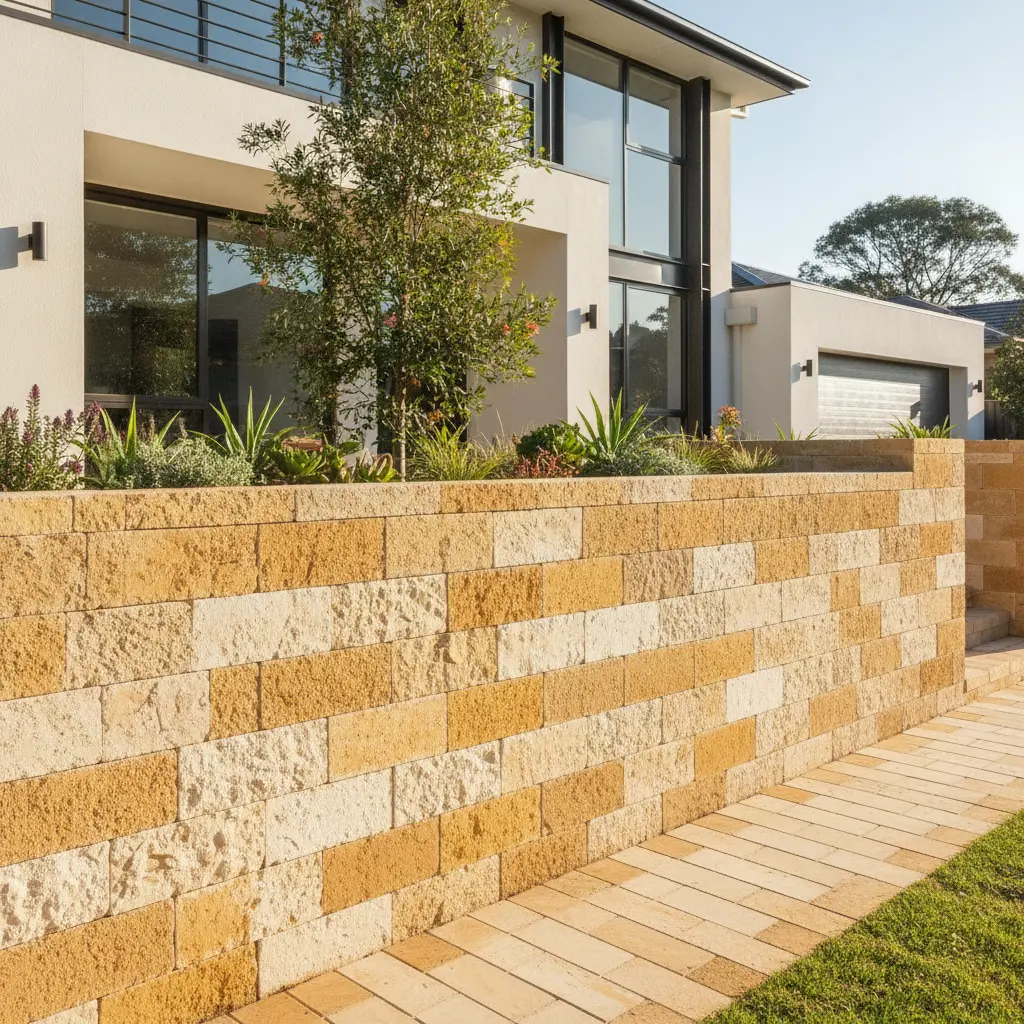
Hydrasplit sandstone is natural sandstone split by a hydraulic splitting machine instead of being cut by a saw or dressed by hand. The splitter leaves a rough, natural split face with straight, even edges, giving the texture of quarried stone with consistent dimensions. It is sold as hydrasplit blocks for walls and cladding-style finishes, and as 50mm hydrasplit paving split to width for strips, edging and capping.
- Hydrasplit paving: 50mm thick, split to any width (150mm strips are common), from $95/m² (guide price)
- Hydrasplit blocks: 110mm bedwidth, heights of 100, 150, 200 and 250mm, plus 300mm high at 130mm bedwidth, from $190/m² of wall face (guide price)
- Face: machine-split natural texture — flatter than rockfaced, rougher than sawn
- Same dimensions as rockfaced blocks, so the two can be specified interchangeably on plans
What does hydrasplit mean?
"Hydrasplit" is short for hydraulically split. A slab or block of sandstone is set in a hydraulic splitter, sometimes called a guillotine, and steel blades are driven into the stone from above and below along a marked line. The pressure builds until the stone breaks cleanly between the blades. Because the break follows the natural grain of the sandstone, the new face is rough and textured, showing the layering and colour of the stone, while the line of the split stays straight.
The result sits between two traditional finishes. A diamond saw gives a smooth, flat face with crisp edges. Rockfacing — the traditional pitched face — is chiselled to leave a bold, projecting face. Hydrasplitting gives a natural broken texture, but on a flatter plane than rockfacing, so walls and strips read as neat, even courses with a hand-quarried feel. It is the reason people searching for hydrasplit sandstone in Sydney are usually after a contemporary look that still feels like real stone.
Hydrasplit vs sawn vs rockfaced: what is the difference?
All of the finishes below are cut from the same natural sandstone at our Glenorie quarry; the difference is how the visible face is produced. Guide prices are ex-quarry and "from" — final pricing depends on quantity, finish and delivery.
| Finish | How it is made | Look and texture | Guide price | Typical uses |
|---|---|---|---|---|
| Hydrasplit | Split by a hydraulic splitter | Natural broken face on a fairly flat plane; straight edges; even coursing | Blocks from $190/m²; paving from $95/m² | Feature and retaining walls, cladding-style facades, strip paving, edging, capping |
| Sawn all round | Diamond-sawn on all six faces | Smooth, flat, crisp arrises; formal and modern | Blocks from $250/m²; pavers from $120/m² | Formal walls, steps, contemporary paving, pool surrounds |
| Rockfaced | Traditional chiselled, pitched face | Bold, projecting rough face; heritage character | Blocks from $180/m² | Heritage-style garden and retaining walls |
| Rough squared | Roughly squared blocks, roughly one-man sized | Irregular, rustic, variable sizes | From $120/m² of wall face | Rustic retaining walls and garden walls |
In short: choose sawn for a crisp, modern line, rockfaced for a traditional heritage face, rough squared for a rustic wall on a budget, and hydrasplit when you want even courses with natural texture. You can see all of these side by side on our sandstone finishes page.
What is hydrasplit sandstone used for?
Walls and retaining walls
Hydrasplit sandstone blocks share the dimensions of our rockfaced blocks: a 110mm bedwidth (the width of a standard brick) and heights of 100, 150, 200 and 250mm, plus 300mm high at a 130mm bedwidth. Laid in a single height they give regular, ashlar-style courses; mixing two or three heights gives a random-coursed look. They suit garden walls, low retaining walls, letterbox and entry walls, and planter boxes. For taller retaining walls, the usual council and engineering rules apply.
Cladding-style feature walls and commercial facades
Because the face is textured but the courses are even, hydrasplit blocks are often specified for feature walls, entry statements and commercial facades where architects want natural stone with a regular grid. For larger projects, our commercial sandstone page covers supply to builders and landscape contractors. If the wall cannot take the depth of a full block, sawn wall cladding (from $140/m²) is the thinner alternative.
Edging, capping and strip paving
Hydrasplit paving is 50mm thick with a hydraulically split face and can be split to any width. Strips around 150mm wide are common, and the same pieces double as garden edging and wall capping. Laid in a stretcher (running bond) pattern, narrow hydrasplit strips make textured paths, borders around lawn and contrast bands within sawn paving.
Hydrasplit paving: sizes and laying
Hydrasplit paving is 50mm thick, the same as our standard sawn pavers, so it can be laid on the same base. For patios, paths and areas next to the house, 50mm sandstone is typically laid on a mortar bed over a concrete slab; for garden paths and edging, many landscapers lay it on a compacted crushed rock base with a bedding layer. Because the split face is textured rather than flat, it suits paths, borders and edging well, while large entertaining areas with furniture are usually paved in a sawn or honed finish and edged in hydrasplit for contrast.
Order by the square metre for paving, or by the lineal metre if you are using strips as edging. Tell us the width you want — we split to size — and allow a little extra for cuts at corners and curves.
How much hydrasplit sandstone do I need?
Hydrasplit blocks are ordered by the square metre of wall face: multiply the wall length by its height, including any course below ground, and add a margin of around 5–10% for cuts and returns. To plan the coursing, divide the wall height by the block height you have chosen.
| Block height | Courses for a 600mm wall | Courses for a 900mm wall | Look |
|---|---|---|---|
| 100mm | 6 | 9 | Fine, brick-like coursing |
| 150mm | 4 | 6 | Balanced, versatile |
| 200mm | 3 | 4–5 | Bolder courses, fewer joints |
| 300mm (130mm bedwidth) | 2 | 3 | Large-format, contemporary |
As a guide, a 10m garden wall 0.6m high has 6m² of face, which is about $1,140 of hydrasplit blocks at $190/m², before delivery. Hydrasplit paving is ordered by the square metre at 50mm thick, from $95/m².
How does hydrasplit sandstone weather?
Hydrasplit is natural sandstone, so it weathers the way Sydney sandstone always has. Outdoors the face tends to mellow over time, and in damp, shaded spots moss and lichen can establish on the texture. The split face shows the grain and the natural colour bands of the stone — from Marbled White and Light Yellow through to Banded Yellow, Browns, Orange and Purples, depending on the quarry run — and its texture tends to disguise minor marks better than a smooth sawn face.
Sandstone is porous, so a penetrating (impregnating) sealer is recommended on paving, capping and walls in splash zones, typically resealed every 2–3 years outdoors. Avoid acid cleaners, which can damage the stone. On free-standing garden walls, many owners leave hydrasplit unsealed and let it age naturally.
Is hydrasplit sandstone right for your project?
Hydrasplit is a good fit when you want a wall or edge that looks natural and textured but reads as neat, even courses — modern homes, commercial entries, and gardens where a rockfaced wall would look too rustic and a sawn wall too formal. If budget is the priority, rough squared blocks start at $120/m² of wall face; if a crisp, flat face is the priority, sawn all round blocks start at $250/m². The easiest way to decide is to see the finishes in person: visit the quarry and compare a hydrasplit face next to sawn and rockfaced stone in the same colour.
Get hydrasplit sandstone from Stone Front
We hydrasplit blocks and paving on site at our Glenorie quarry, split to the width you need, and deliver across greater Sydney, including crane-truck delivery for difficult access. Send your measurements and preferred colour through our quote form for a price based on your quantity, finish and delivery address.
Frequently Asked Questions
How much does hydrasplit sandstone cost in Sydney?
Ex-quarry guide prices start from $95 per m² for 50mm hydrasplit paving and from $190 per m² of wall face for hydrasplit blocks. Final pricing depends on quantity, colour, the width you need the stone split to and delivery, so ask for a quote with your measurements.
Is hydrasplit sandstone natural stone?
Yes. Hydrasplit is natural sandstone; the term describes how the face is produced, not a different material. A hydraulic splitter breaks the stone along a straight line, and the break follows the stone’s natural grain, so the face shows real texture and colour banding rather than a moulded or manufactured pattern.
Is hydrasplit cheaper than sawn sandstone?
On guide prices, yes. Hydrasplit blocks start from $190/m² of wall face, compared with $250/m² for sawn all round blocks; rockfaced blocks start from $180/m² and rough squared blocks from $120/m². For paving, hydrasplit starts from $95/m² and sawn all round pavers from $120/m².
Can hydrasplit sandstone be used for capping and pool edges?
Hydrasplit paving doubles as edging and capping on garden walls, beds and borders. For pool coping, where a smooth edge and consistent overhang are usually wanted, sandstone coping can be cut to size instead. Seal sandstone near pools with a penetrating sealer and avoid acid cleaners, which can damage the stone.
Can I see hydrasplit sandstone before I buy?
Yes. Our quarry at Glenorie is open Monday to Friday 7:00am–3:30pm and Saturday 8:00am–midday, closed Sundays and public holiday weekends. You can compare hydrasplit, sawn and rockfaced faces side by side in the same colour and hand-select the stock you want.
Products Mentioned in This Article
Hydrasplit Paving
Split-face finish paving strips for a contemporary, structured look.
Hydrasplit Blocks
Modern split-face blocks for contemporary walling projects.
Rockfaced Blocks
Traditional rockfaced finish blocks for walls, edging and complete homes.
Sawn All Round Blocks
Premium diamond-sawn blocks with a beautiful finish on all 6 sides.