Crazy Pavers Compared: Sandstone, Travertine, Bluestone and Slate
What crazy paving is, sawn vs split edges, thickness and coverage, and how sandstone compares with travertine, bluestone, quartzite and slate crazy pavers.
The short answer
Choose sawn sandstone flagging if you want neat, contemporary crazy paving with tight joints, from $85/m² (guide price). Choose handsplit sandstone flagging for a rustic, heritage look with natural edges. Choose travertine crazy pavers for a soft, light Mediterranean look laid on a slab. Choose bluestone for a cool grey contrast in shaded or modern spaces, accepting heat in full sun. Choose quartzite or slate for rugged texture, checking slate quality before you buy.
Which option suits which project
Sawn sandstone flagging
Best for: Neat, contemporary crazy paving with tight joints
View sawn sandstone flaggingHandsplit sandstone flagging
Best for: Rustic and heritage paving with natural edges
View handsplit sandstone flaggingTravertine crazy pavers
Best for: Light, Mediterranean-style patios and pool areas
Bluestone crazy pavers
Best for: Cool grey contrast in modern or shaded spaces
Quartzite or slate crazy pavers
Best for: Rugged, multi-toned texture on paths and walls
Side-by-side comparison
| Sawn sandstone flagging | Handsplit sandstone flagging | Travertine crazy pavers | Bluestone crazy pavers | Quartzite or slate crazy pavers | |
|---|---|---|---|---|---|
| What it is | Irregular sandstone pieces with diamond-sawn edges | Irregular sandstone split by hand along the bedding | Irregular pieces of spring-deposited limestone | Irregular pieces of basalt | Irregular split pieces of metamorphic stone |
| Edges | Straight sawn edges | Natural broken edges | Sawn or tumbled, varies by range | Sawn or split, varies by range | Natural split edges |
| Thickness | 50, 75 or 100mm | Thin 30–50, regular 50–75, track 75–100mm | Generally thinner; usually laid on a slab | Generally thinner; usually laid on a slab | Usually thin and uneven; laid on a slab |
| Joint width | About 10–15mm | About 15–25mm | Set by edge and thickness | Set by edge and thickness | Wider joints suit split edges |
| Look | Neat jigsaw in mixed natural colours | Rustic, riven, traditional | Soft creams with pitted texture | Cool blue-grey, contemporary | Layered, multi-toned; quartzite sparkles |
| Heat underfoot | Light colours stay comfortable | Light colours stay comfortable | Light; stays comfortable | Dark; gets hot in full sun | Dark slate hot; pale quartzite cooler |
| Slip when wet | Good grip from sawn face | Good grip from riven face | Honed faces less grip | Smooth or honed faces slippery | Riven faces grip well |
| Porosity and sealing | Porous; penetrating sealer advised | Porous; penetrating sealer advised | Porous with holes; seal | Lower porosity; sealing still advised | Quartzite low; slate varies, some grades flake |
| Wastage to allow | About 10% | About 10–15%; whole 10m² pallets | Ask supplier; trimming adds waste | Ask supplier; trimming adds waste | Ask supplier; trimming adds waste |
| Laying | Mortar bed; quickest to fit | Mortar bed; more sorting and trimming | Mortar on a slab | Mortar on a slab | Mortar on a slab; bed evens thickness |
| Relative cost | From $85/m² at 50mm (guide) | By quote | Get quotes; varies by grade | Usually more than sandstone | Varies widely; get quotes |
| Best uses | Patios, paths, pool surrounds, driveways at 75–100mm | Heritage paths, cottage gardens, wall cladding | Pool areas and Mediterranean styles | Modern courtyards and contrast borders | Rustic paths and feature walls |
| Sold by Stone Front | Yes | Yes | No | No | No |
Imported crazy pavers vary widely in thickness and grade; check the specification of any product against where it will be laid.
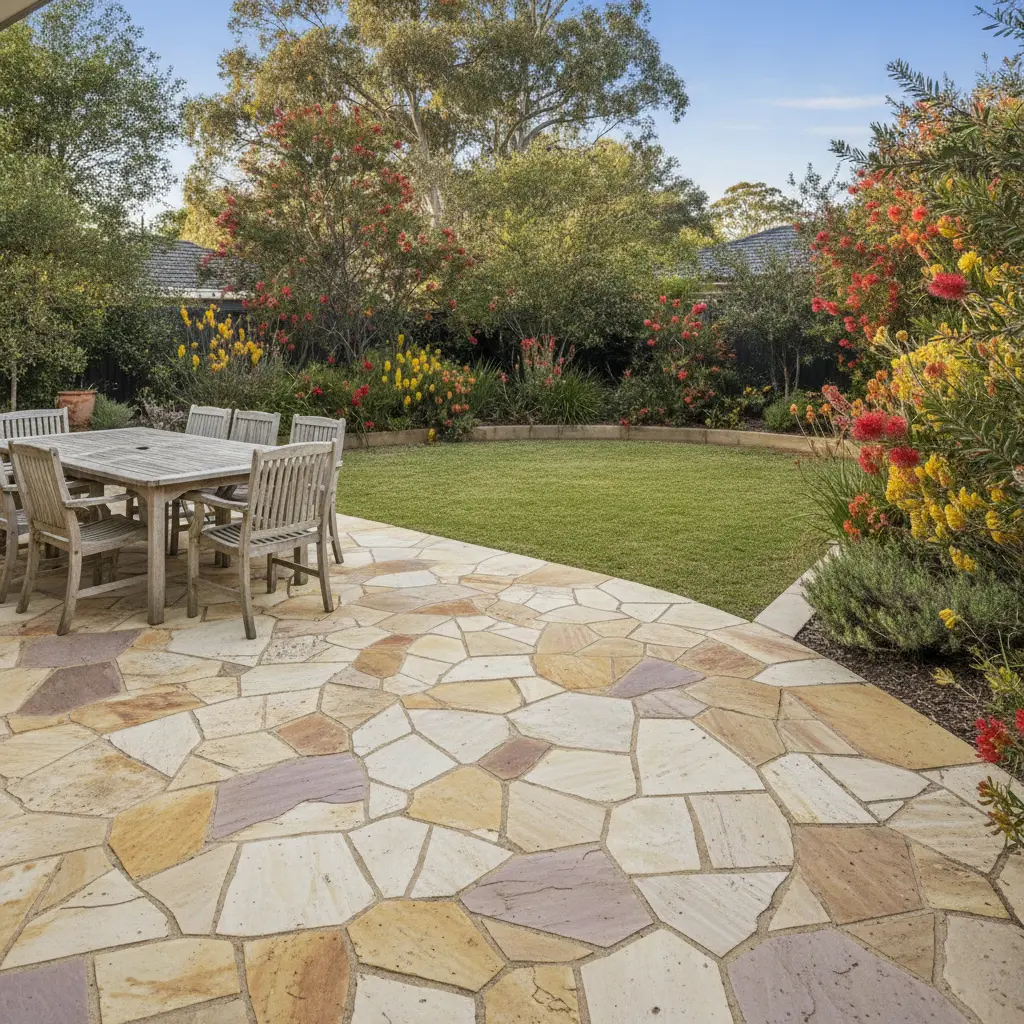
Crazy pavers are irregular pieces of stone fitted together like a jigsaw with mortar joints, and in Sydney they are most often sandstone. They suit patios, paths, pool surrounds, driveways and even walls. This page explains what crazy paving is, how sawn and split edges differ, how thick the pieces should be and how sandstone compares with travertine, bluestone, quartzite and slate.
What is crazy paving?
Crazy paving is paving laid from irregular, non-repeating pieces of stone rather than cut rectangles, with mortar joints between them. The name comes from the random, crazed pattern of the joints. It has been used in Australian gardens for generations, and the natural colour variation and irregular shapes suit both cottage gardens and contemporary pool areas. In the trade, sandstone crazy paving is called flagging: sandstone flagging is the general name for flat, irregular paving stone, whether its edges are sawn or split.
Crazy paving differs from modular paving or random ashlar, which use cut rectangles in mixed sizes laid to a repeating or semi-random pattern. Because every piece is shaped to its neighbours and set in mortar, crazy paving is slower to lay, but it follows curves, steps and odd-shaped areas without long runs of cut edges. That is why it suits winding garden paths, free-form pool surrounds and courtyards with awkward corners.
Sandstone is not the only stone sold as crazy pavers. Travertine is a limestone deposited by mineral springs; bluestone is basalt, a dark volcanic stone; quartzite forms when sandstone is changed by heat and pressure and becomes very hard; and slate forms from fine mudstone and splits into thin layers.
What is the difference between sawn and handsplit crazy pavers?
Sawn crazy pavers have straight diamond-sawn edges and a flat sawn top, while handsplit crazy pavers are split by hand along the stone’s natural bedding, leaving irregular edges and a riven, textured face. The edge decides the look: sawn flagging fits together with tight 10–15mm joints for a neat, contemporary jigsaw, while handsplit needs wider 15–25mm joints and gives a rustic, traditional look that suits heritage homes.
Laying effort follows the edges too. Sawn pieces are faster to fit because their straight sides meet cleanly. Handsplit pieces need more sorting and trimming, and their thickness varies more within a grade, so the mortar bed takes up the difference. Stone Front’s sawn flagging comes in mixed-colour pallets, and handsplit sandstone flagging comes in 10m² pallets in quarry-run colouring.
How thick should crazy pavers be?
Sandstone crazy pavers should be 50mm thick for paths, patios and pool surrounds and 75–100mm where cars drive, while thin 30–50mm pieces are for wall cladding and overlays on sound concrete.
| Sandstone grade | Thickness | Weight per m² | Typical use |
|---|---|---|---|
| Sawn flagging | 50mm | About 115kg | Patios, paths, pool surrounds |
| Sawn flagging | 75 or 100mm | About 173–230kg | Driveways and heavy-use areas |
| Handsplit thin | 30–50mm | About 69–115kg | Wall cladding and overlays |
| Handsplit regular | 50–75mm | About 115–173kg | Heritage and feature paving |
| Handsplit track | 75–100mm | About 173–230kg | Driveways, high traffic, deep edging |
Travertine, bluestone, slate and quartzite crazy pavers are generally sold thinner than sandstone flagging, so they are normally bedded on a concrete slab rather than a compacted base. Check the thickness of any product against where vehicles will drive.
How much crazy paving do I need?
Measure the area in square metres and add about 10% for sawn flagging or 10–15% for handsplit, because irregular pieces need trimming to fit the edges and each other. A 20m² patio in sawn flagging needs about 22m² of stone. Handsplit flagging is sold in whole 10m² pallets, so round up: a 23m² path plus 15% is about 26.5m², which means three pallets. Plan delivery around weight, too, as a 10m² pallet of 50mm flagging weighs about 1.15 tonnes. Imported crazy pavers are often sold by the crate, so ask how many square metres a crate covers at your joint width before ordering.
Are travertine and bluestone crazy pavers hotter or more slippery than sandstone?
Dark crazy pavers are hotter: bluestone and dark slate absorb sun and can be uncomfortable barefoot in summer, while light sandstone, light travertine and pale quartzite stay more comfortable. Slip resistance depends on the surface. Sawn and riven sandstone faces give good grip, and riven quartzite and slate are textured too. Honed travertine and smooth sawn or honed bluestone are more slippery when wet, so choose textured finishes around pools. Porous stones, sandstone and travertine especially, benefit from a penetrating sealer; quartzite absorbs very little, and slate quality varies, with some grades prone to flaking. Our sandstone vs travertine pavers comparison covers those two stones in more depth.
How is crazy paving laid?
- Prepare a sound base: a concrete slab for driveways and pool surrounds, or compacted road base for garden paths and patios, with a fall of about 1:60 to 1:100 away from the house.
- Lay the stone out dry and plan the jigsaw, putting larger pieces at edges and corners.
- Bed each piece on a 25–40mm sand and cement mortar bed, tapping it level with its neighbours.
- Keep joints consistent: about 10–15mm for sawn flagging and 15–25mm for handsplit.
- Point the joints with mortar once the pieces have set, clean off residue, then seal when the paving is fully cured and dry.
Our step-by-step guide to laying crazy paving covers mortar mixes, cutting and pointing in detail.
Get a quote for sandstone crazy paving
Send the area, thickness, sawn or handsplit, and your suburb through the crazy paving quote form, and Stone Front usually replies the same business day. See formats and finished examples on our sandstone crazy paving page.
Frequently Asked Questions
Can crazy paving be laid on sand?
Crazy paving is normally laid on a mortar bed rather than loose sand, because irregular pieces do not interlock the way cut pavers do and would rock and shift. Even on a compacted road base, the pieces are bedded in a 25–40mm mortar bed and the joints pointed, so the surface works as one.
Can I lay crazy paving over existing concrete?
Yes, if the slab is sound, clean and falls away from the house. Bed the pieces in mortar with a cement slurry brushed on the back of each stone to help it bond. Allow for the added height at doorways and steps: 50mm flagging on a 25–40mm bed adds roughly 75–90mm.
Can crazy paving be used on walls?
Yes. Thin handsplit flagging, 30–50mm thick, is used as crazy-pattern cladding on retaining walls, piers and feature walls, fixed to a sound masonry or concrete backing. For a more regular look, sandstone wall cladding and veneer comes in split face, rockfaced, sawn and natural cleft finishes.
What colours does sandstone crazy paving come in?
Sawn flagging comes in mixed-colour pallets and handsplit in quarry-run colouring, blending Glenorie colours such as Marbled White, Light Yellow, Banded Yellow, Browns, Orange and Purples. The mix of tones is part of the appeal, and pieces can be sorted on site to spread the colours evenly.
Is crazy paving cheaper than regular pavers?
The stone can be: sawn flagging starts from $85/m², compared with $120/m² for sawn all round sandstone pavers (guide prices). Laying usually costs more, because every piece is fitted by hand and the joints are pointed, so compare installed prices rather than stone prices alone.