What Is Sandstone Flagging? Handsplit vs Sawn, Grades and Pallets
Sandstone flagging explained: handsplit regular, thin and track grades, sawn flagging for crazy paving, thicknesses, 10m² pallets, weights, uses and guide prices.
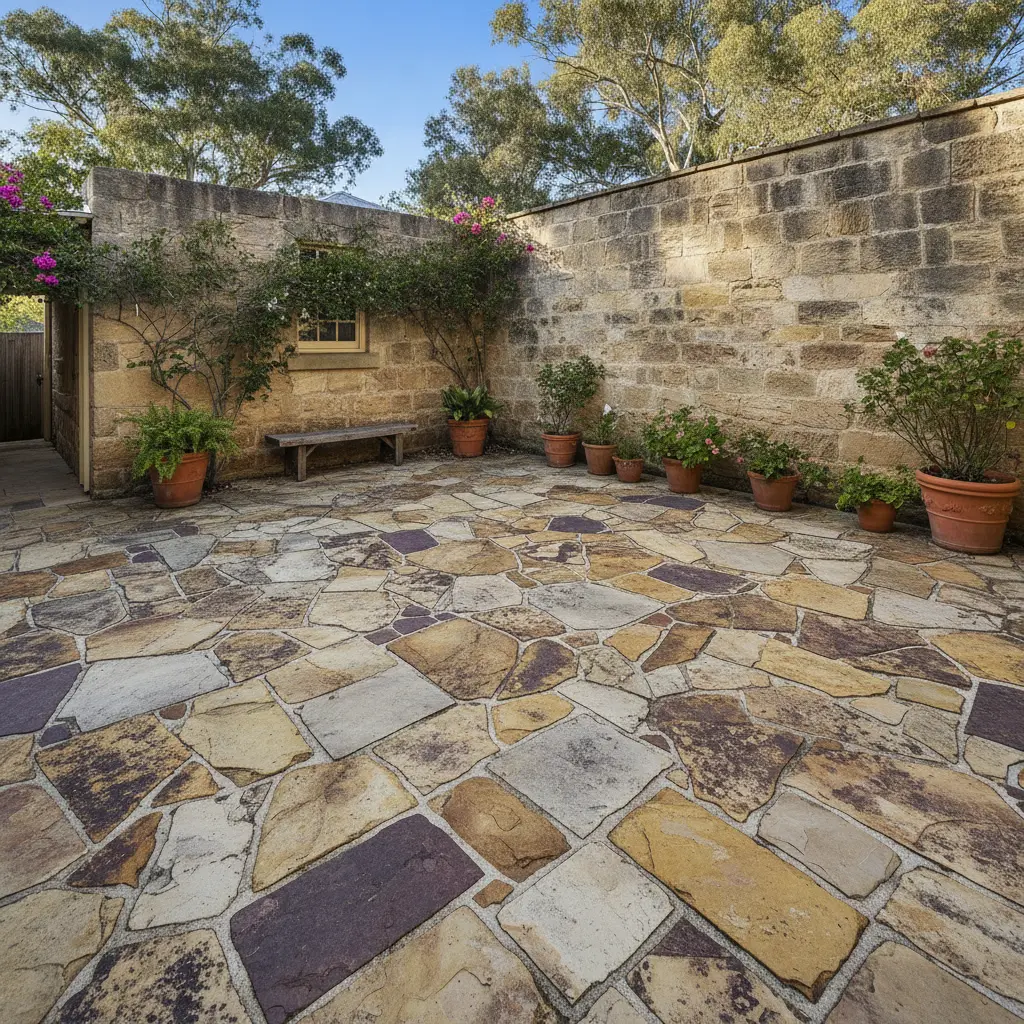
Sandstone flagging is irregular natural sandstone paving laid in a jigsaw pattern. It comes two ways: handsplit flagging, split by hand along the stone’s natural bedding for a riven face, and sawn flagging (crazy paving), which has diamond-sawn edges and a smoother face. Handsplit is supplied in 10m² pallets in three grades: regular (50–75mm), thin (30–50mm) and track (75–100mm). Sawn flagging comes in 50mm, 75mm and 100mm, from $85/m².
- Regular handsplit (50–75mm): heritage and feature paving.
- Thin handsplit (30–50mm): wall cladding and overlays where there is little depth.
- Track handsplit (75–100mm): driveways, high-traffic areas and deep garden edging.
- Sawn flagging: 50, 75 or 100mm in mixed-colour pallets, from $85/m² guide price.
- Allowance: add 10–15% for cutting and fitting irregular pieces.
What is the difference between handsplit and sawn flagging?
Both are irregular pieces of sandstone, but they are made differently and look different once laid.
| Handsplit flagging | Sawn flagging (crazy paving) | |
|---|---|---|
| How it is made | Split by hand along the natural bedding planes | Diamond-sawn faces and edges |
| Face | Riven, textured, slightly varying thickness | Flat with fine saw marks |
| Edges | Natural split edges | Clean sawn edges, tighter joints possible |
| Thickness | Regular 50–75mm, thin 30–50mm, track 75–100mm | 50mm, 75mm or 100mm |
| Supplied as | 10m² pallets, quarry-run colouring | Mixed-colour pallets |
| Look | Traditional, heritage | Informal but neater; can look contemporary |
| Guide price | By quote | From $85/m² |
Handsplit flagging is the paving of old Sydney. Stone Front’s is split at the Glenorie quarry by a dedicated flagging cutter, with the traditional finish but more consistent shape and depth. Sawn flagging gives the same irregular layout with straighter, sawn edges, which suits a cleaner look and an even surface for outdoor furniture.
Which flagging grade do I need?
Regular handsplit (50–75mm)
The most popular grade, supplied in various dimensions as it traditionally was. Use it for courtyards, paths, patios and heritage paving where you need to match existing stone or want genuine natural texture.
Thin handsplit (30–50mm)
The thinner bedwidth makes it the go-to grade for cladding existing walls, and for paving overlays where there is not enough depth for standard stone but a rustic finish is still wanted. For cladding with a more regular look, compare it with sandstone wall cladding panels, typically 20–30mm thick.
Track handsplit (75–100mm)
The heavy grade. The extra thickness suits driveways and high-traffic areas, and the extra bedwidth makes a handsome deep garden edging. Driveways also need the right base; see our sandstone driveway guide.
How much does sandstone flagging weigh?
Sandstone weighs about 2,300kg per cubic metre, so flagging weighs roughly:
- 30mm: about 69kg per m²
- 50mm: about 115kg per m², so a 10m² pallet is about 1.15 tonnes
- 75mm: about 173kg per m², so a 10m² pallet is about 1.73 tonnes
- 100mm: about 230kg per m², so a 10m² pallet is about 2.3 tonnes
Handsplit pieces vary in thickness within their grade, so pallet weights vary too. Plan delivery around the weight: a crane truck can set pallets close to the work area, and if you collect, check the pallet weight against your trailer rating. Our sandstone delivery guide covers trucks and access.
How much flagging do I need?
- Measure the area in square metres. Split irregular shapes into rectangles and triangles.
- Add 10–15% for cutting and fitting irregular pieces; lean towards 15% on small or awkward areas.
- For handsplit flagging, round up to whole 10m² pallets.
Example: a 25m² courtyard plus 15% is 28.75m². In handsplit flagging that is three 10m² pallets, leaving a little spare for repairs later. In 50mm sawn flagging at $85/m², 28.75m² is about $2,444 in stone at guide price, before delivery and laying materials. The paver calculator does these sums, including pallets and weight.
Where is sandstone flagging used?
- Heritage restoration: councils and heritage consultants often require a split, not sawn, finish. Handsplit flagging can be colour-matched to existing stone from photographs.
- Courtyards and paths: the irregular pattern suits cottage gardens and Federation and Victorian homes.
- Pool surrounds: sawn flagging gives a natural look with an even surface underfoot; pair it with cut coping.
- Driveways: track handsplit or 75–100mm sawn flagging on a vehicle-rated base.
- Walls: thin handsplit as cladding over existing masonry.
- Commercial and civil landscaping: split flagging is supplied in trade quantities, quoted by the tonne or by the project.
How is flagging laid?
For patios, pool surrounds and driveways, flagging is usually bedded in a 25–40mm mortar bed on a compacted base or concrete slab, laid as a jigsaw with 10–20mm joints and then pointed. For informal garden paths it can be dry-laid on compacted crushed rock and sand with planted or sand-filled joints, although pieces move over time. Our step-by-step guide to how to lay crazy paving covers the base, layout and pointing, and how to seal sandstone covers sealing.
Should I choose flagging or pavers?
Both are natural sandstone from the same quarry, so the choice comes down to look, laying method and budget:
- Choose flagging for an informal, natural or heritage look, for curved and irregular areas where the jigsaw layout absorbs awkward edges, and where you want to match old Sydney paving.
- Choose pavers for straight joints, a formal or contemporary look, faster laying and less cutting on rectangular areas. Sawn all round pavers start from $120/m² and sawn modular paving from $65/m², guide prices.
- Mix them: a common detail is a flagging field framed by a sawn edging border or a row of hydrasplit strips, which gives crazy paving a cleaner edge.
Flagging takes longer to lay than regular pavers, because each piece is fitted to its neighbours, so allow for that when you budget installation. Our sandstone paver sizes and thickness guide compares the regular formats.
What colours does sandstone flagging come in?
Flagging is supplied in quarry-run colouring from the Glenorie quarry, which includes Marbled White, White with Greys, Light Yellow, Banded Yellow, Light Yellow Multicoloured, Medium Yellow with Purples, White with Browns & Greys, Browns, Orange and Purples. Quarry-run pallets blend these; a single-colour selection costs more because the stone has to be sorted. You can visit the quarry to see colours in person. Our sandstone colour guide describes each one.
Get your quote from Stone Front
Stone Front splits and saws its own flagging at Glenorie and delivers across greater Sydney. Get an exact quote from Stone Front: tell us the product, quantity and your suburb at stonefront.com.au/get-a-quote and we usually reply the same business day. Say which grade you want, or describe the job and we will suggest one. For the full flagging range, see our handsplit sandstone flagging page.
Frequently Asked Questions
What is the difference between flagging and pavers?
Flagging is irregular sandstone paving, either split by hand along the stone’s bedding (handsplit) or with diamond-sawn edges (sawn flagging), laid in a jigsaw pattern. Pavers are cut to regular rectangles or squares. Flagging gives a natural, informal look; pavers give straight joints.
How thick is sandstone flagging?
Regular handsplit flagging is 50–75mm thick, thin handsplit 30–50mm and track handsplit 75–100mm. Sawn flagging is supplied at 50mm, 75mm or 100mm. Use 50mm for foot traffic and 75–100mm where vehicles drive.
How much does sandstone flagging cost?
Sawn flagging (crazy paving) starts from $85/m², guide price, ex-quarry. Handsplit flagging is priced by quote because it is supplied in 10m² pallets in three grades. Get an exact price from Stone Front by sending the grade, area and your suburb.
How much does a pallet of flagging cover?
Handsplit flagging is supplied in 10m² pallets. Add 10–15% to your net area for cutting and fitting irregular pieces, then round up to whole pallets: a 25m² patio plus 15% is 28.75m², so order three pallets.
Is handsplit flagging suitable for heritage restoration?
Yes. Handsplit flagging is produced the traditional way, split along the natural bedding, which is why it suits heritage and conservation work where a split rather than sawn finish is needed. Batches can be colour-matched to photos of existing paving.