Sandstone vs Travertine Pavers: Which Suits Your Project?
Travertine and sandstone are both pale natural pavers. How they differ in make-up, finish, pool use, sizes, crazy paving and matching Sydney stone.
The short answer
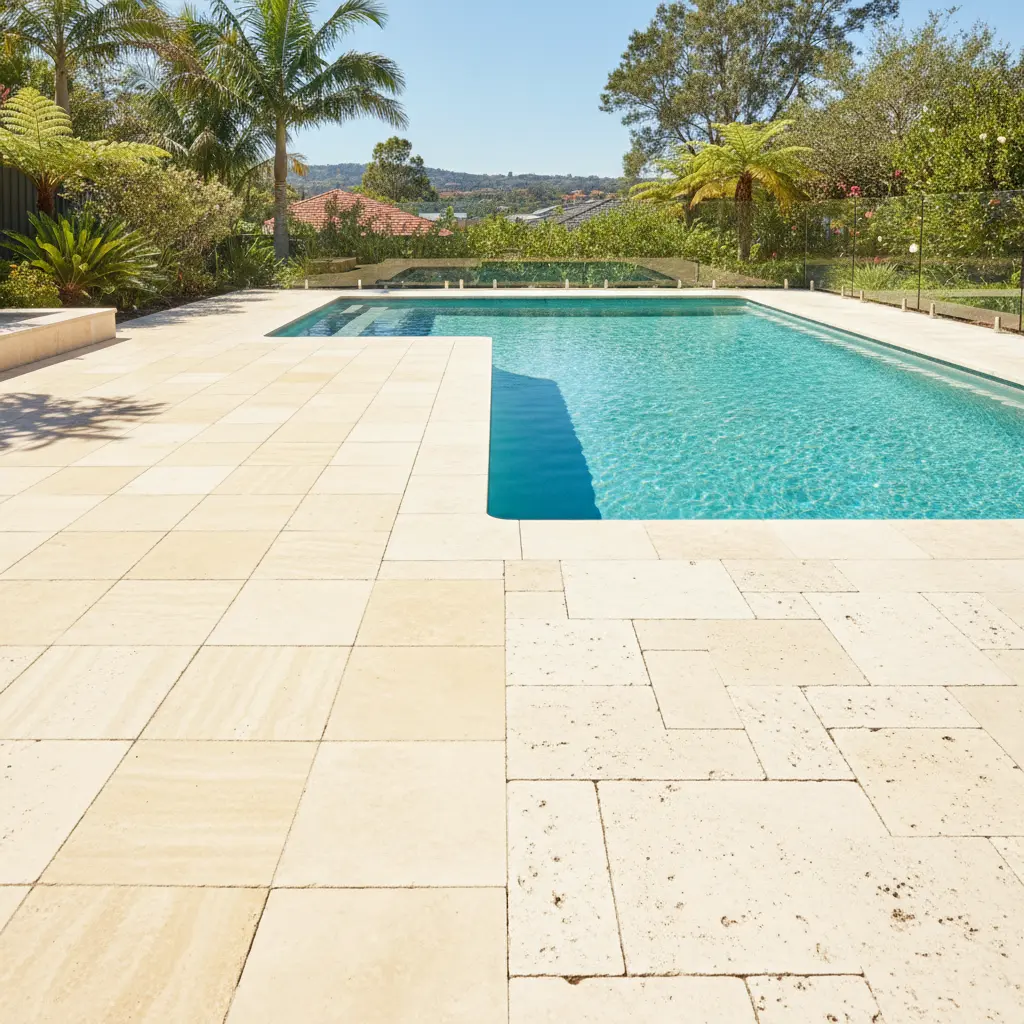
Choose travertine if you want an even cream or ivory Mediterranean look, usually in 30mm pavers or French-pattern sets laid on a slab, and you can keep pool acid and acidic cleaners off it. Choose sandstone if you want stone that matches Sydney’s heritage walls and houses, 50mm pavers that can go on a compacted base, local supply cut to size, and colours from white and gold to brown and purple. Both are pale, comfortable barefoot and need sealing.
Which option suits which project
Sandstone
Best for: Heritage-matched paving, pool surrounds, crazy paving and cut-to-size work in Sydney
View sandstoneTravertine
Best for: Even cream, Mediterranean-style patios and pools laid in French-pattern sets
Side-by-side comparison
| Sandstone | Travertine | |
|---|---|---|
| What it is | Sedimentary rock of quartz sand grains naturally cemented | A limestone (calcium carbonate) laid down by mineral springs |
| Typical outdoor formats | 50mm pavers, 30mm tiles, flagging, coping, 75–100mm for driveways | Mostly 30mm pavers and coping, French-pattern sets, crazy pieces |
| Look | White, yellow, gold, brown, orange and purple tones with banding | Ivory, cream, beige, walnut and silver with small natural voids |
| Surface options | Sawn, sandblasted, honed, hydrasplit or handsplit | Tumbled, honed or brushed; filled or unfilled |
| Heat underfoot | Pale colours stay comfortable; browns and purples warm up more | Pale colours stay comfortable in full sun |
| Slip when wet | Sandblasted and sawn give good grip; honed is smoother | Tumbled and unfilled give grip; honed and filled are smoother |
| Acid | Never use acid cleaners on it | Etched and dulled by acids, including pool acid |
| Porosity and sealing | Porous; penetrating sealer, reseal every 2–3 years outdoors | Porous with voids; seal it and patch fills that wear out |
| Salt-water pools | Use a sealer rated for salt and chlorine | Use a salt-rated sealer and keep acid splashes off |
| Matches Sydney heritage stone | Yes, the same stone family as local walls and buildings | No; reads as European or Mediterranean |
| Supply | Quarried and cut to size at Glenorie | Mostly imported in the importer’s standard sizes |
| Cost (relative) | Guide prices from $65/m² to $120/m², stone only | Varies with grade and fill; compare quotes at equal thickness |
| Best uses | Paths, patios, pools, driveways, crazy paving and steps | Patios, pool surrounds, courtyards and indoor-outdoor floors |
Sandstone prices are Stone Front guide prices for stone only, ex-quarry at Glenorie. Travertine is not sold by Stone Front; get quotes for it at the same thickness and finish.
What are travertine pavers?
Travertine pavers are slabs of travertine, a type of limestone formed where mineral springs, often hot springs, deposit calcium carbonate in layers. Gas bubbles and plant matter trapped as those layers built up leave the small holes and channels that give travertine its texture. Because it is calcium carbonate, travertine reacts with acid the same way other limestones and marble do.
Almost all travertine sold in Australia is imported, and it is sold by colour, grade and finish. These are the terms you will see on a quote:
- Unfilled: the natural holes are left open. More texture and grip, but the holes collect dirt and water.
- Filled: holes are filled at the factory with cement or resin for a smoother face. Outdoors, fills can wear or pop out and need patching.
- Tumbled: pieces are rolled in a drum to soften the edges and face for an aged look. Common for pavers, coping and crazy paving.
- Honed: ground flat and matte. Smoother and more contemporary, with less grip when wet.
- Brushed: wire-brushed to a gentle texture between tumbled and honed.
How is sandstone different from travertine?
Sandstone is made of sand grains, mostly quartz, bound together by natural cements such as silica, clay and iron oxides, whereas travertine is calcium carbonate that crystallised out of spring water. That one difference explains most of the practical ones. Travertine’s calcite is attacked by acids that quartz is not. Sandstone has no voids to fill, though it is porous throughout. And sandstone’s colour comes from iron and mineral banding, so it moves from piece to piece, while travertine tends to sit within a narrower band of creams and beiges.
Stone Front’s sandstone comes from its own quarry at Glenorie in ten colours, from Marbled White and Light Yellow to Browns, Orange and Purples. Quarry-run pallets blend the range and are the most economical; single-colour selections cost more. The sandstone colour guide shows how each tone looks laid.
Which is better around a pool?
Both stones work around a pool when they have a grippy finish and a suitable sealer; the difference is what damages them. Travertine is etched by acid, so the hydrochloric acid used to balance pool water, acid-based tile cleaners and even splashed drinks can leave dull marks. Salt-water pools are hard on any porous stone: as splashed water dries, salt crystals grow inside the pores and can flake the surface over time. Sandstone is not etched by pool acid, but Stone Front still advises never using acid cleaners on it.
On heat, colour matters more than the stone. Pale travertine and pale sandstone both stay comfortable underfoot compared with dark stone; sandstone in browns and purples warms up more than Marbled White or Light Yellow. Whichever you choose, set it up like this:
- Pick a grippy finish: sandblasted or sawn sandstone, or tumbled or unfilled travertine.
- Use proper coping. Sandstone coping is cut 30–40mm thick and 400mm or 500mm wide with a bullnose, pencil-round or drop-face edge; travertine coping usually comes with a bullnosed edge in its standard sizes.
- Lay the surround with a fall away from the pool and the house so water drains off.
- Seal with a penetrating sealer rated for salt and chlorine, then reseal outdoor stone every 2–3 years.
- Rinse coping with fresh water now and then, and keep acid cleaners off both stones.
See sandstone pool pavers for the range and the pool coping guide for profiles and falls.
What sizes and thicknesses do they come in?
Travertine pavers are usually 30mm thick and sold either in single sizes or as French-pattern sets that mix several sizes into a random-looking layout; at that thickness they are normally laid on a mortar bed over a concrete slab. Sandstone is sold thicker as well as thinner, so it can go on a compacted base for foot traffic or carry cars.
| Use | Sandstone (Stone Front) | Travertine (typical) |
|---|---|---|
| Patios and paths | 50mm sawn all round pavers, 400x400, 600x400, 600x600mm or cut to size, from $120/m² | 30mm pavers on a slab |
| Over an existing slab | 30mm outdoor tiles, 300x300 to 600x600mm, from $110/m² | 30mm pavers |
| French pattern | Any mix of sizes sawn to order | Standard French-pattern packs |
| Crazy paving | Sawn flagging 50, 75 or 100mm from $85/m²; handsplit flagging by quote | Tumbled irregular pieces, usually around 30mm |
| Driveways | 75mm minimum for cars, 100mm for heavier vehicles | Thin pavers need a reinforced slab |
Order extra for cuts: about 5–10% for French pattern and 10–15% for crazy paving. The paver calculator works it out for your area and pattern.
Travertine crazy pavers vs sandstone crazy paving
Travertine crazy pavers are irregular pieces of travertine, usually tumbled, set in mortar on a slab with open joints that are then grouted or pointed. Sandstone crazy paving comes two ways. Sawn flagging has irregular shapes with diamond-sawn edges and a flat sawn face, in 50, 75 or 100mm, from $85/m² guide price; it fits together tightly and suits contemporary layouts. Handsplit flagging is split by hand along the bedding for a riven, traditional face and comes in 10m² pallets. Both sandstone versions are thicker than typical travertine pieces and carry the full sandstone colour range, so a crazy-paved area looks busier and warmer. Browse sandstone crazy paving or compare every option in crazy pavers compared.
Which suits a Sydney heritage home?
Sandstone, because it is the same family of stone as many of Sydney’s colonial and Victorian buildings, foundations and garden walls. New sandstone paving sits naturally beside an old sandstone wall or a terrace’s front steps, and Stone Front can colour-match a batch to photos of existing stone. Travertine reads as European or Mediterranean, which suits rendered contemporary houses, resort-style pools and Tuscan-inspired gardens rather than a Federation cottage or a sandstone cottage in the Hills.
Get a sandstone paving quote
Send Stone Front the product, area and your suburb through the sandstone paver quote form and you will usually hear back the same business day. If you are still weighing up travertine, ask for quotes on both at the same thickness and finish, and include the base and laying, so you compare like with like.
Frequently Asked Questions
Can travertine or sandstone be laid over an existing concrete slab?
Yes. 30mm travertine pavers and Stone Front’s 30mm outdoor sandstone tiles are both bedded in mortar or adhesive on a sound slab. Check the finished height first: stone plus bedding adds roughly 40–50mm, which can cause problems at door thresholds and with drainage falls.
Is travertine suitable for a driveway?
Thin travertine pavers need a reinforced concrete slab to carry cars. Sandstone is sold thick enough to take vehicles: use 75mm minimum for cars and 100mm for heavier vehicles or steep driveways, laid on 150–200mm of compacted road base or a reinforced slab.
How often should travertine or sandstone pavers be resealed?
Reseal outdoor sandstone every 2–3 years with a penetrating sealer on clean, dry stone. For travertine, follow the sealer maker’s guidance. For both, a water-drop test tells you when: if drops soak in and darken the stone rather than beading, it is time to reseal.
Can I see the sandstone colours before I order?
Yes. Quarry visits at Glenorie are by arrangement and can be booked when you request a quote. You can inspect stock and see the ten colours, from Marbled White to Purples, and ask for a batch to be colour-matched to photos of existing stone.
Can travertine and sandstone be used in the same garden?
They can, but they rarely match. Travertine is an even cream or beige, while sandstone varies from white to gold, brown and purple. If you combine them, keep each to a separate area, such as travertine on a covered terrace and sandstone for walls, steps and edging.