Pool Pavers Compared: Sandstone, Travertine, Porcelain and More
Sandstone, travertine, porcelain, concrete or bluestone around the pool: which stays cooler, grips when wet, copes with salt water and needs least upkeep.
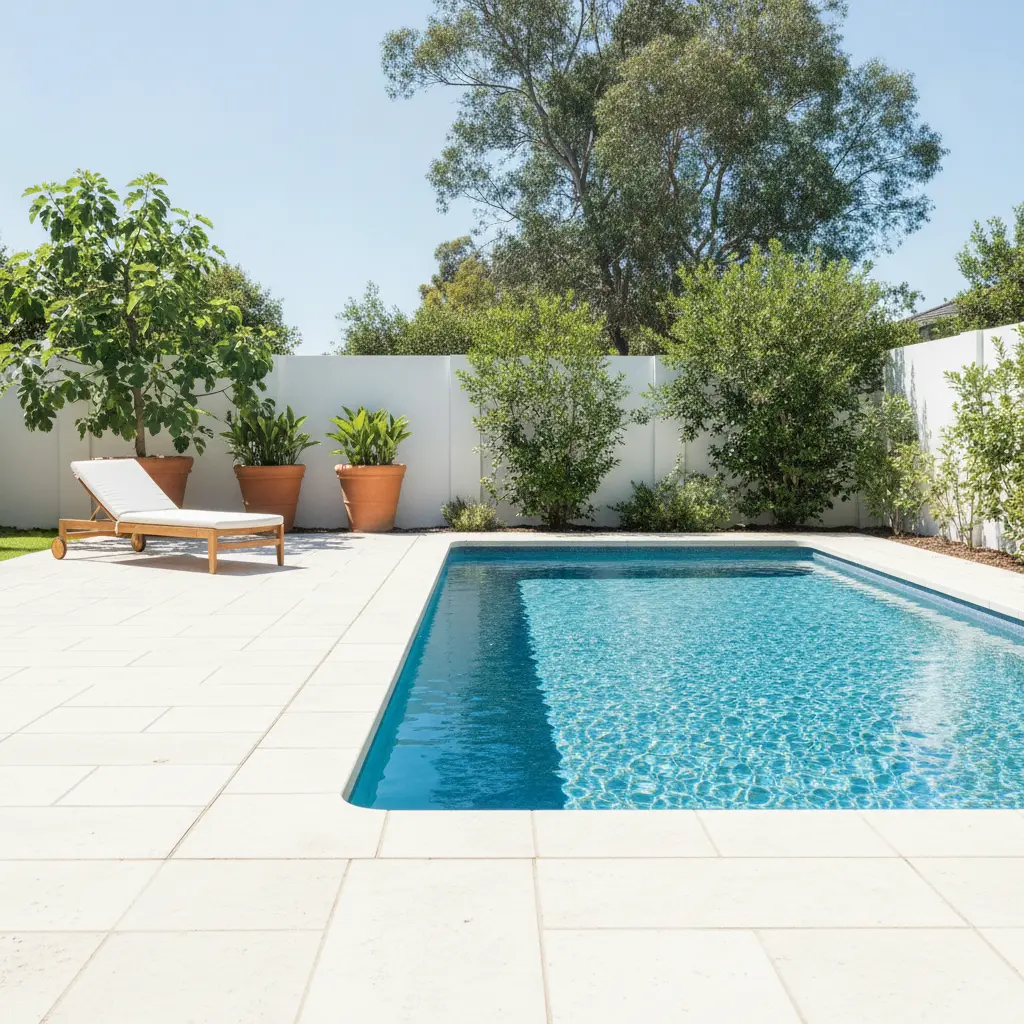
The short answer
Choose sandstone if you want a cool, natural pool surround that suits Sydney homes, in a sandblasted or sawn finish sealed with a salt-rated sealer. Choose travertine for a similar light, cool surface with a Mediterranean texture. Choose porcelain for the least maintenance and no sealing, after checking its slip rating. Choose concrete pavers when budget leads. Choose bluestone or granite for a dark, contemporary contrast, but expect bluestone to get hot in full sun.
Which option suits which project
Travertine
Best for: Light, Mediterranean-style pool areas
Porcelain
Best for: Low-maintenance pools where no sealing is wanted
Concrete pavers
Best for: Budget pool surrounds with a uniform look
Bluestone or granite
Best for: Dark, contemporary pools and hard-wearing surfaces
Side-by-side comparison
| Sandstone | Travertine | Porcelain | Concrete pavers | Bluestone or granite | |
|---|---|---|---|---|---|
| What it is | Sedimentary quartz stone, quarried at Glenorie | Limestone deposited by mineral springs, with natural holes | Fired, very dense ceramic | Moulded cement and aggregate units | Dense igneous stone; bluestone is basalt |
| Usual pool formats | 50mm pavers, 30mm tiles, 30–40mm coping | Commonly 30mm pavers with matching coping | Usually 20mm pavers with matching coping | Thicker moulded pavers and coping units | Usually 20–30mm pavers and coping |
| Heat underfoot | Light colours stay comfortable | Light colours stay comfortable | Depends on colour; dark gets hot | Depends on colour; dark gets hot | Bluestone gets hot; light granite cooler |
| Slip when wet | Sandblasted or sawn give good grip | Tumbled faces grip; honed less so | Check the P slip rating | Textured faces grip; smooth less so | Flamed or sandblasted grip; honed slippery |
| Porosity and sealing | Porous; seal with a salt-rated penetrating sealer | Porous with holes; seal | Almost no absorption; no sealing | Moderately porous; sealing advised | Lower porosity; sealing still advised |
| Salt-water pools | Suits when sealed and hosed down | Suits when sealed; surface can pit | Unaffected by salt | Surface can wear; seal | Generally resistant; seal joints and edges |
| Coping profiles | Bullnose, pencil-round, drop-face; radius cut to template | Bullnose and drop-face pieces common | Bullnose or drop-face to match range | Moulded bullnose units | Bullnose, pencil-round or drop-face |
| Look | Warm creams, yellows and browns with natural banding | Soft creams and walnut tones, pitted texture | Any look, including stone-look prints | Uniform colours; can fade | Cool grey to charcoal, or speckled granite |
| Hardness | Softer; wears in gracefully | Medium; softer than granite | Very hard; can chip if struck | Varies with quality | Very hard and dense |
| Maintenance | Reseal every 2–3 years; no acid cleaners | Reseal; refill holes as they open | Wash; check grout | Reseal; replace stained units | Low; reseal occasionally |
| Relative cost | From $110/m² tiles, $120/m² pavers (guide) | Get quotes; varies by grade | Get quotes; varies widely | Usually lowest per m² | Usually at the upper end |
| Sold by Stone Front | Yes | No | No | No | No |
Heat and slip depend heavily on colour and finish; ask any supplier for slip test results for wet barefoot areas.
Pool pavers are the paving laid around a swimming pool, together with the coping that caps the pool edge. They do a harder job than patio paving: wet bare feet, full sun, splashed salt or chlorinated water and frequent cleaning. Here is how sandstone, travertine, porcelain, concrete pavers and bluestone or granite handle each of those.
What are the main types of pool pavers?
The main pool paver materials in Sydney are natural sandstone, travertine, porcelain, concrete pavers, and dense stones such as bluestone and granite. Sandstone is a sedimentary stone of cemented quartz grains, and Sydney’s own stone is quarried at Glenorie in ten colours. Travertine is a limestone deposited by mineral springs, recognisable by its natural holes. Porcelain is a fired ceramic made very dense, sold as 20mm outdoor pavers in stone, concrete and timber looks. Concrete pavers are moulded from cement and aggregate in uniform colours. Bluestone is basalt, a dark volcanic stone, and granite is a hard igneous stone in light to dark speckled colours.
Which pool pavers stay coolest underfoot?
Light-coloured pavers stay coolest, whatever the material, because colour largely decides how much sunlight a surface absorbs. Pale sandstone and light travertine are comfortable for bare feet on most summer days, while bluestone, charcoal granite and dark porcelain or concrete can become too hot to stand on in full afternoon sun. In sandstone, Marbled White, White with Greys and Light Yellow are the cooler choices, while Browns and Purples absorb more heat. If you love a dark stone, keep it for shaded areas or borders and use a lighter paver where people walk barefoot.
Which pool pavers are least slippery when wet?
Pool pavers are least slippery when they have a textured finish suited to wet barefoot areas, and the finish matters more than the material: the same stone can be safe sandblasted and slippery honed.
- Sandstone: sandblasted is the most slip-resistant sandstone finish and the usual pool choice; sawn also gives good grip.
- Travertine: tumbled and unfilled surfaces have more grip than honed, filled faces.
- Porcelain: choose an outdoor range rated for pool surrounds. In Australia, slip resistance is tested to AS 4586 and given a P rating from P0 to P5, higher being more slip resistant; ask for the test report.
- Concrete pavers: textured and exposed-aggregate faces grip better than smooth faces.
- Bluestone and granite: flamed, sandblasted or bush-hammered finishes suit pools; honed and polished faces are slippery when wet.
Keep any surface clean too: algae on shaded, damp paving is slippery on every material, so trim back overhanging plants and make sure the surround drains instead of holding puddles.
Which pavers suit a salt-water chlorinator pool?
Porcelain is the least affected by salt water because it absorbs almost no water, but natural stone works well around salt pools when it is sealed and cared for. The risk with porous materials, sandstone and travertine included, is salt crystallising inside the surface as splashed water dries, which can make the surface flake or fret over time. Concrete pavers can wear the same way.
- Seal natural stone and concrete pavers with a penetrating sealer rated for salt and chlorine before the pool is filled.
- Hose down the splash zone regularly so salt does not build up.
- Reseal outdoor sandstone every 2–3 years, or sooner if water stops beading.
- Never use acid cleaners on sandstone, travertine or other natural stone.
Our sandstone pool coping guide covers sealers and falls for salt-water pools in more detail.
Which pool coping profile should I choose?
Bullnose coping is the most common profile because its rounded edge is comfortable to sit on and kind to hands and feet climbing out. Sandstone coping is cut 30–40mm thick and 400mm or 500mm wide in these profiles:
| Profile | Edge shape | Look and use |
|---|---|---|
| Bullnose | Full half-round edge | Classic and comfortable to sit on |
| Pencil-round | Small radius on the corner | Crisp and modern, still smooth to touch |
| Drop-face | Thickened front edge | Looks like a chunky slab; suits modern pools |
| Square | Sharp corner | Minimal look; edge is harder on bare skin |
Radius pieces for curved pools are cut to a template at the quarry. Travertine, porcelain, concrete and granite ranges generally offer bullnose and drop-face coping made to match their pavers; whichever you choose, order coping and pavers together for a colour match.
Coping is bedded in mortar on the pool’s concrete beam and is usually laid before the surrounding paving, so the paving can then be set to fall away from it. Allow for the coping in your quantities separately: it is ordered in lineal metres around the pool edge, while the paving is ordered in square metres. Sandstone 50mm pavers weigh about 115kg per m², so a pool surround of 40m² is roughly 4.6 tonnes of stone to place by hand, which is worth planning around site access.
How do pool pavers compare on looks and upkeep?
Sandstone gives warm creams, yellows and browns with natural banding, and it suits Sydney homes because it is the local stone. Travertine has a soft, Mediterranean look, but its holes can open over time and need filling. Porcelain gives the most consistent look and the least upkeep, though stone-look prints can repeat across a large area. Concrete pavers are uniform and can fade in strong sun. Bluestone and granite give a cool, contemporary contrast with blue water and very hard surfaces.
Pool areas are used at night too, so plan lighting with the paving; our pool area lighting ideas show how to light steps, paths and garden edges around a pool. For two-way detail, read sandstone vs travertine pavers and sandstone vs porcelain pavers.
Get a quote for sandstone pool pavers
Send the paving area, coping length in lineal metres, preferred finish and your suburb through the pool paver quote form, and Stone Front usually replies the same business day. Sizes, finishes and coping options are on our sandstone pool pavers page.
Frequently Asked Questions
What size pavers suit a pool surround?
Larger formats such as 600 x 400mm and 600 x 600mm give fewer joints and a calmer look around a pool, while 400 x 400mm suits smaller or curved areas with more cuts. Stone Front’s sawn all round sandstone pavers come in these sizes at 50mm thick and can be cut to any specified size.
How thick should pool pavers be?
Sandstone pool pavers are 50mm thick when laid on a compacted base with bedding sand, or 30mm outdoor tiles when bedded on a concrete slab. Sandstone coping is 30–40mm. Porcelain pool pavers are usually 20mm and should be laid exactly as the manufacturer specifies for outdoor use.
Which way should pool paving fall?
Pool paving should fall away from the pool water and away from the house, so rain and splash water drain to the garden or a drain rather than back into the pool. A fall of about 1:60 to 1:100, or 10–17mm per metre, is typical for outdoor paving.
Do sandstone pool pavers fade?
Sandstone’s colour runs through the stone rather than sitting on the surface, so it does not fade the way pigmented products can, though it may mellow slightly as it weathers. Pavers look patchy when dirt, algae or leaf tannin soak in, which sealing and regular hosing help prevent.
Can I use the same stone for the coping and the paving?
Yes, and it gives a seamless look. Sandstone coping is cut 30–40mm thick to match sawn pavers and tiles in the same colour selection. Many designs instead use a contrasting coping, such as a lighter bullnose edge against darker paving, to outline the shape of the pool.