Pool Area Lighting Ideas: Solar Lighting Around the Pool
How to light pool steps, coping edges, the gate and palms with low, warm solar lights, avoid glare on the water and pair lighting with sandstone coping.
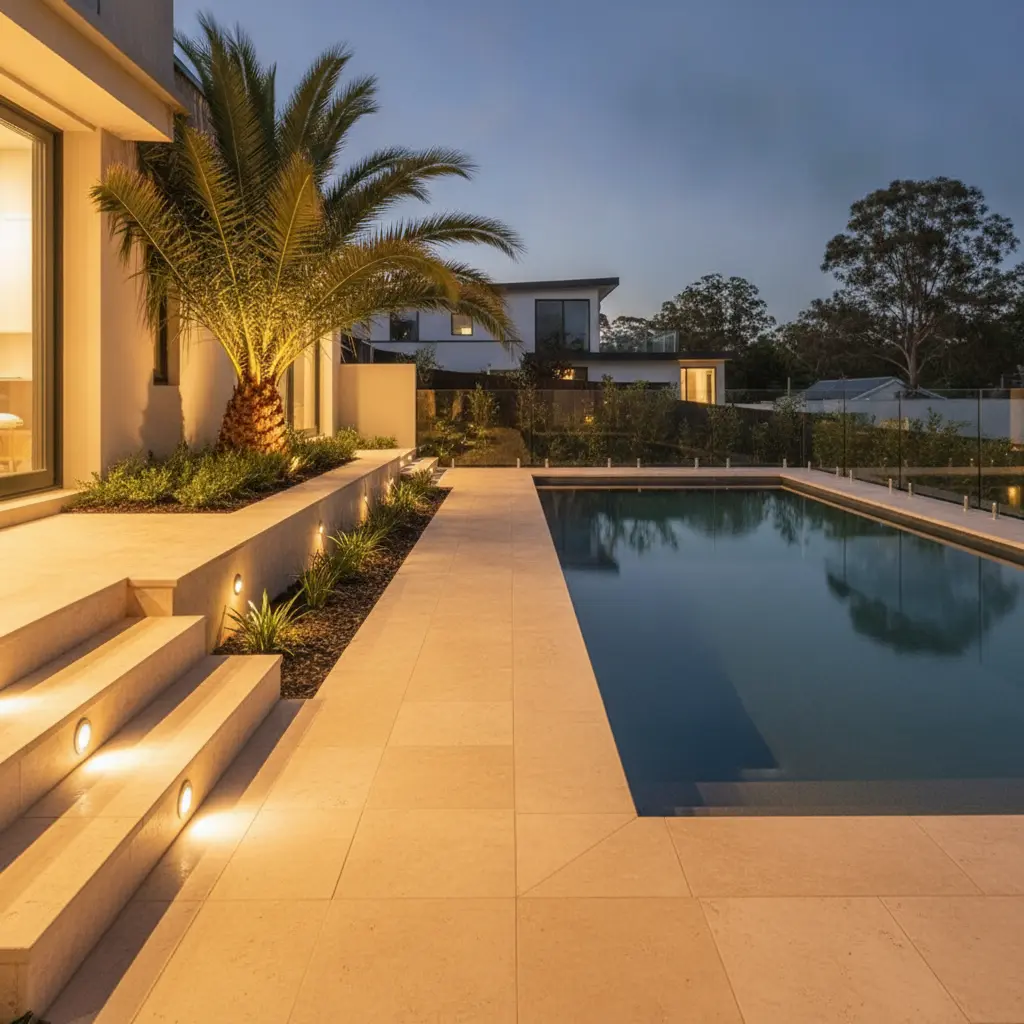
The way to light a pool area safely is to light what surrounds the water: the steps, paths, coping edges, the pool gate and a few feature plants, using low, warm, shielded lights rather than bright lights aimed at the pool. Solar fixtures suit pool surrounds because there is no mains cabling near the water. One note up front: we do not sell in-pool or floating solar pool lights.
- Light the edges, not the water. Steps, coping edges, the gate and paths matter most for safety.
- Keep lights low and warm. Warm white (roughly 2700–3000K) flatters sandstone coping and cuts glare on the water.
- IP65 is weatherproof, not waterproof. It means dust-tight and protected against water jets, not rated to sit underwater.
- Pool barrier rules are separate. Lighting does not change what your fence must comply with; check the NSW pool barrier requirements.
Are solar pool lights in the pool or around it?
People searching for "solar pool lights" usually mean one of two things. The first is a floating or in-pool light: a sealed ball or disk that drifts on the surface or sits on the pool floor and charges by day. The second is lighting around the pool: steps, paths, garden beds, fences and palms. These are different products with different ratings.
We sell the second kind only. Our lights are rated IP65, which protects against rain and water jets but does not make them suitable for immersion, so none of them belong in the water. If you want lights in the pool itself, talk to your pool builder or a licensed electrician about fittings made and rated for underwater use. The rest of this guide is about the area around the pool, which is where most of the night-time safety and atmosphere comes from anyway.
Pool area lighting ideas
Light the pool steps and the path to the pool
Changes of level near water are the first thing to light. The Solar Step Light fixes to the riser of a stone or timber step and throws a low-glare light down onto the tread, so people see the step without looking into a bright point. Fit one to every second riser on garden steps leading down to the pool, and alternate sides on wider flights. For the path from the house, a line of stake lights or disks 1.5–2 m apart is enough to show the route.
Mark the coping and paving edges
The Solar In-Ground Disk Light sits flush in soil, so it can mark the outer edge of the pool paving from the garden strip or lawn beside it. Set disks in the soil, not in the paving: cutting holes in coping or pavers weakens the stone and creates a hollow that collects water. Avoid low spots where pool splash or rain collects. A line of disks about 1.5–2 m apart along the garden side of the paving shows where the hard surface ends.
Light the pool fence, gate and retaining walls
The Stainless Solar Wall & Fence Light fixes with two screws to masonry, sandstone or timber posts. A light on the post beside the pool gate makes the latch easy to find and check at night. On a sandstone retaining wall behind the pool, a light every 1.5–2 m turns the wall into a soft backdrop. Fix lights on the outside of the barrier, where they cannot be used as a foothold (see the safety section below).
Uplight palms and feature walls
Palms, frangipanis and a sandstone feature wall behind the pool are the natural accents. The Warm White Solar Spotlight placed low and close to a trunk or wall picks out the shape without lighting the water. Aim each spotlight away from the pool and away from the main viewing spots, so the beam lands on the feature and not across the water.
Set the mood in the entertaining area
Where the pool doubles as the entertaining space, the Backyard Entertaining Lighting Kit combines wall lights for the fence and posts, in-ground lights for the beds or paving edge, and two warm spotlights for a palm or wall. For a path-led layout, the Path & Ground Lighting Kit pairs stake lights for the path with disks for the edges.
Pool area lighting planning table
| Pool zone | Fixture | Placement | Spacing |
|---|---|---|---|
| Garden steps to the pool | Step light | On the riser, light aimed down | Every second riser |
| Path from the house | Stake lights or disks | Beside the path, set back from the edge | 1 every 1.5–2 m |
| Outer edge of pool paving | In-ground disk | In the soil or lawn beside the paving, not in it | 1 every 1.5–2 m |
| Pool gate | Wall and fence light | Outside face of the gate post | 1 per gate |
| Retaining or feature wall | Wall and fence lights, warm spotlight | On the face or below the capping; spotlight low and close | Wall lights every 1.5–2 m |
| Palms and feature plants | Warm spotlight | Low, aimed up the trunk and away from the water | 1 per palm, 2 for a group |
How do you stop glare on the pool?
Still water acts like a mirror. A bright light aimed at the pool, or one placed on the far side of it, reflects straight back at anyone looking out from the house or the deck. A few rules keep the water dark and calm:
- Aim away from the water. Spotlights should point at trunks and walls, with the pool behind the light, not in front of it.
- Keep it low. Step lights, disks and downward wall lights put light on the ground, where it is needed, without a visible bright source.
- Use warm white. Warm white reflects as a soft glow; cool white reads as hard points of light on the surface. Our guide to warm white vs cool white solar lights explains the difference.
- Check from the house. Walk around at dusk on the first evening and turn or move any light whose reflection you can see from the living area.
Pool lighting safety: the gate, the steps and the fence rules
Good lighting helps people find the steps, the gate latch and the edge of the paving after dark, but it does not make a pool safe on its own and it is not part of pool barrier compliance. Pool fencing in NSW has its own rules, including gate operation and areas around the barrier that must stay non-climbable. Before you fix anything to or near the pool fence, check the NSW pool barrier requirements with your council or a pool safety certifier, and make sure no light, bracket or spotlight stake gives a child a foothold on the outside of the fence.
Keeping electrics away from water
The practical advantage of solar beside a pool is that there is no mains cabling to run through wet ground and no power point to fit outdoors. Each light carries its own small panel and rechargeable battery. That said, follow the manufacturer's guidance for every fitting: keep lights out of areas that flood or hold water, and do not put IP65 fittings anywhere they will be submerged. Pool splash can leave salt or chlorine residue on panels, so wipe them with a damp cloth every few weeks to keep them charging. Any mains-powered pool or garden lighting needs a licensed electrician. Our comparison of solar and wired outdoor lighting covers the trade-offs.
Pairing pool lighting with sandstone coping
Golden and cream sandstone is a popular pool surround in Sydney because it stays comfortable underfoot and suits the light. At night, warm white light makes the stone glow; cool white tends to flatten it to grey. Low disks along the garden side of the coping and a warm spotlight grazing a sandstone wall behind the pool make the stone part of the night-time view. If you are still choosing materials, see our sandstone pool pavers and the sandstone pool coping guide. Planning the lighting at the same time lets you leave soil strips beside the paving for in-ground lights.
Light your pool area with Stone Front
Start with the steps and the gate, then add warm accents on palms and walls. The Backyard Entertaining Lighting Kit covers a typical pool and patio area, and our outdoor lighting ideas cover the rest of the yard.
Frequently Asked Questions
Do you sell floating solar pool lights?
No. Our range is for lighting around a pool, not in it. Every light is rated IP65, which protects against rain and water jets but not immersion. For floating or underwater lights, choose products made and rated for use in the water, and ask your pool builder for advice.
Will chlorine or salt water damage solar lights?
Splash can leave a film of chlorine or salt on panels and housings, which cuts charging and can mark finishes over time. Place lights back from the splash zone, choose stainless steel housings where possible, and wipe panels and fittings with fresh water every few weeks.
Do I need an electrician for pool area lighting?
Not for solar lights, which carry their own panel and battery and need no cabling. Any mains-powered lighting near a pool, including in-pool lights, must be installed by a licensed electrician, who will apply the specific wiring rules for areas around pools.
How bright should pool area lighting be?
Soft. Around a pool you want to see steps, edges and the gate, not floodlight the water. Low warm white lights at foot level, plus one or two spotlights on palms or a wall, give enough light to move around safely without glare off the surface.
Can I fix lights to a glass pool fence?
Not to the glass. Fix lights to masonry piers, posts or a nearby retaining wall on the outside of the barrier, and check that nothing you add creates a foothold in a non-climbable zone. NSW pool barrier rules apply regardless of lighting, so confirm them with your council or a certifier.