Outdoor Lighting Ideas for Australian Gardens and Backyards
12 outdoor lighting ideas for paths, entries, sandstone walls, decks, driveways and entertaining areas, each with the fixture, placement and matching solar kit.
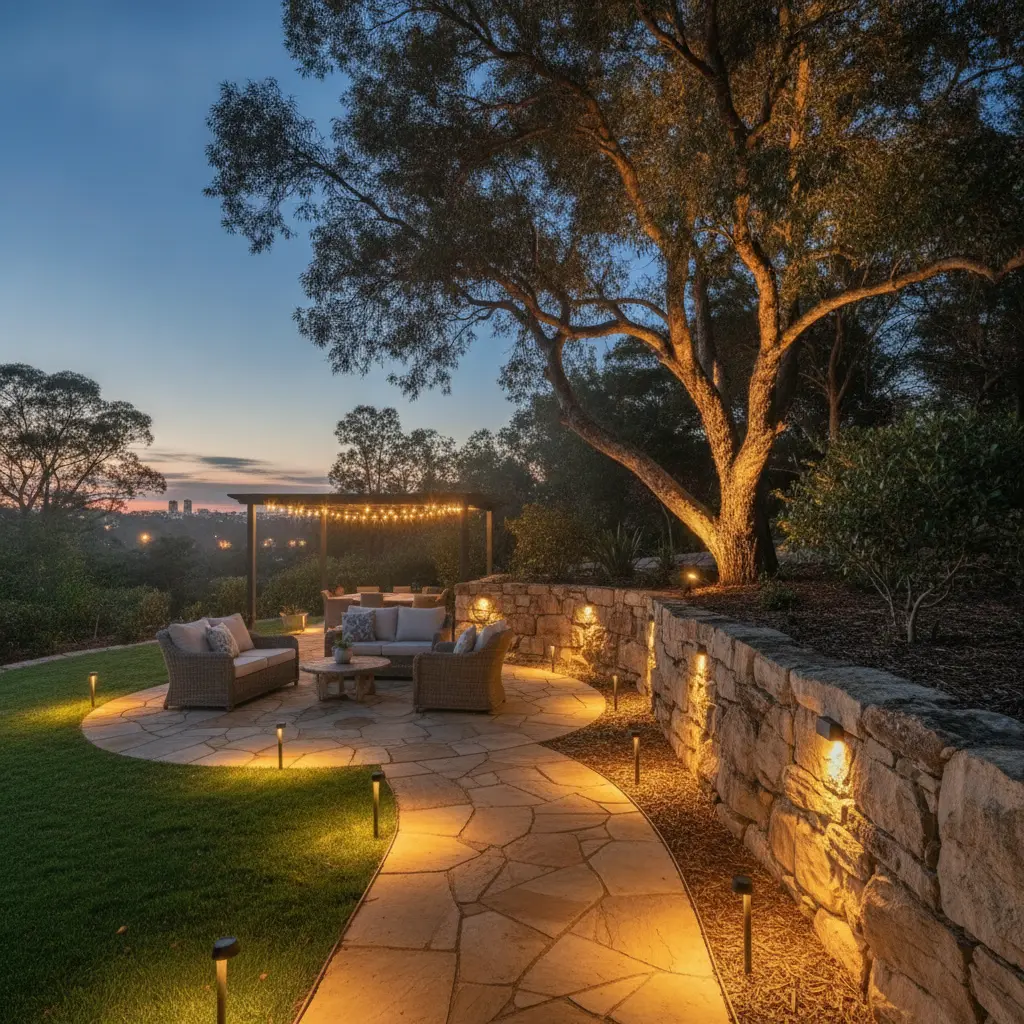
Good outdoor lighting ideas start with three layers: low lights that mark paths, steps and edges for safety; accent lights that pick out a tree, a sandstone wall or a feature plant; and soft ambient light around the places you sit. The twelve ideas below cover the front garden, the backyard and the entertaining area, each with the fixture, where to put it and the matching solar kit.
What is layered outdoor lighting?
Lighting designers talk about layers because one type of light rarely works on its own. A yard lit only by path lights looks like a runway; one lit only by a spotlight on a tree looks like a stage with everything else in darkness. Three layers cover almost every garden:
- Path and safety light marks where people walk: paths, steps, deck edges, gates and changes of level. It sits low, points down and is spaced so the line reads clearly. Fixtures: stake lights, step lights and in-ground disks.
- Accent light gives the eye something to rest on: a tree, a sculptural plant, a rock-faced sandstone wall. It is directional and usually aimed up or across a surface. Fixtures: spotlights.
- Ambient light sets the mood where people gather: a soft glow on walls, fences and the edges of a patio, so the space feels enclosed rather than black beyond the table. Fixtures: wall wash lights and wall and fence lights.
Start with the safety layer, add one or two accents, then fill in ambient light where you sit. Keep to one colour temperature throughout. Warm white, roughly 2700–3000K, suits sandstone, timber and planting, as our guide to warm white vs cool white solar lights explains.
Front garden and entry lighting ideas
1. Light the path from the street
What it does: shows visitors where to walk and leads them to the door. Fixture: Solar Pathway Stake Lights, which push into the ground with no tools. Where: along one side of the path about 1.5–2 m apart, or alternating sides on a wider path, set back a little from the edge so they are not kicked. Kit: the Path & Ground Lighting Kit suits a path of roughly 8–12 m with beds beside it.
2. Frame the gate and front door
What it does: marks the threshold and makes the step, the latch and the house number easy to find. Fixture: stainless wall and fence lights. Where: one on each gate pillar or either side of the door, on a face that gets sun for most of the day. Kit: the Entry & Garden Lighting Kit pairs four wall lights for the entry with six path lights and two spotlights for a front tree or wall.
3. Edge the garden beds with flush lights
What it does: gives the garden its shape at night with no visible fittings by day. Fixture: in-ground disk lights. Where: just inside the bed edge, 1.5–2 m apart, kept clear of mulch and out of low spots. Our guide to solar deck and in-ground lights covers installing them. Kit: Path & Ground Lighting Kit.
Garden lighting ideas for trees, walls and slopes
4. Uplight a feature tree
What it does: lifts the canopy out of the dark and gives the garden depth when you look out from the house. Fixture: a spotlight from our solar spotlights range. Where: about half a metre to a metre from the trunk, aimed up into the canopy. Use two from different angles on a large tree. The panel sits on the light itself, so choose the sunny side of the trunk. Kit: Feature Lighting. Our uplighting guide covers aiming in detail.
5. Graze a sandstone wall
What it does: brings out the texture of rockfaced sandstone blocks or split logs, so the wall becomes a feature at night. Fixture: warm spotlights set low and close to the wall, aimed up at a shallow angle so the light skims the face, with wall lights on pillars or along the top. Kit: the Sandstone Wall Lighting Kit (eight wall lights and two warm spotlights). See how to light a sandstone garden for more.
6. Run a line of light along a retaining wall
What it does: makes the level change visible and turns a long wall into a soft band of light. Fixture: stainless wall and fence lights. Where: on the face or just below the capping, roughly every 1.5–2 m, with each panel facing open sky. Kit: the Retaining Wall Lighting Kit is sized for walls of about 15–25 m. More layouts are in our retaining wall lighting ideas.
Backyard lighting ideas for steps, decks and fences
7. Light every second step
What it does: shows each tread and stops missed steps. Fixture: the low-glare Solar Step Light. Where: on every second riser, alternating sides on wider flights; two lights cover a flight of up to four steps. Our guide to how many step lights you need has the full rule set.
8. Define the deck edge and the fence line
What it does: outlines the deck and pushes the boundary of the yard outwards, so the garden feels bigger at night. Fixture: stainless wall and fence lights from the solar fence lights range. Where: one on each deck corner, one every 1.5–2 m of exposed fascia, and one on every second fence post. Kit: the Fence, Deck & Step Lighting Kit. Our deck and stair lighting ideas go further.
Outdoor entertaining area lighting ideas
9. Ring the seating area with low, warm light
What it does: lets you see faces and food without a bright light shining in anyone's eyes. Fixture: wall lights on the fence and posts around the seating, disks in the nearby beds, and a spotlight on a tree just beyond the table to give the view some depth. Where: keep fittings below seated eye level and aimed down or away from the table. Kit: the Backyard Entertaining Lighting Kit (eight wall lights, four ground lights and two spotlights). If the entertaining area wraps around a pool, read our pool area lighting ideas first.
10. Wash the patio wall
What it does: a soft downward wash on the house wall or a sandstone feature wall lights the patio indirectly, which is more comfortable than a single bright light by the door. Fixture: the Solar Wall Wash Light, browsable with the rest of the solar wall lights. Where: either side of the back door, then every 2–3 m along the wall, on walls that see sun. Kit: Pathway & Patio (five step lights and four wall wash lights).
Driveway and whole-yard lighting ideas
11. Mark the driveway edge
What it does: shows drivers the line of the drive and the turn in from the street. Fixture: in-ground disks along the lawn border and stake lights on the garden side. Where: beside the wheel paths, never in them, about 2.5–3 m apart, doubled up at the entrance. Kit: the Driveway Edge & Path Kit.
12. Plan the whole yard in one go
What it does: gives the front and back a consistent look, with one colour temperature and fittings that match. Fixture: a mix of spotlights, wall lights and step lights. Where: walk the yard at dusk with a torch and mark the paths, steps, two or three features and the seating area. Kit: the Whole Yard Bundle (four spotlights, four wall lights and five step lights), or combine two of the kits above. Installing in stages works well: fit the safety layer first and add accents once you have lived with it for a few evenings.
Outdoor lighting planning table
| Area | Layer | Fixture | Spacing or quantity rule |
|---|---|---|---|
| Front path | Safety | Stake lights | 1 every 1.5–2 m, one side or alternating |
| Gate or front door | Safety and ambient | Wall and fence lights | 1 each side |
| Garden bed edges | Ambient | In-ground disks | 1 every 1.5–2 m |
| Feature tree | Accent | Spotlight | 1 for a small tree, 2 for a broad canopy |
| Sandstone feature wall | Accent and ambient | Spotlights plus wall lights | Wall lights every 1.5–2 m; spotlights on the strongest sections |
| Retaining wall | Safety and ambient | Wall and fence lights | 1 every 1.5–2 m |
| Outdoor steps | Safety | Step lights | Every second riser; 2 for up to 4 steps |
| Deck edge | Safety | Wall and fence lights | 1 per corner, plus 1 every 1.5–2 m of exposed edge |
| Fence line | Ambient | Wall and fence lights | 1 every second post, or about every 2 m |
| Patio wall | Ambient | Wall wash lights | 1 either side of the door, then every 2–3 m |
| Driveway edge | Safety | Disks and stake lights | 1 every 2.5–3 m, beside the wheel paths |
Common outdoor lighting mistakes
- Too many lights. A path light every half metre looks like a runway. Start with the spacings above and add only where you find dark gaps.
- Panels in shade. Solar panels need roughly 6–8 hours of direct sun. Check each spot in the middle of the day, and remember winter shadows are longer.
- Mixed colour temperatures. Warm and cool white side by side look patchy. Pick one and keep to it.
- Glare at eye level. Aim lights down or across surfaces, not at the house or the seating area.
- Forgetting the view from inside. Much of the value of garden lighting is what you see through the windows, so light the features visible from the living room.
Plan your outdoor lighting with Stone Front
Each idea above maps to a kit, so you can light one area at a time and keep the look consistent. Browse the solar path lights alongside the wall lights and spotlights linked above, or start with the kit that matches the part of the yard you use most.
Frequently Asked Questions
How many lights does a backyard need?
Start with the safety layer: a light every 1.5–2 m along paths and edges and one on every second step. Then add two or three accents and some ambient light around the seating. Our kits hold 10 to 14 lights for one area, a sensible starting point for a suburban backyard.
Can I install outdoor lighting myself?
Solar lighting, yes: each light has its own panel and battery, so the job is stakes, screws and placement. Mains-powered outdoor lighting in NSW must be installed by a licensed electrician, and low-voltage systems typically need a transformer plugged into a weatherproof outdoor power point.
Do I need council approval for garden lighting?
Most NSW councils do not require approval for low-level garden lighting at a house, but light spilling into a neighbour’s windows can lead to a nuisance complaint. Aim lights down and away from boundaries, and check with your council before anything unusual, such as tall pole lights.
Can I mix solar and wired outdoor lights?
Yes. Many homes use wired lights near the house, where power is easy to reach, and solar lights in the far garden, along fences and on retaining walls where cabling would mean trenching. Keep both at the same colour temperature, ideally warm white at about 2700–3000K, so they read as one scheme.
Do solar garden lights work in shade?
Poorly. A solar panel needs roughly 6–8 hours of direct sun to charge well, so lights in deep shade under trees or eaves run short or dim. Check each spot at midday, move the light into sun where you can, and use wired lighting for areas that never see the sun.