Warm White vs Cool White Solar Lights: Which Suits Your Garden?
Warm white (2700–3000K) or cool white (5000–6500K)? How each looks on sandstone, timber, planting and brick, and when cool white makes sense.
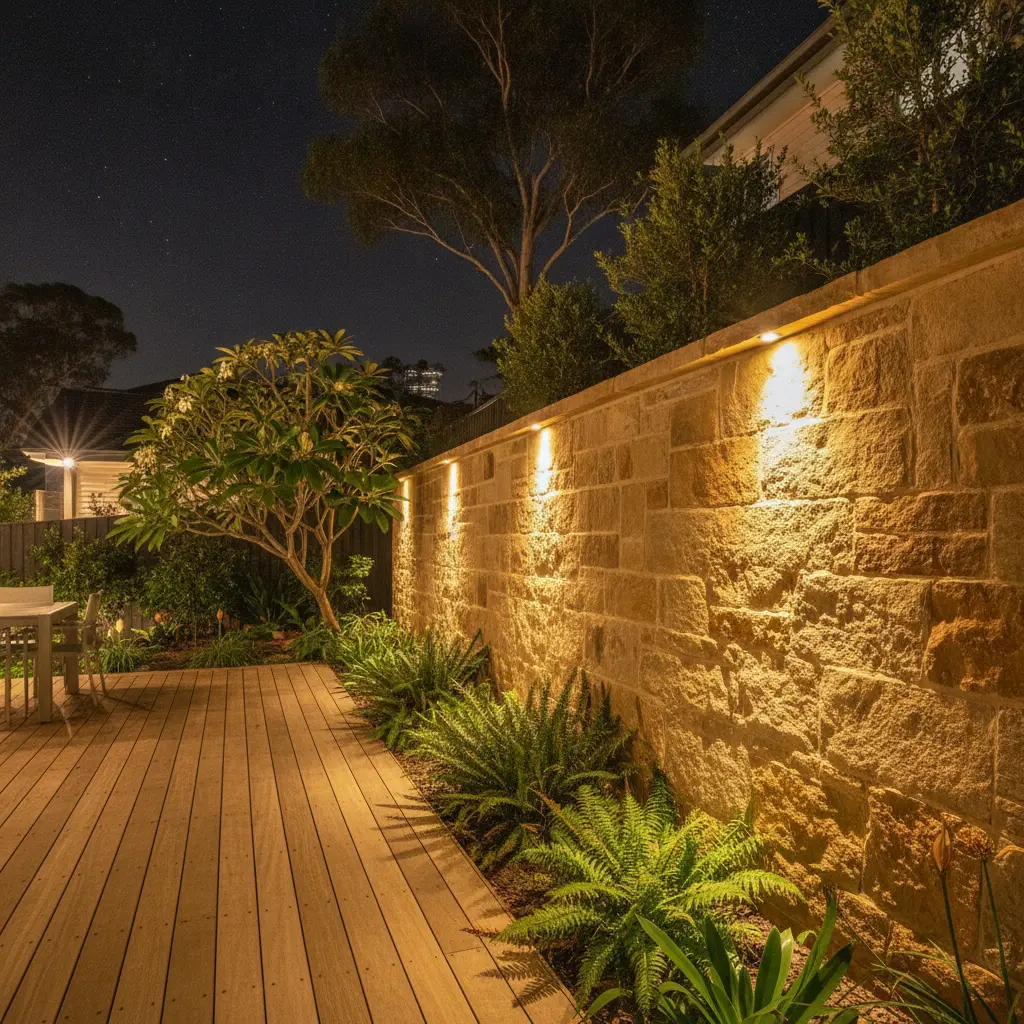
Warm white solar lights (about 2700–3000K) give a soft, slightly golden glow that flatters sandstone, timber and planting, while cool white lights (about 5000–6500K) look bluer and harsher and suit security and task lighting. For a Sydney garden with golden or cream sandstone, warm white is the usual choice; cool white tends to make the stone look grey and flat.
- Warm white: roughly 2700–3000K, similar to traditional incandescent globes.
- Neutral white: roughly 4000K, a clean white without a strong yellow or blue cast.
- Cool white or daylight: roughly 5000–6500K, a bluish white like an overcast midday sky.
- The rule: use one colour temperature per area of the garden, and warm white for sandstone.
What is colour temperature?
Colour temperature describes how warm (yellow-orange) or cool (blue) a white light looks. It is measured in kelvin, written K. The lower the number, the warmer the light. It has nothing to do with how hot the light gets, and it is separate from brightness: a warm white light and a cool white light can put out the same amount of light, though cool white often looks brighter to the eye because of its blue content.
| Colour temperature | Name | Look | Suits |
|---|---|---|---|
| 2700–3000K | Warm white | Soft, golden, relaxed | Sandstone walls and paving, timber decks, planting, entertaining areas, entries |
| About 4000K | Neutral white | Clean and crisp, little colour cast | Modern grey or white render, concrete, work areas |
| 5000–6500K | Cool white or daylight | Bright, bluish, clinical | Security lighting, side passages, bin areas, car spaces |
How do warm white and cool white look on sandstone?
Sydney sandstone runs from creams and whites through yellows, browns, oranges and purples. Most of those colours sit at the warm end of the spectrum, so they glow under warm white light: a Banded Yellow or Light Yellow wall picks up a honey tone and the bands in the stone stand out. Under cool white the same wall loses its warmth and can look grey, flat or even slightly green, because there is less red and yellow in the light for the stone to reflect.
| Sandstone colour | Under warm white | Under cool white |
|---|---|---|
| Light Yellow, Banded Yellow | Honey-gold; the banding stands out | Greyish; the banding looks muted |
| Browns, Orange | Rich and deep | Muddy and flat |
| Medium Yellow with Purples | Warm, with the purple veining visible | Yellows turn grey and purples look cold |
| Marbled White, White with Greys | Soft cream | Crisp but stark, closer to concrete |
Paler stone such as Marbled White or White with Greys handles neutral light better, but still looks softer and more natural under warm white. Our sandstone colour guide shows the quarry colours. For a sandstone wall, the Warm White Solar Spotlight set low and close to the face brings out the texture of a sandstone retaining wall, especially rockfaced blocks, while wall lights along the top give an even line of light.
How does colour temperature look on timber, planting and brick?
Timber decks and fences
Timber is warm-toned, so warm white light makes it look rich and natural. Cool white can make stained timber look dull and grey-brown. The Stainless Solar Wall & Fence Light is warm white and suits fence posts and deck edges.
Planting
Leaves are one place cool light has a case: it makes greens look crisper. Warm white makes foliage look softer and more natural, and suits flowering plants and trunks. In a garden built around sandstone, warm white keeps the plants and the stone in the same light, which reads as one scene.
Recycled red brick
Red and brown recycled red bricks come alive under warm white, which deepens the reds and shows the variation between bricks. Cool white can turn them pinkish-grey.
Can you mix warm white and cool white lights?
Within one view, avoid it. Warm and cool lights side by side make the cool fittings look cold and the warm ones look yellow, and the garden reads as patchy. Common rules:
- One temperature per zone. Keep everything visible from one spot, such as the patio, at the same temperature.
- Separate security lighting. If you want a cool white security light in the side passage or over the car space, keep it out of sight of the main garden.
- Buy from one range. "Warm white" varies between brands. Two lights both labelled warm white can still look different, so match fittings within a range where you can.
Does colour temperature affect glare?
Yes, in practice. Cool white light is scattered more in the eye and looks harsher, so a cool white fitting in your line of sight feels glarier than a warm one of similar output. Whatever the colour, aim lights down or across a surface, keep fittings low, and shield the source. A downward light such as the Solar Wall Wash Light puts the glow on the wall, not in your eyes.
Warm white, wildlife and insects
As a general rule, light with more blue in it tends to be more disruptive at night. Many insects are drawn more strongly to blue-rich light, and bright white light can affect nocturnal animals. Warm white, kept low, aimed down and only as bright as needed, is gentler on gardens. Solar marker lights help here too: they are low-level fittings rather than floodlights. If wildlife is a priority on your block, keep lighting to the paths and features you use and leave the rest of the garden dark.
When does cool white make sense?
Cool white has its place. It suits:
- Security lighting on side passages, bin areas and car spaces, where seeing detail matters more than atmosphere.
- Work areas such as a shed door or barbecue prep bench, where colour accuracy and alertness help.
- Very modern designs in grey render, concrete and steel, where a neutral 4000K may suit better than warm white.
For a sandstone garden, timber deck or entertaining area, warm white is almost always the better fit. For ideas on where each light goes, see our outdoor lighting ideas; for poolside colour choices, see our pool area lighting ideas.
How to choose warm white solar lights
Colour labels are not always precise, so check a few things before you choose:
- Look for a kelvin figure. "Warm white" with a figure of 2700–3000K is clearer than a label alone. Lights described only as "white" or "bright white" are usually cool.
- Check the modes. Some solar spotlights offer several modes, and some have a white or colour-changing setting as well as warm white. Make sure every light in a group is set the same way.
- Look at night photos. Photos of a light switched on at night show its colour far better than daytime shots of the fitting.
- Keep to one range per area. Fittings from the same range match each other; mixing brands is where colour differences show up.
- Do not trade colour for apparent brightness. Cool white can look brighter in the box, but in a garden a warm light in the right place does more than a cool light in the wrong one.
Many low-cost solar lights use cool white LEDs, which is why so many gardens end up with a blue-white glow along the paths. Checking the colour temperature first avoids that, and if you already have a mixed set, replace the odd ones out in the most visible area first. If your existing lights have also faded or stopped, our guide to solar lights not working covers the usual causes.
Warm white solar lights from Stone Front
Our solar range is built around warm white because it suits the sandstone we quarry. For a wall, the Sandstone Wall Lighting Kit pairs eight warm white wall lights with two warm spotlights, so the whole wall stays in one colour temperature from end to end.
Frequently Asked Questions
Is 3000K or 4000K better for outdoor lighting?
For most gardens, 3000K: it is warm enough to flatter sandstone, timber and planting without looking orange. 4000K is a neutral white that suits modern grey render, concrete and work areas. If the garden has golden or cream sandstone, choose 3000K or slightly lower.
Are warm white solar lights less bright than cool white?
Not necessarily. Brightness depends on the LEDs, panel and battery, not the colour label. Cool white often looks brighter because the eye reads blue-rich light as sharper, but a well-placed warm white light shows paths and steps just as clearly.
Do warm white lights attract fewer insects?
Generally, yes. Many night-flying insects are drawn more strongly to blue-rich light, so warm white tends to attract fewer of them than cool white. Keeping lights low, aimed down and no brighter than needed helps too, though no light colour keeps insects away entirely.
Can I change the colour of my solar lights?
Usually not. Most solar lights have a fixed colour set by their LEDs. Some spotlights have several modes, including a white or colour-changing setting, so check the mode before deciding a light is the wrong colour. Otherwise, replace mismatched lights with a warm white model.
What colour light makes sandstone look good at night?
Warm white, around 2700–3000K, which brings out the yellows, browns and oranges in Sydney sandstone. Set a spotlight low and close to the wall so the light grazes the face; that shows the texture of rockfaced and split stone far better than a light aimed straight on.