Motion Sensor vs Dusk-to-Dawn Solar Lights: Which Do You Need?
Solar sensor lights switch on when something moves; dusk-to-dawn lights glow from nightfall. How they differ, where each works and how to combine them.
The short answer
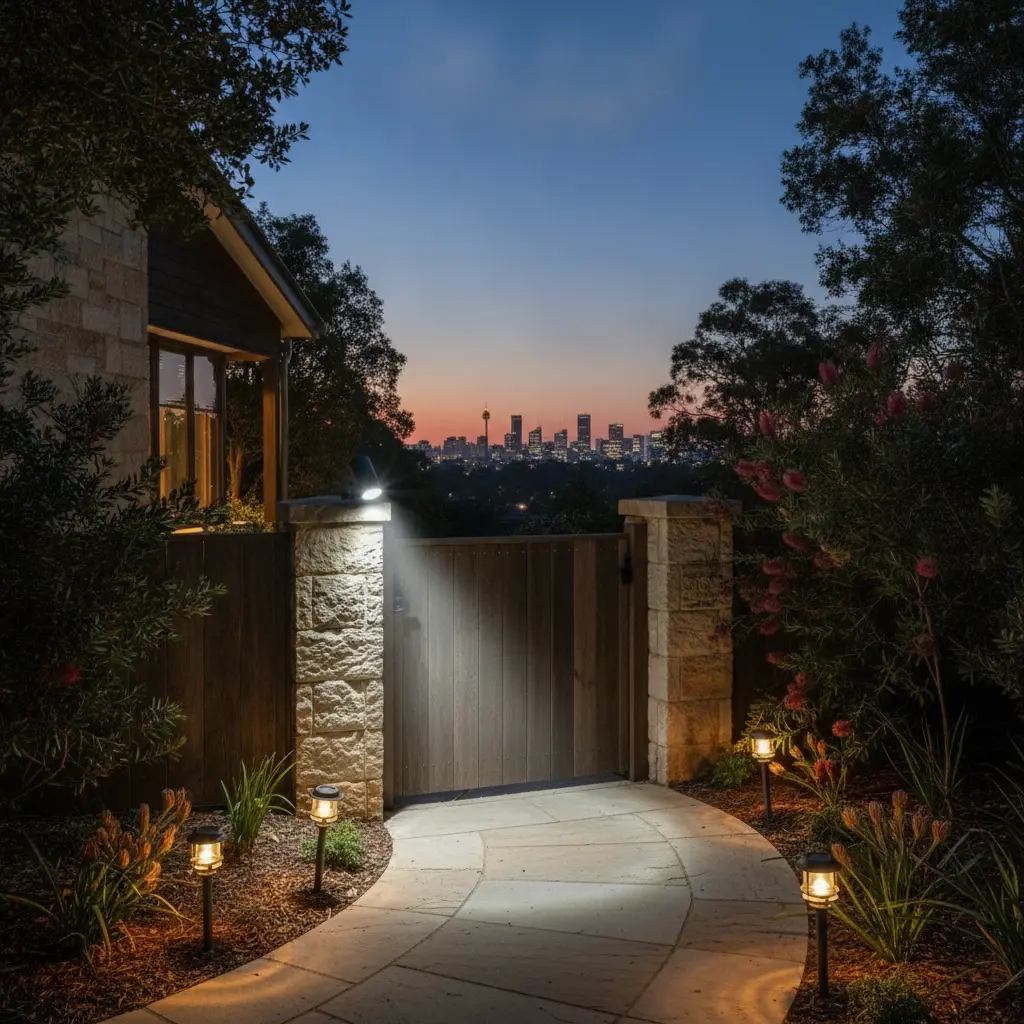
Choose motion-sensor solar lights for security and convenience at gates, side passages, bins, garage doors and driveways, where you want bright light only when someone is there; because they light only when triggered, the stored charge goes further. Choose dusk-to-dawn solar lights for ambience and wayfinding along paths, steps, fences and walls, where a steady warm glow should be on all evening. Most gardens use both: steady low lights for the layout, sensor lights at the entry and access points.
Which option suits which project
Motion-sensor solar lights
Best for: Security and task light at gates, side passages, driveways and bins
View motion-sensor solar lightsDusk-to-dawn solar lights
Best for: All-evening ambience and wayfinding on paths, steps, fences and walls
View dusk-to-dawn solar lightsSide-by-side comparison
| Motion-sensor solar lights | Dusk-to-dawn solar lights | |
|---|---|---|
| How it switches on | Armed at dark; movement in the sensor zone triggers it | A light sensor turns it on automatically at dusk |
| When it is lit | Short bursts after movement, then off or dimmed | Continuously from dusk until the stored charge runs low |
| Use of stored charge | Low: full power only while triggered | Higher: draws power all evening |
| Main job | Security, deterrence and task lighting | Ambience, wayfinding and showing off the garden |
| Typical spots | Gates, side passages, bins, garage doors, driveway ends | Paths, steps, fences, walls and garden beds |
| Look at night | Dark until triggered, then a sudden bright pool | A steady, even glow that shapes the garden |
| Placement | Aim so people cross the sensor zone, not walk straight at it | Space evenly along the route or feature |
| False triggers | Swaying branches, pets, wildlife, warm air from units | None: no motion sensor involved |
| Light on neighbours | Brief, but sudden flashes annoy if aimed over fences | Constant, so keep fittings low and aimed down |
| After short winter days | Usually holds up, as each trigger uses little charge | May fade before morning after short or cloudy days |
| Sun the panel needs | About 6–8 hours of direct sun | About 6–8 hours of direct sun |
| Stone Front example | Solar Landscape Spotlight 4-pack: motion sensor, IP65 | Stainless Wall & Fence, step, stake and disk lights |
Detection range and angle vary between models; check the product details before you set out a layout.
What is the difference between motion-sensor and dusk-to-dawn solar lights?
The difference is what switches the light on. Every solar light charges a rechargeable cell from its panel during the day and uses a light sensor to know when night has fallen. A dusk-to-dawn light stops there: once it gets dark it switches on and stays on, running from stored charge. A motion-sensor light adds a second sensor, usually a passive infrared (PIR) sensor, and only lights at full output when that sensor detects movement. Some models then switch off and some drop back to a dim glow until the next trigger.
In Stone Front’s range, the Solar Landscape Spotlight 4-pack has a motion sensor, 56 LEDs, an adjustable head and a choice of stake or wall mounting. The Stainless Solar Wall & Fence Light is warm white and comes on automatically at dusk, as do the step, pathway stake and in-ground disk lights. All of them are rated IP65.
“Dusk to dawn” describes when the light is meant to be on, not a promise that it lasts until morning. A solar light can only run for as long as its stored charge allows, so after a short, cloudy winter day a dusk-to-dawn light may fade before sunrise. Panels need roughly 6–8 hours of direct sun to charge fully.
Why do motion-sensor solar lights last longer on one charge?
Motion-sensor solar lights last longer on a charge because they spend most of the night drawing little or no power. A dusk-to-dawn light runs its LEDs for the whole evening, so the energy collected during the day is spread across many continuous hours. A sensor light only runs its LEDs at full output for the short periods after someone walks past, so the same charge covers many triggers across the night.
That has two practical effects. First, a sensor light can afford to be much brighter when it does come on, which is what you want at a gate or side passage. Second, it copes better with Sydney’s shorter winter days and cloudy spells, because it was never relying on a full battery to stay lit until morning. Rechargeable cells in any solar light need replacing after a few years; a light used in short bursts simply asks less of its cell each night.
Are solar sensor lights good for security?
Solar sensor lights are well suited to security because a sudden light is noticeable to the person who triggers it, to you inside the house and to neighbours. They also give you light exactly when you need it: carrying bins down the side of the house, finding the key at the back gate or walking from the car to the door. A steady light that is always on does not draw the same attention, so for deterrence a sensor light usually does more.
Dusk-to-dawn lights do the other half of the job. Lit paths, steps and walls make a property look occupied, show the safe way to the door and stop people tripping on level changes. For steps in particular, low steady light is safer than relying on a sensor: the Solar Step Light 5-pack is stainless, low-glare and on from dusk, so every tread is visible before anyone sets foot on it. Our guide to solar driveway lights shows how the two types share the work on a long driveway.
Where should you put a solar motion sensor light?
Put a solar motion sensor light where people pass across the front of the sensor, at a spot that also gets direct sun for its panel. PIR sensors detect the heat of a body moving across their field of view far more readily than a body walking straight towards them, so placement matters more than brightness. Detection range and angle vary from model to model, so check the details of the light you choose rather than relying on a general figure.
- Find the approach path. Stand where visitors arrive (the gate, the side passage, the end of the driveway) and note which way they walk.
- Mount it to the side. Position the light so that path crosses the sensor’s view at an angle rather than heading straight at it.
- Check the panel’s sun. A light in a shaded side passage may need its panel in a sunnier spot; an adjustable head lets you aim the light separately from the panel.
- Aim the light down. Tilt the head so the beam lands on the ground where people walk, not into eyes, windows or over the fence.
- Test it at night. Walk the route after dark for a few evenings and adjust the angle until it triggers where you want and nowhere else.
Why does my solar sensor light keep turning on by itself?
A solar sensor light that switches on with nobody there is usually seeing heat or movement you have not noticed. The common causes are branches or shrubs swaying in the sensor’s view, pets and wildlife such as possums, cars passing on the street, and warm air from heat-pump units, air-conditioners or sun-warmed walls. Trim back foliage, angle the head lower so the sensor sees the path rather than the street, and keep it away from air-conditioner outlets.
Bear in mind that PIR sensors work on the difference between body heat and the background, so on very hot nights they can be less responsive. If a sensor light does not come on at all, run through the checks in solar lights not working: switch position, a dirty or shaded panel, a worn cell and another light source fooling the dusk sensor.
Can you combine sensor and dusk-to-dawn lights?
Yes, and most well-lit gardens do. Use dusk-to-dawn lights to draw the layout of the garden all evening, then add sensor lights at the few points where people arrive or work after dark.
| Area | Light type | Stone Front option |
|---|---|---|
| Front path and garden edges | Dusk-to-dawn | Solar Pathway Stake Light, warm white |
| Steps and level changes | Dusk-to-dawn | Solar Step Light, stainless, low-glare |
| Fences and sandstone walls | Dusk-to-dawn | Stainless Solar Wall & Fence Light, Solar Wall Wash Light |
| Paving and driveway edges | Dusk-to-dawn | Solar In-Ground Disk Light, flush |
| Side passage, gate and bins | Motion sensor | Solar Landscape Spotlight, wall mounted |
| Driveway end and garage door | Motion sensor | Solar Landscape Spotlight, stake or wall mounted |
Keep the steady lights warm white (about 2700–3000K) so they flatter sandstone and planting, and let the sensor lights be the bright, functional layer. The Driveway Edge & Path Kit is a starting point for the front of the house.
Choose solar lights for your garden
Start with where people walk and where they arrive. Browse solar spotlights for sensor lighting at gates and passages, and solar path lights for the all-evening layer, or see the full solar lighting range and kits.
Frequently Asked Questions
Do solar sensor lights work through glass?
No. Passive infrared sensors detect body heat, and ordinary window glass blocks most of that infrared, so a sensor light behind a window will not see movement outside. The panel also charges poorly behind glass. Mount solar sensor lights outdoors with a clear view of the approach path and direct sun on the panel.
Will a solar motion light switch on for cars passing in the street?
It can, if the sensor can see the footpath or road. Warm engines and moving cars are exactly what a PIR sensor detects. Mount the light lower, tilt the head down towards your own path or driveway, and position it so the street is outside its view. Testing over a few nights is the reliable way to tune it.
Can a motion-sensor solar light stay on all night instead?
Some sensor lights include a setting that keeps a dim glow between triggers or stays on continuously, but it depends on the model, so check its product details. Running a sensor light continuously uses its stored charge much faster, so for steady all-night light along paths a dedicated dusk-to-dawn light is usually the better tool.
Do solar sensor lights work in winter?
Yes, and they generally cope with winter better than lights that stay on all evening, because each trigger uses only a small amount of stored charge. Shorter days and a lower sun still reduce charging, so clean the panel, trim anything that shades it and aim it towards the northern sky where you can.
Are dusk-to-dawn solar lights bad for wildlife?
Constant light can disturb nocturnal animals and insects, so keep dusk-to-dawn lights low, warm white and aimed at the ground rather than into trees and canopy. Light only the paths, steps and features you need, and use motion-sensor lights for areas that only need light occasionally.