IP65 vs IP67 Outdoor Lights: What IP Ratings Mean Outside
IP65 means dust-tight and protected against water jets; IP67 survives brief immersion. What each rating means outdoors and where IP65 lights are fine.
The short answer
IP65 means a light is dust-tight and protected against water jets from any direction, which covers rain, hosing and sprinklers in an open garden. IP67 adds protection against temporary immersion to 1m for 30 minutes, so choose IP67 or IP68 where water can pool over the light, such as low spots and ponds. IP44 suits covered spots under eaves. All Stone Front solar lights are IP65: mount them where water drains away and never submerge them.
Which option suits which project
IP44
Best for: Covered spots under eaves, verandas and pergolas, out of direct rain
IP66
Best for: Exposed walls hit by storms, strong hosing or wind-driven spray
IP67
Best for: Spots where water may briefly cover the light, such as low in-ground positions
IP68
Best for: Ponds, water features and fittings that stay underwater
Side-by-side comparison
| IP44 | IP65 | IP66 | IP67 | IP68 | |
|---|---|---|---|---|---|
| First digit (solids) | Objects over 1mm | Dust-tight | Dust-tight | Dust-tight | Dust-tight |
| Second digit (water) | Splashing from any direction | Water jets from any direction | Powerful water jets | Temporary immersion to 1m for 30 min | Continuous immersion beyond 1m, maker’s conditions |
| Rain | Sheltered spots only | Yes | Yes | Yes | Yes |
| Hose and sprinklers | Not direct | Yes | Yes | Not implied unless dual-rated, e.g. IP66/IP67 | Not implied unless dual-rated |
| Pressure washing | Avoid | Avoid | Avoid close range | Avoid | Avoid |
| Puddles and pooling water | No | No: keep above water | No: keep above water | Brief cover only | Yes |
| Ponds and water features | No | No | No | Not for continuous use | Yes, to the maker’s depth |
| Under eaves and verandas | Yes | Yes | Yes | Yes | Yes |
| Open garden, walls and fences | No | Yes | Yes | Yes | Yes |
| Flush in-ground | No | Yes, with drainage below | Yes, with drainage below | Yes | Yes |
| Typical fittings | Covered porch and wall lights | Solar path, step, wall and spot lights | Exposed coastal and commercial fittings | In-ground uplights in low spots | Pond and fountain lights |
| Stone Front range | None | All seven Stone Front solar lights | None | None | None |
Ratings follow IEC 60529 and describe a new, correctly closed fitting tested by its maker.
What does IP65 mean?
IP65 means a light fitting is fully dust-tight (the 6) and protected against water jets from any direction (the 5). IP stands for Ingress Protection, and the code comes from the international standard IEC 60529, which sets test methods for how well an enclosure keeps out solid objects and water. The first digit rates solids and the second rates water; a higher number means stronger protection against that particular kind of ingress.
| Digit | First digit: solids | Second digit: water |
|---|---|---|
| 4 | Objects over 1mm, such as wires and small tools | Splashing water from any direction |
| 5 | Dust-protected: some dust may enter, not enough to stop it working | Water jets from any direction |
| 6 | Dust-tight: no dust enters | Powerful water jets |
| 7 | Not used | Temporary immersion to 1m for 30 minutes |
| 8 | Not used | Continuous immersion beyond 1m, under conditions the maker specifies |
An X in place of a digit, as in IPX5, means that category was not tested or not declared. It does not mean zero protection, but it does mean the maker is not claiming any.
Is IP65 waterproof?
IP65 is weatherproof rather than waterproof in the sense most people mean. An IP65 light is built to keep working through rain, a garden hose and sprinklers, because it has been tested against jets of water sprayed at it from every direction. It has not been tested for sitting in water. If an IP65 fitting ends up under a puddle, in a flooded garden bed or in a pond, water can get past its seals.
That is why IP65 is the usual rating for solar garden lights. Every light in Stone Front’s range is IP65, from the Solar Step Light and the Solar Pathway Stake Light to the spotlights and wall lights. They are made for exposed positions in an open garden, as long as they sit where water drains away.
What is the difference between IP65 and IP67?
The difference between IP65 and IP67 is immersion. Both are dust-tight. An IP65 light has passed a water-jet test; an IP67 light has passed a test where it is submerged to 1m for 30 minutes. That makes IP67 the safer choice for a fitting that might be briefly covered by water, such as an uplight in a low part of the lawn that floods in a storm.
IP67 is not automatically “better” than IP65 in every way. Under IEC 60529, the immersion ratings (7 and 8) do not imply that a product has also passed the jet tests (5 and 6). A fitting that has passed both is marked with both codes, such as IP66/IP67. If a light will be hosed or hit by sprinklers and may also sit in water, look for a dual rating rather than assuming the higher number covers everything.
Neither rating says anything about brightness, battery life, UV resistance or corrosion. It only describes how well the enclosure keeps out dust and water when new and correctly closed.
Which IP rating do you need for each part of the garden?
Match the rating to the worst water the light will face, not the average day.
- Under eaves, verandas and pergolas: IP44 is usually enough where the fitting is sheltered from direct rain. Anything higher works too.
- Open garden, paths, walls and fences: IP65 handles rain and wind-driven showers. This is where the Stainless Solar Wall & Fence Light and wall wash lights belong.
- Near sprinklers and areas you hose down: IP65 is rated for water jets; IP66 gives more margin for exposed coastal walls or very strong jets.
- In-ground where water pools: IP67 or higher, or move the light. An IP65 flush light is fine in-ground only where water drains away from it.
- Ponds and water features: IP68, rated for the depth the maker states. No IP65 or IP67 fitting should live underwater.
Can IP65 lights go in the ground?
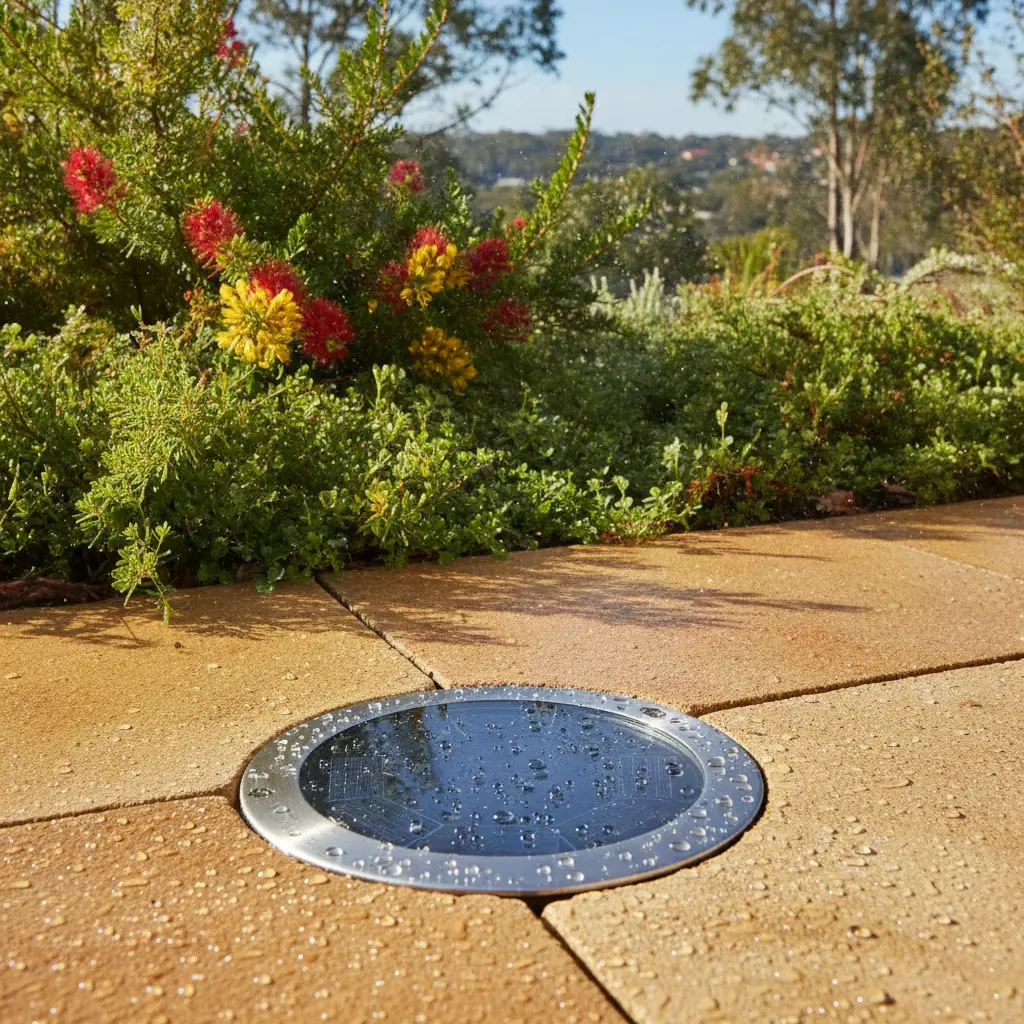
Yes, IP65 lights can go in the ground when water can drain away beneath and around them. The Solar In-Ground Disk Light is stainless and ABS, sits flush with the surface, has 8 LEDs per light and is rated IP65, which suits paving, decks and garden edges. What it should not do is sit in a hollow that holds water after rain.
- Drain below it. Set each disk on a bed of free-draining gravel rather than clay or packed soil, so rain soaks away instead of collecting around the body.
- Choose the high side. In paving that falls to a drain, place lights along the higher edge, not at the low point where water runs.
- Sit it level or just proud. Set the top flush with, or fractionally above, the surrounding surface, never in a dip.
- Keep the panel clear. A flush light charges through its top, so sweep off leaves, soil and mulch regularly.
Our guide to solar deck and in-ground lights covers spacing and installation in more detail.
Does salt air affect IP65 outdoor lights?
Salt air does not change a light’s IP rating, but it can corrode metal parts and, over time, the seals that the rating depends on. Near the coast, the grade of stainless steel matters: 316 stainless resists salt air better than 304, which can develop surface rust spots (tea staining) in exposed seaside positions. If you live close to the water, check the steel grade of any fitting before you buy and rinse stainless parts with fresh water every so often to wash off salt.
Seals and plastics also age in strong Australian sun. If a light that was dry for years starts collecting water inside, check that the battery hatch is fully closed and the seal is seated before blaming the rating.
Find IP65 solar lights for your garden
All Stone Front solar lights are IP65 for open-garden use. Browse solar path lights and solar wall lights, or start with the Path & Ground Lighting Kit.
Frequently Asked Questions
What does IP stand for in IP65?
IP stands for Ingress Protection, sometimes expanded as International Protection. The rating comes from the international standard IEC 60529, which tests how well an enclosure keeps out solid particles and water. The two digits are separate scores, so IP65 is a 6 for solids (dust-tight) and a 5 for water (protected against jets).
Does a higher IP rating mean a better outdoor light?
Not necessarily. An IP rating only describes protection against dust and water. It says nothing about brightness, battery life, corrosion resistance or build quality. An IP67 light is not guaranteed to resist water jets unless it is also marked IP65 or IP66, so pick the rating that matches the spot rather than the biggest number.
Can I hose down IP65 solar lights?
Yes. IP65 fittings are tested against water jets from any direction, so normal hosing, rain and sprinklers are fine. Avoid pressure washers at close range, which go well beyond the test conditions and can force water past seals. Wipe solar panels with a soft damp cloth rather than blasting them clean.
Why is there water inside my IP65 solar light?
The usual causes are a battery hatch or switch cover not fully closed, a seal that has aged or been pinched, condensation from warm days and cold nights, or the light sitting in water after rain. Dry it out, check and reseat the seals, and move in-ground lights away from spots where water pools.
Is IP65 the same as weatherproof?
In everyday use, yes: IP65 is what most makers mean by a weatherproof outdoor light, because it is dust-tight and protected against water jets. Weatherproof is not a defined test term, though, so always look for the actual IP code rather than relying on the word alone.