Sandstone vs Granite Pavers: Hardness, Grip, Look and Cost
Granite is hard, dense and low-porosity; sandstone is warmer, lighter and easier to cut. How they compare for wear, grip, weight, looks and cost.
The short answer
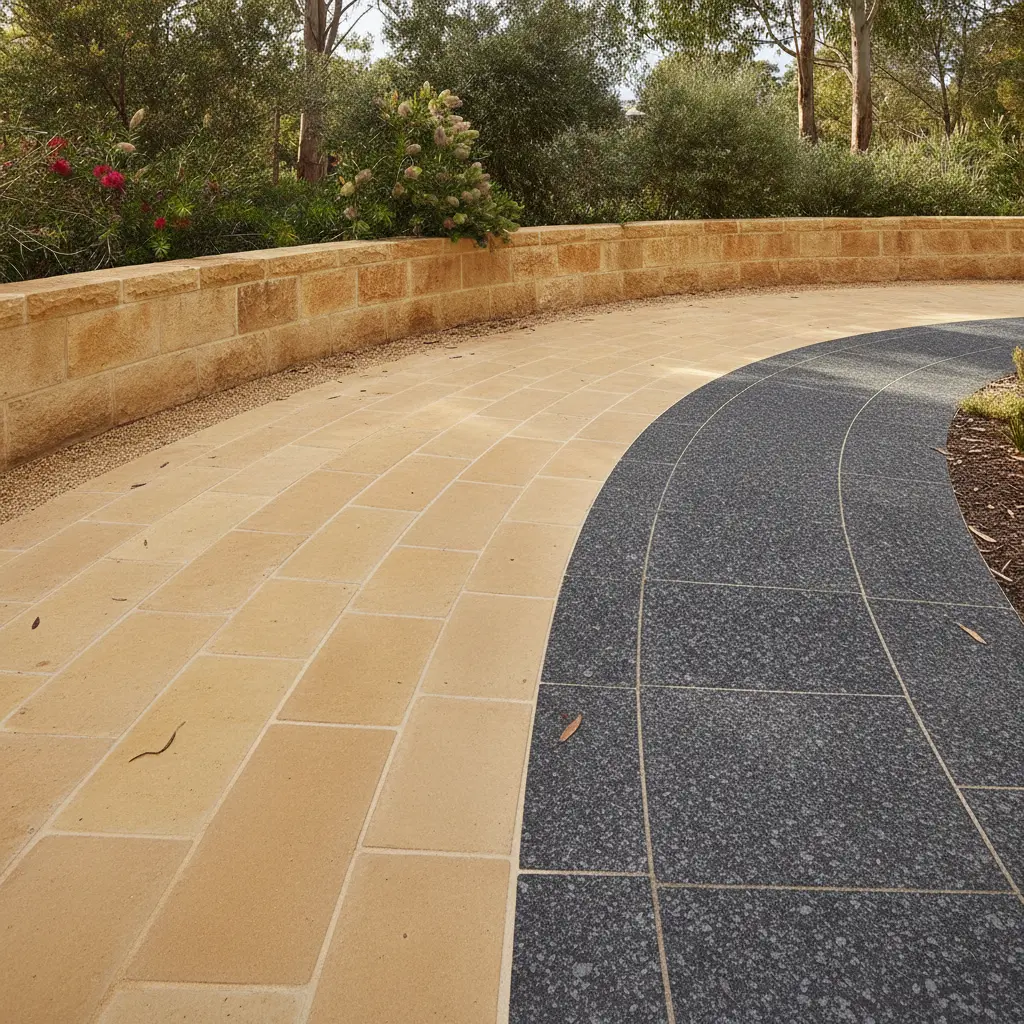
Choose granite if the paving takes heavy foot traffic or commercial wear, you want a hard, low-porosity stone that resists staining, and you like a cool grey, black or speckled look. Choose sandstone if you want warm colours that suit Sydney homes and heritage stone, pavers cut to custom sizes and edges at the quarry, lighter stone that is easier to cut on site, and a comfortable pale surface around a pool. Both need a textured finish for grip outdoors.
Which option suits which project
Sandstone
Best for: Homes, pools and heritage settings that want warm colour and custom cutting
View sandstoneGranite
Best for: High-traffic commercial paving and modern grey or black designs
Side-by-side comparison
| Sandstone | Granite | |
|---|---|---|
| What it is | Sedimentary: quartz sand grains naturally cemented | Igneous: interlocking quartz, feldspar and mica crystals |
| Hardness | Moderate; cuts and shapes easily | Very hard; resists scratching and wear |
| Density | About 2,300kg/m³ | About 2,600–2,700kg/m³ |
| Porosity | Porous; seal and reseal every 2–3 years outdoors | Low porosity; often sealed against oil and grease |
| Colour | Warm whites, yellows, golds, browns, oranges and purples | Greys, black, white and pink with speckled crystals |
| Grip finishes | Sandblasted gives the most grip; sawn is reliable | Flamed or bush-hammered for grip; polished is slippery wet |
| Heat underfoot | Pale colours stay comfortable | Pale greys moderate; dark granite gets hot |
| Typical formats | 50mm pavers, 30mm tiles, flagging, 75–100mm for driveways | Commonly 20–30mm pavers; setts, kerbs and steps |
| Custom cutting | Cut, bullnosed and rockfaced at the quarry | Needs heavy diamond tooling; custom work is slower |
| Look in Sydney | Matches local sandstone buildings and walls | Reads modern or civic; contrasts with sandstone |
| Commercial use | Plazas and paths in sandblasted finish, thicker for loads | Common in streetscapes, plazas and transport hubs |
| Cost (relative) | Guide prices from $65/m² to $120/m², stone only | Varies by origin and finish; compare quotes at equal thickness |
| Best uses | Homes, pools, courtyards, heritage work and driveways | Commercial, high-traffic areas and modern homes |
Sandstone prices are Stone Front guide prices for stone only, ex-quarry at Glenorie. Stone Front does not sell granite; densities are typical published ranges.
What are granite pavers?
Granite pavers are slabs of granite, an igneous rock that formed when molten rock cooled slowly deep underground, giving it large interlocking crystals of quartz, feldspar and mica. Those crystals make it very hard, dense and low in porosity, and they give granite its speckled look in greys, black, white and pink. Most granite paving sold in Australia is imported, cut into 20–30mm pavers and tiles, plus thicker setts, kerbs, steps and bollards.
Because typical granite pavers are thin and heavy, they are usually bedded in mortar or adhesive on a concrete slab, or laid by a paving contractor on a well-compacted base with a bound bedding layer in commercial work. Granite setts and cobbles, which are thicker and roughly cube-shaped, are laid for driveways and streetscapes where vehicles turn. Sandstone pavers at 50mm can go on a compacted crushed sandstone or road base with 20–30mm of bedding sand, which is often simpler for a home patio or path.
Granite has a long history in Sydney too. Granite from Moruya on the NSW South Coast faces the pylons of the Sydney Harbour Bridge, and granite kerbs and plinths sit alongside sandstone in many older civic buildings. The two stones have been paired for well over a century.
Is granite better than sandstone for heavy traffic?
For sheer resistance to wear, yes: granite is harder than sandstone and keeps its surface and edges under constant foot traffic, trolleys and cleaning machines, which is why it is common in CBD streetscapes, plazas and transport hubs. For a home, that extra hardness is rarely needed. Sandstone of the right thickness performs well on paths, patios, pool surrounds and driveways: 50mm for foot traffic, 75mm minimum for cars and 100mm for heavier vehicles or steep driveways.
Sandstone is also used commercially. Stone Front supplies architects, builders and council and civil contractors, quotes trade quantities by the tonne or by the project, and has MSDS documentation for commercial work. See commercial sandstone supply.
Which has better grip: flamed granite or sandblasted sandstone?
Both are good outdoor choices, and both are far grippier than their smooth versions. Flamed granite is made by passing a high-temperature flame over the sawn face so surface crystals burst off, leaving a rough, slightly sparkly texture. Sandblasting sandstone blasts grit at the sawn face to open its texture, and it is the most slip-resistant sandstone finish. What to avoid outdoors is a polished granite or a honed finish of either stone in wet areas.
- Pool surrounds and ramps: sandblasted sandstone, or flamed or bush-hammered granite.
- Patios, paths and step tops: sawn sandstone or flamed granite.
- Covered and indoor areas: honed sandstone or honed granite.
- Never outdoors in the wet: polished granite.
If a project specifies slip resistance, ask for each product’s wet pendulum P-rating under AS 4586 for the finish you are buying. See sandstone finishes for how each finish looks.
Is granite heavier and harder to cut?
Yes. Granite is denser, so a square metre weighs more at the same thickness, and its hardness means cutting, drilling and edge work take longer and wear diamond blades faster. Sandstone is lighter to handle and much easier to cut on site. These weights per square metre are calculated from typical densities:
| Thickness | Sandstone (about 2,300kg/m³) | Granite (about 2,650kg/m³) |
|---|---|---|
| 20mm | About 46kg/m² | About 53kg/m² |
| 30mm | About 69kg/m² | About 80kg/m² |
| 50mm | About 115kg/m² | About 133kg/m² |
Stone Front cuts sandstone pavers, treads, capping, pool coping and edging to size at the Glenorie quarry, with square, bullnose, pencil-round or chamfer edges, and rockfacing as stonemasonry. The cut-to-size guide explains how to write a cutting list.
Which looks better on a Sydney home?
That depends on the house. Granite gives a cool, crisp, contemporary or civic look in greys, black and speckled tones, and suits modern architecture, steel and glass, and high-contrast designs. Sandstone gives warmth, from Marbled White and Light Yellow through Browns, Orange and Purples, and sits naturally beside Sydney’s sandstone walls, terraces and Federation houses. It also works in a modern scheme when you choose a single pale colour in large sawn all round pavers. The sandstone colour guide shows each tone, and the two stones can be combined, for example granite steps or banding within a sandstone field.
Heat follows colour. Pale grey granite stays reasonably comfortable, but black and dark grey granite absorb a lot of sun and can be too hot for bare feet in summer. Pale sandstone colours stay comfortable, which is one reason sandstone is common around Sydney pools.
What drives the cost of granite or sandstone paving?
For both stones, the price per square metre is driven by the same handful of things, so compare like with like:
- Thickness: 100mm stone contains twice the stone of 50mm, so it costs more to buy, freight and lift.
- Finish: flamed, sandblasted and honed finishes are extra processing on top of a sawn face.
- Size and cutting: standard sizes cost less than custom cuts, curves and bullnosed edges.
- Colour: quarry-run sandstone is the most economical; single-colour selections cost more, as do rarer granite colours.
- Quantity: full pallets cost less per square metre than part pallets.
- Delivery and access: a crane drop costs more than a kerbside drop, and heavier stone means more weight per load.
- Base and laying: thin pavers on a new slab add concrete costs that a compacted base for 50mm pavers avoids.
Stone Front’s sandstone guide prices start from $65/m² for sawn modular paving, $95/m² for hydrasplit paving and $120/m² for sawn all round pavers, stone only, ex-quarry; see sandstone prices for the full list.
Get a sandstone paving quote
Send Stone Front the product, area and your suburb through the sandstone paver quote form, and you will usually get a reply the same business day. Use the paver calculator first to work out the area with extra for cuts. For commercial projects, include drawings and the specification so the stone, finish and thickness can be quoted together.
Frequently Asked Questions
Does granite need sealing?
Granite has low porosity, so it absorbs water slowly, but oils, grease and some dark liquids can still soak in over time. Many installers apply a penetrating sealer to outdoor granite, particularly near barbecues and driveways. Sandstone is more porous and should be sealed, then resealed every 2–3 years outdoors.
Can granite be used around a pool?
Yes, in a flamed or bush-hammered finish and a pale colour. Avoid polished granite, which is slippery when wet, and dark granite in full sun, which gets hot underfoot. Seal with a sealer rated for salt and chlorine. Sandblasted sandstone coping and pavers are the common sandstone alternative.
Are granite setts or sandstone pavers better for a driveway?
Granite setts are thick and very hard, so they handle turning wheels well, but they are heavy and usually laid by specialists. Sandstone driveways use 75mm pavers minimum for cars and 100mm for heavier vehicles or steep driveways, on 150–200mm of compacted road base or a reinforced slab.
Can sandstone be used for commercial paving?
Yes. Sandstone is used for plazas, paths and building surrounds, usually in a sandblasted finish and at a thickness suited to the loads. Stone Front quotes trade and civil quantities by the tonne or by the project, supplies MSDS documentation, and can sequence multi-load deliveries to a build program.