Sandstone Billets: What They Are, Sizes, Weights and Uses
What sandstone billets are, how they compare with large blocks, split logs and boulders, how much they weigh, what machinery places them and how to order them.
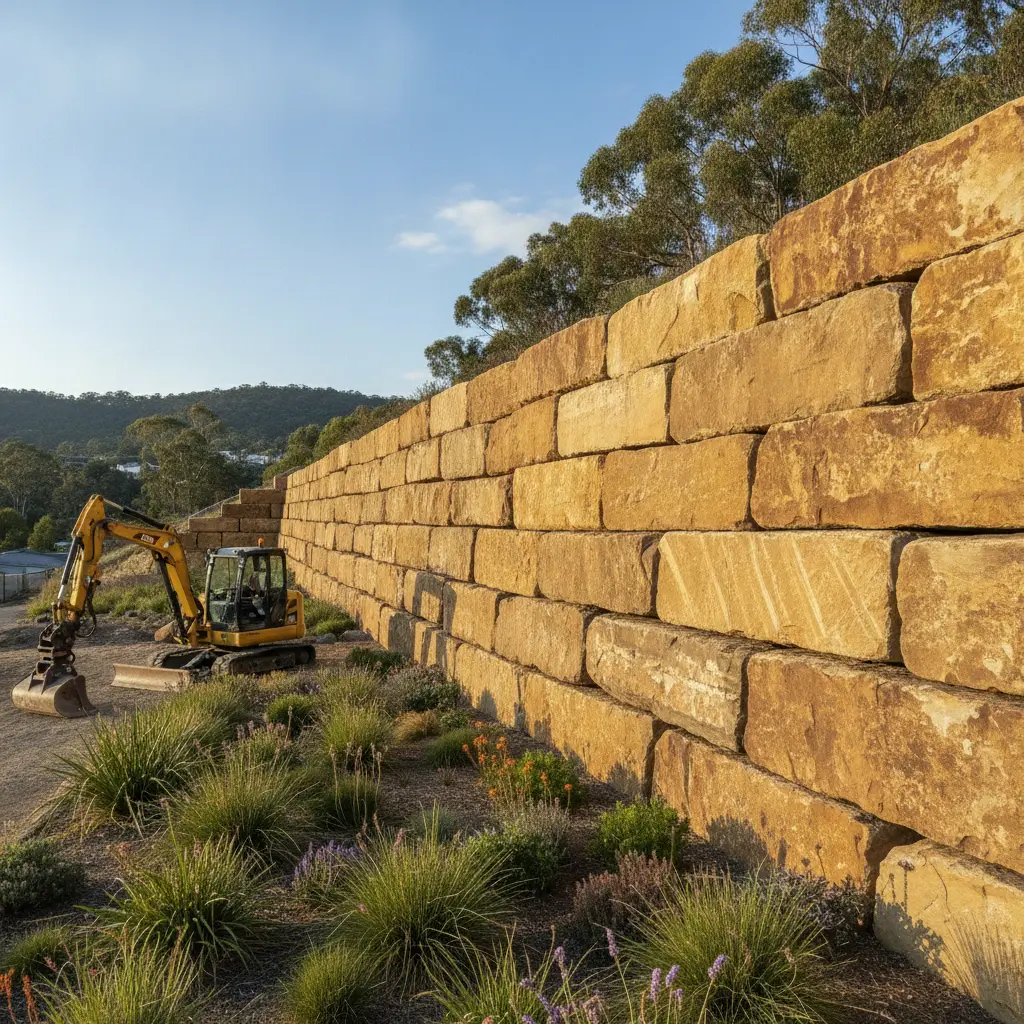
Sandstone billets are large-format pieces of natural sandstone used where a wall or feature needs real mass: structural retaining walls, commercial landscaping and architectural features. They are always placed by machine, come with natural or sawn faces, and often weigh around a tonne each. Billets are priced by quote because sizes depend on what the quarry face produces, so ask Stone Front for the sizes in stock.
- What: the largest regular-shaped walling stone, bigger than 2–3 man blocks and split logs.
- Weight: sandstone is about 2,300kg/m³, so a 1,200 x 600 x 600mm billet is about 994kg.
- Placement: excavator with a rock grab; billets may need a machine of 8 tonnes or more.
- Uses: structural retaining, civil batters, creek stabilisation, entry statements, large steps.
- Price: by quote, with crane-truck delivery available.
How do billets compare with other large sandstone?
Billets sit at the top of a range of large-format walling stone. The right choice depends on the wall, the machine you can get in and the look you want.
| Stone | Size | Approximate weight | Placed with | Best for |
|---|---|---|---|---|
| Standard walling blocks | 110mm bed, 100–250mm high | About 10–38kg each | By hand | Garden walls, house walls, edging |
| Split logs | About 300 x 300mm, 1–2m long | About 207kg per metre | Small machinery | Garden retaining walls to about 1m, steps |
| Large rough squared blocks | 2–3 man size, usually one sawn side | About 100–300kg | 3–5 tonne excavator with grab | Structured retaining walls |
| Select boulders | Excavator size, shaped faces and beds | Varies | Excavator | Natural-looking structural walls |
| Sandstone billets | Large format | Often around a tonne or more | Excavator, often 8 tonnes or more | Large retaining walls, features, civil work |
Weights are calculated at 2,300kg/m³ and rounded; real pieces vary. For detailed block and log weights, see our sandstone block sizes and weights guide.
How heavy is a sandstone billet?
Work it out from the dimensions: length x width x height in metres, multiplied by 2,300, gives kilograms. A few examples:
- 1,000 x 500 x 500mm: 0.25m³, about 575kg.
- 1,200 x 600 x 600mm: 0.432m³, about 994kg.
- 1,500 x 600 x 600mm: 0.54m³, about 1,242kg.
- 1,800 x 800 x 600mm: 0.864m³, about 1,987kg.
Sandstone ranges from about 2,200 to 2,400kg/m³, so allow roughly 4% either way, and a little more when the stone is wet. These weights decide the machine, the truck and whether a crane truck is needed, so give us the sizes you are planning around when you ask for a quote.
What are sandstone billets used for?
Structural retaining walls
Billets are gravity stone: their weight holds the soil back. They suit large residential retaining walls, batters on subdivisions and commercial sites, and walls where a block wall would need many more courses. Retaining walls above a set height, or close to a boundary, generally need council approval and engineering, so check before you order. Our guide to retaining wall approvals and drainage covers what to sort out first.
Feature installations and entry statements
A single billet with a sawn top can be a bench, a plinth or a sign base; a pair can frame a driveway entrance. Sawn faces give a cleaner, architectural look, while natural faces suit bushland settings.
Large steps
For machine-placed steps on a big slope, billets give more regular shapes than boulders. Keep the rise between steps consistent; as a common guide, 150–180mm rise and at least 300mm of tread. See how to build sandstone steps.
Civil and commercial landscaping
Billets, large blocks and boulders are used for creek and erosion stabilisation, park edging and traffic control. For civil work, the quarry can sequence multi-load deliveries to a build program and provide MSDS documentation.
What machinery and access do billets need?
Billets are never hand-placed. Plan for:
- An excavator with a rock grab sized for the heaviest piece. A 3–5 tonne excavator handles most 2–3 man blocks; billets and large boulders may need 8 tonnes or more.
- A firm, compacted or engineered base under the first course, as the designer specifies.
- Truck access close to the wall, or a crane truck to lift pieces over a fence or down a slope.
- Clearance from overhead power lines and trees for the crane and excavator.
- An experienced operator. Safe Work Australia advises mechanical aids for heavy loads, and stone this size needs a machine and someone who knows how to use it.
If you are not sure which class of stone suits your machine, tell us the machine size and the wall dimensions and we will advise. Our delivery guide explains crane versus kerbside drops.
How are billets laid in a wall?
Every billet wall should follow the engineer’s design for the site, but the principles are the same as any gravity wall:
- Biggest stone at the bottom. Set the heaviest billets in the first course on the prepared base, partly below finished ground level so the wall cannot slide.
- Step back into the slope. Set each course back slightly so the wall leans into the soil it holds.
- Bridge the joints. Place each billet so it bears on two below it, as with any coursed stone.
- Drain behind the wall. Free-draining backfill and a drainage pipe at the base stop water pressure building up.
- Turn the best face out. Decide the main viewpoint and set each billet’s best face, or its sawn face, towards it.
- Pick one colour batch. Billets from the same part of the quarry share tones, so the wall reads as one piece of stone.
Crushed sandstone from the same quarry makes a free-draining backfill. Our crushed sandstone guide explains the grades.
Billets or sandstone logs?
For garden walls up to about one metre, split logs are usually simpler: they go in with small machinery, each course is one log high, and a single-skin log wall can typically reach about a metre without engineering. Billets make sense when the wall is larger, an excavator can work on site, and an engineer has designed the wall for that stone. Our sandstone sleepers guide covers log sizes and weights in detail.
How to order sandstone billets
- Send the wall or feature size: length, height and any engineering drawings.
- Tell us the machine you or your contractor will use, and its lifting capacity.
- Describe access: where a truck can park, slope, overhead wires, fences.
- Say which faces you want: natural, or sawn tops or fronts.
- Visit if you can. Seeing billets at the Glenorie quarry lets you check sizes and colours.
Get your quote from Stone Front
Stone Front quarries billets, large blocks and boulders at Glenorie and delivers them across greater Sydney, including by crane truck. Get an exact quote from Stone Front: tell us the product, quantity and your suburb at stonefront.com.au/get-a-quote and we usually reply the same business day. For the wider large-format range, see large sandstone blocks Sydney.
Frequently Asked Questions
What is a sandstone billet?
A sandstone billet is a large-format piece of natural sandstone used where a wall or feature needs real mass: structural retaining walls, commercial landscaping and architectural features. Billets are machine placed and come with natural faces or sawn faces.
How heavy is a sandstone billet?
Weight depends on size. Sandstone weighs about 2,300kg per cubic metre, so a billet measuring 1,200 x 600 x 600mm is about 994kg, roughly a tonne. Multiply length x width x height in metres by 2,300 to estimate any piece.
What machine do I need to place sandstone billets?
Billets are always machine placed. A 3–5 tonne excavator with a rock grab handles most 2–3 man blocks, while billets and large boulders may need 8 tonnes or more. Tell Stone Front your machine size and the stone class can be matched to it.
Are billets better than sandstone logs for a retaining wall?
They suit different walls. Split logs (about 300 x 300mm) go in with small machinery and suit garden walls to about one metre. Billets suit larger, structural walls where an excavator can work and an engineer has designed the wall.
How much do sandstone billets cost?
Billets are priced by quote because sizes vary with what the quarry face produces. The price depends on the size and number of pieces, any sawn faces and delivery, including crane-truck delivery where needed. Ask Stone Front for the sizes currently in stock.
Products Mentioned in This Article
Sandstone Billets
Large sandstone billets for retaining, landscaping and structural applications.
Split Logs (Sandstone Logs)
Approximately 300x300mm logs for retaining walls and stepped landscapes.
Sandstone Boulders
Natural boulders from gabion-size to large feature rocks.
Rough Squared Blocks
Economical blocks for retaining walls and garden projects.