Sandstone Sleepers: Sizes, Weights and How They Compare With Timber
What sandstone sleepers (split logs) are, their 300 x 300mm size and weight, how many you need for a wall, and how they compare with timber and concrete sleepers.
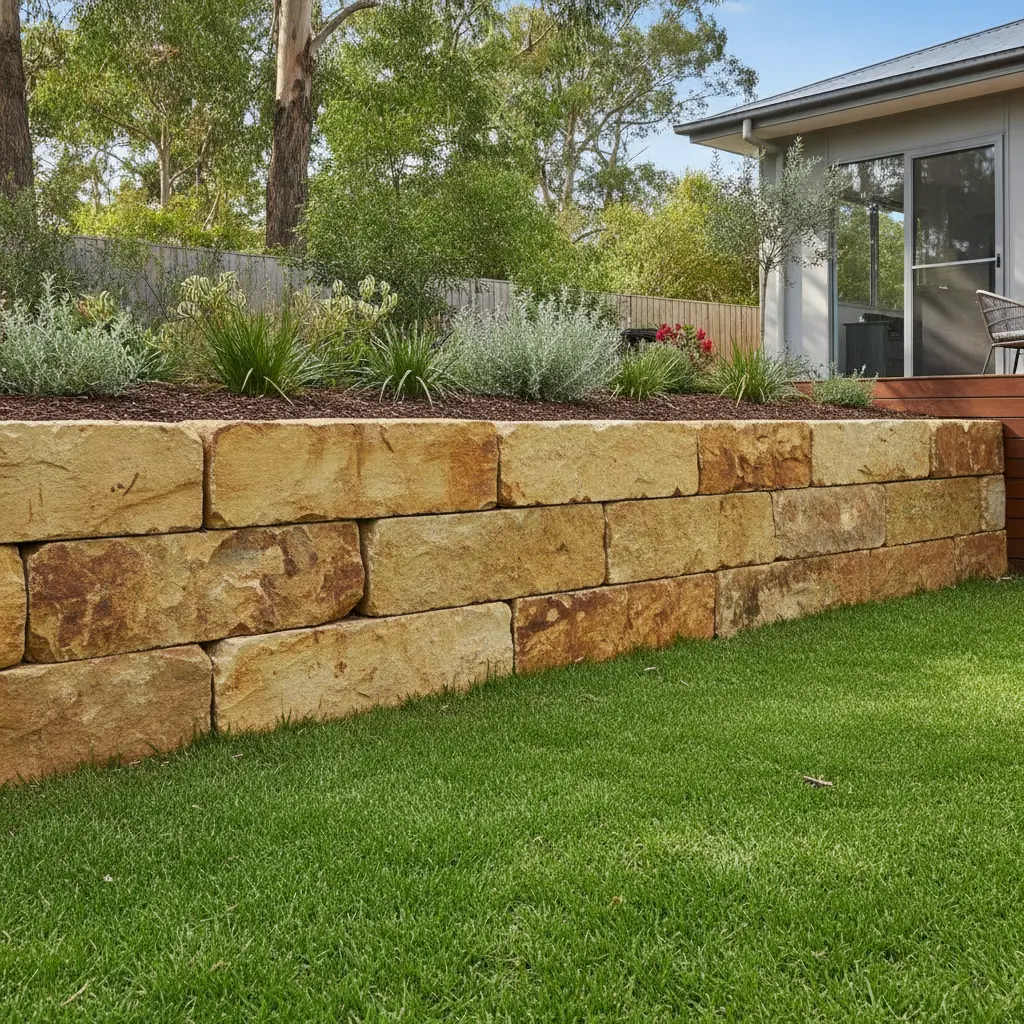
Sandstone sleepers are solid sandstone logs laid in courses like timber sleepers. Stone Front’s split logs are about 300 x 300mm in cross-section and about 1–2m long, sawn top and bottom with a natural rough face, and weigh about 207kg per lineal metre. Each course adds about 300mm of height, and a single-skin log wall typically reaches about one metre before engineering is needed. Unlike timber, sandstone does not rot or attract termites.
- Size: about 300 x 300mm cross-section, lengths of about 1–2m.
- Weight: about 207kg per metre; a 1.5m log is about 310kg.
- Courses: about 300mm each, so 3 courses give roughly 900mm.
- Installation: small machinery, not by hand.
- Price: by quote per log, with delivery across greater Sydney.
What are sandstone sleepers?
"Sandstone sleepers" is the name many people use for sandstone logs, because they do the same job as timber or concrete sleepers in a retaining wall: long, squared lengths stacked horizontally in courses. The difference is that they are solid natural stone. Stone Front’s split logs are quarried, sawn and split at Glenorie. The sawn top and bottom let each course sit flat on the one below, while the exposed face is left as a natural rough split face, so the wall looks like stone rather than a manufactured product.
Because each log is about 300mm high, a wall goes up quickly: three courses give roughly 900mm. Split logs need only small machinery to install, which makes them practical where access is limited compared with larger stone such as billets or boulders.
How do sandstone sleepers compare with timber and concrete?
| Sandstone sleepers (split logs) | Treated pine sleepers | Concrete sleepers with steel posts | |
|---|---|---|---|
| Material | Solid natural sandstone | Treated timber | Precast concrete panels between steel posts |
| Typical life | Does not rot or rust | About 15–20 years before rot and termites win | Longer than treated pine |
| Look | Natural split stone face that weathers into the garden | Timber; greys and splits with age | Concrete; stays grey |
| Up-front cost | Higher | Lowest | Mid |
| Drainage | Joints between logs let water out | Needs drainage behind | Needs drainage behind |
| Installation | Small machinery; heavy | By hand with posts | Post holes and concrete |
Timber sleeper walls are the cheapest to build upfront, but timber eventually needs replacing, which means demolition, disposal and a rebuild. A sandstone log wall costs more on day one and then does not need rebuilding the way timber does. Our sandstone log prices page sets out the whole-of-life comparison.
How many sandstone sleepers do I need?
Count courses, then lineal metres:
- Divide the total wall height, including the course that sits partly below ground, by 0.3 and round up. That is the number of courses.
- Multiply the number of courses by the wall length. That is the lineal metres of log.
- Add a little extra for corners, returns and any steps built into the wall.
| Wall height (incl. buried course) | Courses | Lineal metres of log per metre of wall | Stone weight per metre of wall |
|---|---|---|---|
| 300mm | 1 | 1 | About 207kg |
| 600mm | 2 | 2 | About 414kg |
| 900mm | 3 | 3 | About 621kg |
Example: a 10m wall 900mm high is 3 courses, or 30 lineal metres of log, weighing about 6 tonnes. That weight is why delivery and machinery planning matter. Tell us the wall length and height and we can select log lengths that keep joints to a minimum.
How high can a sandstone sleeper wall be?
A single-skin log retaining wall can typically go to about one metre without engineering. Above that height, or where the wall supports a driveway, pool or structure, sits on reactive clay or retains a steep slope, an engineer should specify the footing, drainage and setback, and may recommend two lower walls with a planted terrace between them.
Approval is a separate question. Most NSW councils require approval for retaining walls over about 600mm high and for walls close to a boundary, so check with your council or a private certifier before you dig. Our guide to retaining wall approvals and drainage explains what to check.
How is a sandstone sleeper wall built?
In outline:
- Excavate and compact a level footing, as specified for the site.
- Bed the first course partly below ground so the wall cannot slide.
- Lay slotted ag pipe at the base with free-draining backfill and geotextile behind the wall.
- Stack the next courses with staggered joints and a slight setback into the slope.
- Backfill and compact behind each course as you go.
Our step-by-step guide to building a sandstone log retaining wall covers each stage, the machinery and common mistakes. At about 207kg per metre, a 2m log weighs over 400kg, so plan on a small excavator or a machine with a suitable lifting attachment, and an operator who has placed stone before.
Other ways to use sandstone sleepers
- Garden steps: one log makes a step about 300mm high; set logs into a bank to form wide, low bush steps. See how to build sandstone steps.
- Raised garden beds: one or two courses make a solid planter edge that will not rot against wet soil.
- Seating: a course and a half, about 450mm, is a comfortable seat height around a fire pit or lawn.
- Edging: a single log set flush with the lawn makes a heavy garden edge or mowing strip.
- Driveway cuttings: logs are commonly used to hold back the bank beside a driveway.
Sleepers, logs or blocks?
Logs are the fastest stone wall to build because each course is 300mm high. Blocks give more design freedom: mixed heights, curves, tighter corners and four face finishes, and they can be laid by hand. Rough squared blocks start from $120/m² of wall face, guide price. Our comparison of sandstone logs vs blocks covers look, cost and installation, and sandstone retaining wall cost gives a worked example.
Get your quote from Stone Front
Stone Front quarries and splits its sandstone logs at Glenorie and delivers them across greater Sydney, including by crane truck for tight or steep sites. Get an exact quote from Stone Front: tell us the product, quantity and your suburb at stonefront.com.au/get-a-quote and we usually reply the same business day. Give us the wall length, the height and a photo of the access. The full range is on our sandstone logs Sydney page.
Frequently Asked Questions
Are sandstone sleepers the same as sandstone logs?
Yes. "Sandstone sleepers" is a common name for sandstone logs, because they are laid in courses like timber sleepers. Stone Front’s split logs are about 300 x 300mm in cross-section, sawn top and bottom with a natural rough face, in lengths of about 1–2m.
How heavy is a sandstone sleeper?
A 300 x 300mm split log weighs about 207kg per lineal metre, so a 1.5m log is about 310kg and a 2m log about 414kg. They are placed with small machinery, not by hand.
How high can a sandstone sleeper wall be?
A single-skin log retaining wall can typically go to about one metre without engineering, but council rules vary with height, location and how close the wall is to a boundary. Taller walls need engineering advice and may be built in tiers.
Do sandstone sleepers last longer than timber sleepers?
Yes. Treated pine sleeper walls typically last 15–20 years before rot and termites take hold, and concrete sleepers last longer than timber. Sandstone does not rot or rust, so a well-drained log wall does not need rebuilding the way a timber wall does.
How many sandstone sleepers do I need?
Each course is about 300mm high, so divide the wall height by 0.3 and round up to get the number of courses, then multiply by the wall length to get lineal metres of log. A 10m wall 900mm high is 3 courses, or 30 lineal metres.