Stacked Sandstone and Dry Stone Walls: Stone, Method and Quantities
What stacked sandstone is, which stone to use, how to build a dry stone wall with batter, through-stones, hearting and coping, and how much stone to order.
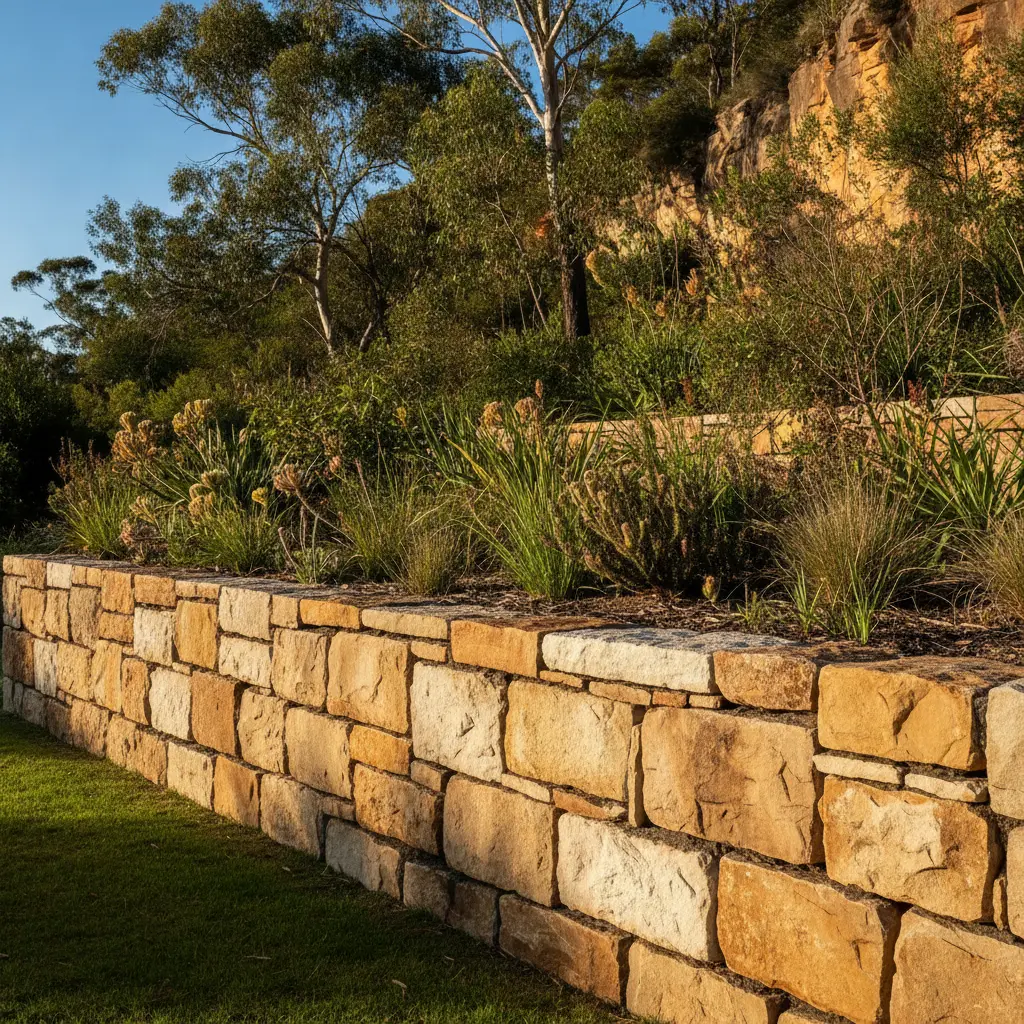
Stacked sandstone is natural sandstone laid in courses without visible mortar: either a true dry stone wall of rough squared blocks held together by weight and friction, or thin split stone cladding fixed to a wall for the same look. Build a dry stone wall with a batter, through-stones, hearting and coping, keep it low, and engineer any retaining wall over about 1m.
- Stone: rough squared blocks, roughly one-man size, from $120/m² of wall face (guide price)
- Coverage: a pallet is four layers and about 4m² of wall face, weighing about 1.84 tonnes
- Height: keep dry walls low; most NSW councils require approval for retaining walls over about 600mm or near a boundary
- Stacked look on a wall: split face cladding from $140/m², or thin handsplit flagging 30–50mm
What is stacked sandstone?
Stacked sandstone means two different things, and it helps to know which one you want before you buy. The first is a dry-stacked wall: solid blocks of sandstone laid course on course with no mortar, so the wall stands by the weight of the stone and the way the pieces lock together. This is the traditional dry stone wall, used for garden walls, low retaining walls and bed edges.
The second is a stacked-stone finish: thin strips or pieces of split sandstone fixed to an existing wall of brick, block or concrete so it looks like a dry-stacked wall. This is cladding rather than structure. Sandstone wall cladding in a split or natural cleft face is typically 20–30mm thick and starts from $140/m², and thin handsplit flagging (30–50mm) is also used for cladding and overlays. Cladding suits house walls, fire pits, letterboxes and the face of a concrete retaining wall where a structural dry wall would not be practical.
Which sandstone suits a dry stone wall?
Rough squared blocks are the usual stone for a dry stone wall because they have roughly flat beds that sit steadily on each other while keeping a natural, irregular face.
| Stone | What it is | Dry-stacked use | Guide price |
|---|---|---|---|
| Rough squared blocks | Roughly one-man size, mixed colours | Garden walls, low retaining, bed edges | From $120/m² of wall face |
| Large rough squared blocks | 2–3 man size, generally one sawn side | Base courses, bigger walls by machine | Per tonne, by quote |
| Select boulders | More shaped boulders for structured walls | Informal and curved walls | By quote |
| Split logs | About 300 x 300mm, sawn top and bottom | Fast, regular courses with machinery | By quote |
| Rough split-top capping | Capping made for dry-stacked walls | Coping course on top of the wall | By quote |
Rockfaced and sawn blocks, with their 110mm bedwidth and regular heights, are designed to be laid like brickwork in mortar; they can be dry laid for very low edging, but rough squared stone is better suited to a true dry wall. Rough squared blocks are sold palletised or loose by the tonne, and you can hand-select loose stone from the bins at the Glenorie quarry by arrangement.
How high can a dry stone wall be?
Keep a dry-stacked sandstone garden wall low, and treat anything that holds back soil as a retaining wall with the same rules as any other. Most NSW councils require approval for retaining walls over about 600mm or close to a boundary, and you should engage an engineer for walls over about 1m or for any wall supporting a driveway, building or pool. Check with your council before you start.
A dry wall of one-man stone works well as a knee-high garden wall or a retaining wall up to around 600mm. To hold a taller bank, terrace it with two or more low walls rather than building one high one; our retaining wall ideas show how terraces and stepped beds work.
How do you build a dry stone wall?
Build a dry stone wall from the largest stones at the bottom to the coping at the top, leaning the face back into the slope and locking each course over the joints below.
Step 1: Set out and dig the footing
Mark the line with string and pegs. Dig a trench into firm, undisturbed ground, wider than the base of the wall. Compact a level bed of 75mm minus crushed sandstone in layers so the foundation course has a firm, free-draining base.
Step 2: Lay the foundation course
Use the largest, flattest stones first, partly buried below finished ground. Lay each stone with its length running into the wall rather than along the face, because a stone that reaches back is far harder to push out.
Step 3: Set the batter
The batter is the backward lean of the face. Dry stone walls commonly lean back somewhere between about 1 in 5 and 1 in 8, roughly 40–60mm for every 300mm of height. A simple timber batter frame at each end, with string lines between, keeps the lean even.
Step 4: Break the joints
Place each stone across a joint in the course below: one stone over two, two over one. Vertical joints that line up through several courses create a weak seam that can open up. Sit each stone level or tilted very slightly back into the slope so it cannot slide forward.
Step 5: Fill with hearting
Pack the gaps behind and between the face stones with smaller pieces of stone, called hearting, placed by hand rather than tipped in. Hearting stops the face stones rocking inward. Never fill with soil, which washes out and holds water.
Step 6: Add through-stones and drainage
At intervals along the wall and about halfway up, lay long through-stones (tie stones) that run from the face well back into the wall or bank to tie it together. On a retaining wall, lay slotted ag pipe at the base and backfill behind the stone with free-draining gravel wrapped in geotextile. Dry walls drain through their joints, but water still needs a way out.
Step 7: Finish with a coping
The coping is the top course that weighs the wall down and sheds water. Use heavy stones set on edge, or rough split-top capping made for dry-stacked walls. Plant the bed behind to bind the soil.
How much stone do you need for a stacked sandstone wall?
Measure the face area of the wall in square metres (length x height, including the buried course), then convert to pallets or tonnes. A pallet of rough squared blocks covers about 4m² of wall face and weighs about 1.84 tonnes at an average depth of 200mm, so loose stone at that depth builds roughly 2.2m² of face per tonne.
| Wall (length x height) | Face area | Pallets of rough squared blocks | Approx. weight |
|---|---|---|---|
| 5m x 0.4m | 2m² | About half a pallet | About 0.9t |
| 8m x 0.6m | 4.8m² | About 1.2 pallets | About 2.2t |
| 12m x 0.6m | 7.2m² | About 1.8 pallets | About 3.3t |
A free-standing dry wall has two faces plus hearting, so it needs roughly twice the face stone of a single-faced retaining wall of the same size. Buying loose by the tonne lets you order the quantity you need rather than rounding up to whole pallets. For mortared block walls, the calculator below works out courses, lineal metres and weight; it is also on its own page as the sandstone block calculator.
Calculator
Sandstone block wall calculator
- Courses
- 4
- 200mm per course
- Lineal metres of block
- 32.0 m
- Blocks (approx.)
- 80
- If they average 400mm long
- Wall face
- 6.40 m²
- About 253kg per m² at 110mm bed
- Approx. weight
- 1,619 kg
- About 1.62t, or 51kg per lineal metre
Should a sandstone wall be dry-stacked or mortared?
Dry-stack a sandstone wall when it is low, informal and you want it to drain freely; mortar it when it is taller, formal, close to a house or made of regular sawn or rockfaced blocks.
| Dry-stacked | Mortared | |
|---|---|---|
| Look | Natural, deep shadow joints, cottage or bush style | Neat, regular courses, formal or heritage |
| Usual stone | Rough squared blocks, boulders, logs | Rockfaced, hydrasplit and sawn blocks |
| Drainage | Drains through the joints | Needs weep holes and drainage behind |
| Footing | Compacted crushed rock base | Often a concrete footing |
| Height | Keep low | Taller walls possible with engineering |
| Skill | Patience in choosing and fitting stones | Bricklaying skills and mortar work |
| Repairs | Lift and reset the stones that moved | Cut out and relay the damaged section |
For a mortared block wall, follow our guide to building a sandstone block retaining wall.
Order stone for your dry stone wall
Send the wall length, height and suburb through the quote form for rough squared blocks, and say whether you want pallets or loose stone. Stone Front usually replies the same business day, and you can arrange a visit to the Glenorie quarry to hand-select stone from the bins.
Frequently Asked Questions
Is a dry stone wall strong without mortar?
Yes, when it is built properly. A dry stone wall stands by the weight of the stone, the backward lean of the face, stones laid with their length into the wall, joints broken course to course and through-stones tying it together. It can also flex slightly with ground movement without cracking, which a rigid mortared wall cannot.
Can I add mortar to a dry stone wall later?
It is better not to. Pointing the face of a dry wall traps water that used to drain through the joints and makes the wall rigid without making it much stronger. If a dry wall has bulged or loosened, take down the affected section and rebuild it dry, with better hearting and through-stones.
Do I need a concrete footing for a dry stone wall?
Low dry stone garden walls are usually built on a trench of compacted crushed rock dug into firm ground, which drains and lets the wall settle evenly. Retaining walls over about 600mm, walls on clay and walls carrying a load may need an engineered footing, so check with your council and an engineer.
What is the difference between stacked stone cladding and a dry stone wall?
A dry stone wall is structural: solid blocks stacked without mortar that stand on their own. Stacked stone cladding is a thin facing, typically 20–30mm of split sandstone, fixed to an existing brick, block or concrete wall to give the same look. Cladding needs a sound wall behind it; a dry wall is the wall.
Can I hand-pick the stone for a dry stone wall?
Yes. Rough squared blocks can be bought loose by the tonne, and by arrangement you can visit the Glenorie quarry to inspect stock, see the colours and hand-select stones from the bins. Choosing pieces with flat beds and good length makes a dry wall easier to build.
Products Mentioned in This Article
Rough Squared Blocks
Economical blocks for retaining walls and garden projects.
Sandstone Boulders
Natural boulders from gabion-size to large feature rocks.
Sandstone Wall Cladding & Veneer
Transform walls with natural sandstone veneer and cladding panels.
Split Logs (Sandstone Logs)
Approximately 300x300mm logs for retaining walls and stepped landscapes.