How to Joint Sandstone Pavers: Mortar, Polymeric Sand or Open Joints
Mortar pointing, polymeric sand, jointing sand or open joints: which suits sandstone pavers, joint widths, step-by-step methods and how to avoid stains.
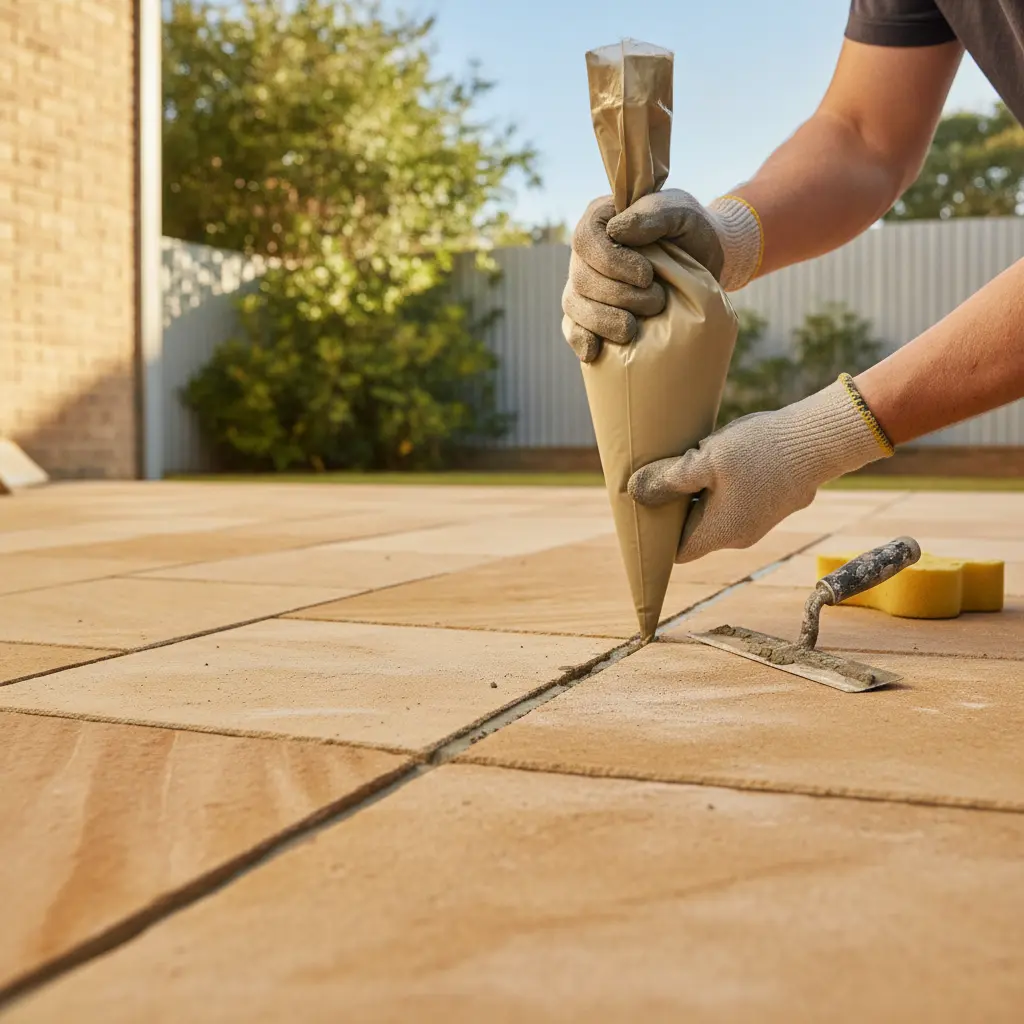
Joint sandstone pavers to suit how they were laid. Pavers bedded in mortar on a slab are pointed with mortar, usually in 5–10mm joints. Pavers laid on a sand bed are filled with dry jointing sand or polymeric sand in tight 2–5mm joints. Stepping stones and wide-gap layouts can be left open and filled with gravel or turf. Pre-seal the stone and clean as you go to avoid stains.
- Mortar bed: mortar pointing, 5–10mm joints; crazy paving 10–15mm sawn, 15–25mm handsplit
- Sand bed: fine jointing sand or polymeric sand, 2–5mm joints
- Before jointing: a penetrating sealer on clean, dry stone helps stop mortar and polymer stains
- Never use acid cleaners on sandstone
What are the ways to joint sandstone pavers?
There are four common ways to fill the joints between sandstone pavers, and the right one depends mostly on what the pavers are laid on.
| Method | Pavers laid on | Typical joint | Look | Watch for |
|---|---|---|---|---|
| Mortar pointing | Mortar bed on a slab or rigid base | 5–10mm; 10–25mm for crazy paving | Crisp, solid, formal | Cement stains if smeared; cracks if the base moves |
| Polymeric sand | Sand bed over compacted base | As the bag specifies; narrow to medium | Firm, sand-coloured | Haze on porous stone if residue is left on the surface |
| Dry jointing sand | Sand bed over compacted base | 2–5mm | Soft, traditional | Washes out over time; weeds and ants |
| Open joints, gravel or turf | Gravel, crushed sandstone or soil | Wide, often 50mm or more | Informal, garden-like | Pavers can move; mowing and edging |
Which jointing method suits sandstone pavers?
Match the joint to the bed. A rigid mortar bed needs rigid mortar joints; a flexible sand bed needs flexible sand joints. Mixing them causes problems: mortar joints over a sand bed crack as the pavers move, and sand joints over a slab trap water with nowhere to drain.
- Sawn pavers on a mortar bed (pool surrounds, driveways, areas next to the house) are usually mortar-pointed with 5–10mm joints.
- Sawn all round pavers dry-laid on sand (paths, patios) use fine jointing sand or polymeric sand in 2–5mm joints. Because they are sawn on all six sides, sawn all round pavers can be laid either way.
- Crazy paving is always laid on mortar and pointed, with 10–15mm joints for sawn flagging and 15–25mm for handsplit. See how to lay crazy paving.
- Stepping stones sit in lawn or gravel with open joints.
If you have not laid the pavers yet, our guide to how to lay sandstone pavers covers both bed types, base depths and falls.
How do you point sandstone pavers with mortar?
Point mortar-bedded sandstone pavers about a day after laying, with a fairly dry pointing mortar pressed firmly into the joints and kept off the face of the stone.
- Pre-seal the stone. Once the pavers are laid, clean and fully dry, apply a penetrating sealer to the surface and let it cure. It reduces how much cement and pigment soak into the stone. Check that the sealer suits pre-grouting use.
- Wait for the bed to firm up. Leave the pavers about 24 hours so they do not shift while you work.
- Mix the pointing mortar. Use a bagged paving joint mortar or a mix of fine washed sand and cement (around 3–4 parts sand to 1 part cement is typical), with oxide if you want a coloured joint. Mix it fairly dry, like damp sand that holds its shape.
- Fill the joints. Use a grout bag or narrow pointing trowel so the mortar goes into the joint, not across the stone. Fill to full depth.
- Compact and tool. Press the mortar in firmly and tool it flush or very slightly recessed, keeping the same profile throughout.
- Brush off crumbs. When the mortar is thumbprint-firm, brush loose crumbs off with a soft brush.
- Clean as you go. Wipe any smears with a damp sponge and clean water straight away, rinsing the sponge often.
- Cure slowly. Protect fresh joints from rain, hot sun and foot traffic, following the mortar’s cure times, then seal the whole surface once dry.
How do you use polymeric sand on pavers?
Polymeric sand is fine sand mixed with a binder that sets when wetted, so the joint stays firm and resists washout, weeds and ants while still flexing with the pavers. It is for sand-bedded pavers, and it must go onto clean, dry stone.
- Check the bag. Confirm the product suits your joint width and depth and is suitable for natural stone. Test it on a spare paver first.
- Pick dry weather. The pavers, joints and bedding must be dry, with no rain forecast for at least a day.
- Seal first. On porous sandstone, a cured penetrating sealer helps stop the binder marking the surface.
- Sweep it in. Pour sand onto the paving and sweep it into the joints until full.
- Settle and top up. Tap the pavers gently with a rubber mallet or vibrate the joints so the sand settles, then top up to just below the paver surface.
- Remove every grain from the surface. Sweep, then use a leaf blower on low to clear all dust from the stone. Residue left on the face is what causes haze.
- Wet as directed. Mist with a fine spray in stages, as the bag specifies, without flooding the joints or washing sand over the stone.
Plain jointing sand is simpler: sweep fine dry sand into the joints, tap to settle and repeat over a few days as it beds in. It is cheap and easy to top up, but expect to re-sand from time to time.
How wide should joints be between sandstone pavers?
Joint width depends on how accurately the stone is cut and how it is laid. Keep whatever width you choose consistent across the whole area.
| Paving | Laid on | Joint width |
|---|---|---|
| Sawn all round pavers | Sand bed | 2–5mm |
| Sawn all round pavers, sawn modular paving | Mortar bed on slab | 5–10mm |
| Sawn flagging (crazy paving) | Mortar bed | 10–15mm |
| Handsplit flagging (crazy paving) | Mortar bed | 15–25mm |
| Stepping stones | Lawn or gravel | Wide, often 50mm or more |
How do you stop jointing from staining sandstone?
Stop jointing stains by sealing first, keeping mortar and sand off the face, and cleaning straight away. Sandstone is porous, so cement slurry, coloured oxides and polymer binders soak in quickly and are hard to remove once set. A penetrating sealer applied before jointing gives you time to wipe smears off. See how to seal sandstone for sealer types.
Never use acid cleaners on sandstone, including the acid washes often used to clean mortar off brick; they can damage and discolour the stone. If a cement haze appears, clean with water and a stiff brush, or a cleaner made for natural stone.
White, powdery deposits on new paving are usually efflorescence: salts carried up from the mortar or base as water evaporates. Brush them off dry rather than washing them in, and they usually fade as the paving dries out. Persistent efflorescence points to water getting under the paving, so check falls and drainage.
How do you repoint or re-sand old paver joints?
Repoint mortar joints when they are cracked, loose or missing. Rake out the loose mortar with a plugging chisel or a narrow raking tool, taking care not to chip the stone edges, and clear out deep enough that the new mortar has a solid key. Brush out the dust, dampen the joint lightly and point as above. If joints keep cracking in the same place, the bed below has moved and the pavers may need relaying.
For sand joints, pull any weeds, sweep out loose material and refill with jointing or polymeric sand. Reseal the stone afterwards; outdoor sandstone is typically resealed every 2–3 years. Our sandstone cleaning guide covers routine care.
Order sandstone pavers
Sawn all round pavers start from $120/m², sawn flagging for crazy paving from $85/m² and sawn modular paving from $65/m² (guide prices, stone only). Request a quote for sawn all round pavers or any paving product with the area and your suburb; Stone Front usually replies the same business day.
Frequently Asked Questions
Can I use polymeric sand on pavers laid on a concrete slab?
Usually not. Polymeric sand is made for pavers on a sand bed over a compacted base, where water drains down through the joints. Over a slab, water sits under the joint and the binder may not cure properly. Pavers on a mortar bed over concrete are normally pointed with mortar instead.
How long before I can walk on newly jointed pavers?
It depends on the material. Dry jointing sand can be walked on straight away. Polymeric sand and pointing mortar both need time to cure, so follow the times on the bag, keep the area dry and protected, and allow longer before furniture or vehicles go on the paving.
Can I grout sandstone pavers like tiles?
Thin outdoor sandstone tiles bedded on a slab are grouted much like tiles, with narrow joints. Thicker pavers on a mortar bed are pointed with a stiffer pointing mortar pressed into the joint, rather than a runny grout spread across the surface, because slurry spread over porous sandstone is very likely to stain it.
Why is my polymeric sand joint soft or crumbling?
Common causes are joints that were not filled to full depth, too little water when activating, too much water that washed the binder out, rain before it cured, or a damp bed underneath. Rake out the failed sand, let the joint dry completely, and refill and activate it following the bag.
What colour mortar suits sandstone pavers?
Most people choose a joint colour close to the stone, such as a warm off-white or light buff, so the paving reads as one surface. A darker joint outlines each paver for a more formal, grid-like look. Mix a small test batch and let it dry before committing, as mortar lightens as it cures.
Products Mentioned in This Article
Sawn All Round Pavers
Diamond-sawn on all sides for a formal, elegant finish.
Sawn Flagging (Crazy Paving)
Natural irregular shapes with sawn edges for a classic, informal look.
Sawn Modular Paving
Economical modular pavers with a smart, contemporary finish.
Sandstone Tiles (Outdoor)
Precision-cut outdoor tiles for patios, pool areas and alfresco spaces.