Australian vs Imported Sandstone: What’s the Difference?
Local Sydney sandstone vs imported Himalayan, Mint, Teakwood and Rainbow: formats, thickness, colour matching, supply and what to ask any supplier.
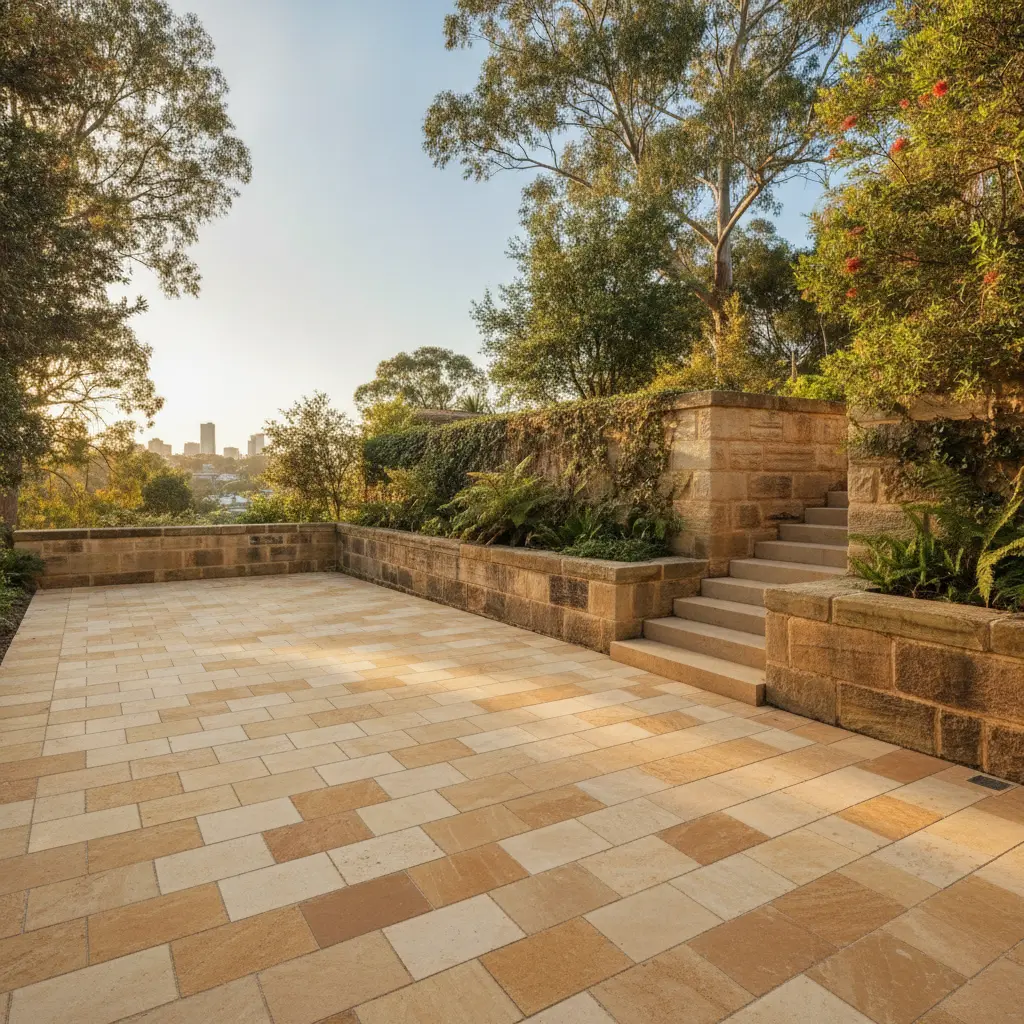
The main differences between Australian and imported sandstone are format, matching and supply. Local Sydney sandstone is quarried here and can be cut to custom sizes and thicknesses — from 50mm pavers to blocks and logs — and matched to existing Sydney stonework. Imported sandstones sold in Australia, such as Himalayan, Mint, Teakwood and Rainbow, are usually supplied as thin, calibrated tiles or pavers, often 20–30mm thick, in fixed sizes.
- Origin: local stone is quarried, sawn and split at Glenorie NSW; most imported sandstone sold here comes from India
- Format: imported stone is mostly thin calibrated tiles and pavers; local stone covers paving, tiles, cladding, blocks, logs, boulders and crushed sandstone
- Thickness: imported pavers are often 20–30mm; our sawn pavers are 50mm, or 75–100mm for driveways
- Matching: local stone can be cut to match existing block sizes and colour batches can be matched from photos
What is imported sandstone?
Most imported sandstone sold in Australia is quarried in India, processed into tiles and pavers, and shipped here in containers. It is sold under trade colour names rather than quarry names. The names you will see most in Sydney are:
- Himalayan (Himalayan White): a pale white-to-grey stone
- Mint: a pale cream-white stone, often described as mint white or mint fossil
- Teakwood: a banded stone with brown, wood-grain-like veining
- Rainbow: a multicoloured stone with bands of yellow, red, brown and cream
These are trade names, and the same name can describe slightly different stone depending on the importer and the shipment. That is not a criticism — all natural stone varies — but it means you should judge the actual stock, not the name.
What is Australian sandstone?
The sandstone we sell is quarried, sawn and split at our working quarry in Glenorie NSW 2157, in Sydney's Hills District, which has been operating since before 1980. Because the stone is processed on site, it is available in a wide range of products: sawn and modular paving, crazy paving, hydrasplit paving, tiles, wall cladding, edging and capping, blocks, logs, boulders, gabion spalls, billets and crushed sandstone. Colours come from the quarry run and include Marbled White, White with Greys, Light Yellow, Banded Yellow, Light Yellow Multicoloured, Medium Yellow with Purples, White with Browns & Greys, Browns, Orange and Purples. You can read more about the quarry on our sandstone quarry Sydney page.
Australian vs imported sandstone: side-by-side comparison
The table below compares the attributes that tend to matter on a real project. The imported column describes what is typical of thin imported tiles and pavers; individual suppliers may offer other formats, so always ask.
| Attribute | Local Sydney sandstone (Stone Front) | Imported sandstone (typical) |
|---|---|---|
| Origin | Glenorie NSW, quarry-direct | Usually India, via an importer |
| Typical formats | Pavers, tiles, flagging, cladding, edging, blocks, logs, boulders, crushed | Calibrated tiles and pavers, some steps and coping |
| Typical paving thickness | 50mm; 75–100mm for vehicles | Often 20–30mm |
| Custom sizes | Cut to size on site | Usually fixed sizes from stock |
| Colour names | Quarry-run colours (Marbled White, Banded Yellow, Browns and more) | Trade names (Himalayan, Mint, Teakwood, Rainbow) |
| Matching existing Sydney stone | Same local stone type; batches matched from photos | Usually a different colour and grain from existing Sydney stonework |
| Supply | Stock visible at the yard; extra cut when needed | Depends on the importer's stock and next shipment |
| Freight | Delivered across greater Sydney, incl. crane truck | Shipped from overseas, then delivered locally |
| Inspect before buying | Hand-select at the quarry | Ask to see the actual batch |
Why thickness and format matter
Thin, calibrated 20–30mm tiles are designed to be bonded to a rigid base — usually a concrete slab with tile adhesive or a mortar bed. That suits patios, pool surrounds and verandahs over an existing slab. Our 50mm sandstone pavers can be laid on a mortar bed over concrete or, for garden paths, on a compacted base, and our sawn all round pavers are also cut at 75mm or 100mm for driveways. If you are retaining soil, building steps or walls, or edging a garden, you need dimensional stone such as blocks, logs or thicker sawn pieces — formats a local quarry can cut to order.
For indoor and outdoor tiling, our outdoor sandstone tiles are cut from 300x300mm to 600x600mm and to custom sizes, in sawn, honed, natural split and sandblasted finishes. Tell your tiler what thickness and tolerance they need, and we can confirm what is achievable for your job.
Colour: consistency and character
Both local and imported sandstones are natural stone, so both vary from piece to piece. The question is not which is more consistent, but whether you can see and control what arrives. With any supplier, ask to see the batch your order will come from. At our quarry you can inspect stock and hand-select from the bins, and we can match colour batches from photos of your existing stone or of a look you like. If you are drawn to the pale look of Himalayan or Mint, compare our Marbled White and White with Greys; if you like the bands of Teakwood or Rainbow, look at Banded Yellow and Light Yellow Multicoloured. Our sandstone colour guide explains each colour. Wherever possible, order all the stone for one area at the same time so it comes from a single batch.
Matching heritage and existing Sydney sandstone
Sydney has a great deal of existing sandstone — garden walls, steps, house footings, kerbs and paving. When you are extending a wall, replacing broken pavers or repairing heritage-style work, the new stone needs to sit comfortably beside the old. Local sandstone is usually the closer match in colour and grain, and because we cut on site we can match existing dimensions, such as a 110mm block bedwidth, a particular paver size, or capping cut to size. Custom stonemasonry, including bullnosing, rockfacing, pier caps and stair treads, is available by quote.
Lead times, custom sizes and freight
Imported stone is produced overseas and shipped in containers, so what is available locally depends on what the importer has on hand. If a size or colour sells out, or you run short partway through a job, the top-up may need to come from a later shipment. With local stone, stock can be viewed at the yard and extra pieces can be cut to size. Delivery is across greater Sydney, including crane-truck delivery for difficult access. Whichever stone you choose, order enough for the whole job plus a margin for cuts and future repairs, ideally from one batch.
Questions to ask any sandstone supplier
- Where is this stone quarried, and is it the same source every time?
- What is the exact thickness, and what tolerance is it calibrated to?
- Can I see the actual batch or pallet my order will come from?
- Is there enough stock from that batch for my whole job, plus spares?
- Can you cut custom sizes, coping, steps or capping to match?
- What finish is it — sawn, honed, natural split or sandblasted — and is it suitable for my area (pool, driveway, indoor)?
- What sealer do you recommend, and how often should it be reapplied?
- What does the price include — delivery, crane unloading, GST?
- If I need more stone in a few years for repairs or an extension, will you be able to supply a close match?
Get local Sydney sandstone from Stone Front
We sell quarry-direct from Glenorie, with stock you can inspect Monday to Friday 7:00am–3:30pm and Saturday 8:00am–midday. Browse our full range of sandstone supplies in Sydney, or send your plans and photos through our quote form — pricing depends on quantity, finish and delivery.
Frequently Asked Questions
Is Himalayan sandstone the same as Sydney sandstone?
No. Himalayan (or Himalayan White) is a trade name for an imported sandstone, usually from India and usually sold as calibrated tiles or pavers. Sydney sandstone is quarried locally and sold in more formats, including 50mm pavers, blocks and logs. Both are sandstone, but colour and grain differ, so compare samples side by side.
Do you sell Mint, Teakwood or Rainbow sandstone?
No. We sell local sandstone quarried at Glenorie NSW. If you like the pale look of Mint or Himalayan White, compare our Marbled White and White with Greys; for a banded look in the spirit of Teakwood or Rainbow, look at Banded Yellow and Light Yellow Multicoloured. Colour batches can be matched from photos.
Is imported sandstone cheaper than Australian sandstone?
It depends on what you compare. Check thickness, format, finish and what the price includes, such as delivery and GST. Our ex-quarry guide prices start from $65/m² for sawn modular paving, $110/m² for outdoor tiles and $120/m² for sawn all round pavers. Ask every supplier for an itemised quote on the same specification.
Can I mix local and imported sandstone in one project?
You can, but plan for the differences. Colour and grain will not match exactly, so keep each stone to a distinct area — for example imported tiles on a patio and local sandstone for walls and steps. Thin tiles and 50mm pavers also need different bedding heights, so set levels before work starts.
Where can I buy Australian sandstone in Sydney?
Stone Front sells quarry-direct from Glenorie NSW 2157 in Sydney’s Hills District. You can inspect stock and hand-select Monday to Friday 7:00am–3:30pm and Saturday 8:00am–midday, order custom cutting to size, and have stone delivered across greater Sydney, including crane-truck delivery for difficult access.
Products Mentioned in This Article
Sawn All Round Pavers
Diamond-sawn on all sides for a formal, elegant finish.
Sandstone Tiles (Outdoor)
Precision-cut outdoor tiles for patios, pool areas and alfresco spaces.
Sawn Flagging (Crazy Paving)
Natural irregular shapes with sawn edges for a classic, informal look.
Sandstone Wall Cladding & Veneer
Transform walls with natural sandstone veneer and cladding panels.